
How Often Should You Wash 4C Hair?
If you have 4C hair, you may have wondered whether washing your hair every week is too often—or whether waiting two or three weeks between wash days is better.
You might also worry that shampooing will leave your hair dry, tangled, or more prone to breakage. At the same time, going too long without cleansing can leave your scalp uncomfortable or allow products to build up.
So, how often should you wash 4C hair?
The answer depends on your scalp, styling habits, products, and how your hair responds to washing. You don’t need to follow someone else’s wash schedule simply because you have the same hair type.
Here’s how to choose a practical schedule, cleanse your scalp without unnecessary rough handling, and adjust your routine when your needs change.
Table of Contents
How Often Should You Wash 4C Hair?
A practical starting point is to consider washing your 4C hair weekly or every two weeks, then adjust according to your scalp’s needs, product use, and how your hair responds.
Dermatology guidance varies. The American Academy of Dermatology advises washing dry, textured, curly, or thick hair as needed, with a general recommendation of at least once every two to three weeks. DermNet recommends shampooing hair in women of African descent at least every one to two weeks to help limit product buildup and certain scalp problems.
These recommendations are not identical, and neither establishes one perfect schedule for every person with 4C hair.
Your scalp may need cleansing more frequently if you exercise often, sweat heavily, use substantial amounts of styling products, or experience recurring scalp buildup. You may need a different approach if your hair is chemically treated, your scalp is sensitive, or you are following a treatment plan for a scalp condition.
The goal is to keep your scalp clean and comfortable while handling your hair gently enough to minimize unnecessary breakage.
A simple wash-frequency guide
| Your situation | A reasonable starting point |
|---|---|
| Your scalp is comfortable and you use relatively few products | Consider weekly or fortnightly washing and adjust based on your needs. |
| You sweat frequently or exercise regularly | Wash as needed to remove sweat and keep your scalp comfortable. |
| You use gels, creams, oils, or other styling products frequently | Consider cleansing more regularly if residue accumulates. |
| You have recurring dandruff or scalp itching | You may need a suitable dandruff shampoo and a more specific schedule. |
| You wear braids or twists | Plan how to cleanse your scalp and style without excessive tension or rough handling. |
These are starting points, not rigid rules. A clean-feeling scalp and manageable hair are more useful guides than following a schedule that does not suit you.
What Affects How Often You Should Wash 4C Hair?
Your curl pattern matters when deciding how to handle your hair, but it does not determine your entire washing schedule. Several other factors should influence your decision.
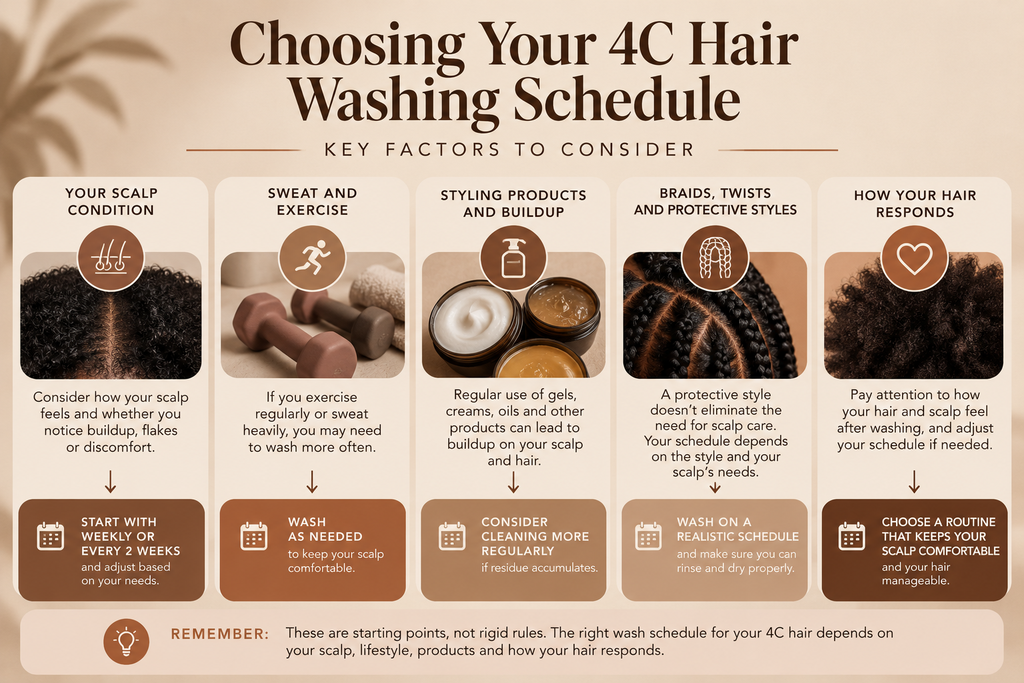
Your scalp condition
Your scalp needs regular cleansing, even if your hair lengths tend to feel dry.
Sweat, excess oil, dead skin, and styling-product residue can accumulate between wash days. If your scalp begins to feel uncomfortable or you notice recurring buildup, consider whether your current schedule is meeting its needs.
However, itching and flakes can have several causes. They are not always signs that you simply need to wash more often.
If symptoms persist despite reasonable cleansing, consider whether you need a different shampoo or professional advice.
Sweat and exercise
If you work out regularly, spend time in hot weather, or sweat heavily, you may need to cleanse your scalp more often than someone who sweats less.
You do not necessarily need to shampoo your hair every time you become slightly sweaty. Consider how much you sweat, whether residue remains, and how comfortable your scalp feels afterward.
If your current schedule leaves your scalp persistently uncomfortable, it may be time to adjust it.
Styling products and buildup
Gels, creams, oils, edge products, and other styling products can accumulate, particularly when you repeatedly apply new layers without cleansing.
If your scalp or roots feel coated, or your usual routine becomes harder to manage, review both your product use and washing frequency.
Adding more oil or cream is not always the answer to hair that feels dry or difficult to manage. Sometimes, reviewing your cleansing and conditioning routine is the more useful first step.
Braids, twists, and other protective styles
A protective style can reduce the need for daily manipulation, but it does not eliminate the need for scalp care.
Your wash schedule will depend on the style, how it was installed, your scalp’s needs, and whether the style can be washed and dried properly.
We’ll look at this in more detail below.
How your hair responds to washing
Pay attention to what happens after wash day.
Does your hair feel manageable after conditioning? Does it become tangled because you handle it roughly while washing? Does your scalp feel better after cleansing, or do you notice irritation after using a particular product?
These observations can help you identify what needs adjusting.
If washing leaves your hair difficult to handle, review your technique, conditioner, and product choices before assuming that washing itself is the problem.
Signs You May Need to Wash Your 4C Hair More Often
Your wash schedule may need adjusting if you regularly notice:
- Product residue accumulating on your scalp or roots.
- Persistent sweat or an uncomfortable scalp between wash days.
- Recurring flakes that may be related to inadequate cleansing.
- A scalp that feels better after washing but becomes uncomfortable again soon afterward.
- Heavy product layering that makes your hair increasingly difficult to manage.
These signs do not all have the same cause. For example, persistent flakes may be associated with dandruff or another scalp condition rather than simple product buildup.
Before changing your schedule dramatically, consider what you are noticing and whether any particular product appears to trigger discomfort.
If you have persistent itching, redness, soreness, or unusual hair loss, do not rely on more frequent washing alone to solve the problem.
Can Washing 4C Hair Too Often Cause Dryness or Breakage?
Washing is not automatically damaging to 4C hair. Problems can arise when cleansing is unnecessarily harsh, conditioning is inadequate, or washing involves excessive pulling, rubbing, and detangling.
The important distinction is between cleansing your scalp and roughly handling your hair lengths.
The American Academy of Dermatology recommends applying shampoo primarily to the scalp to remove buildup, dead skin, and excess oil while avoiding unnecessary drying of the lengths. It also recommends conditioning after washing and handling textured hair gently.
Here are a few ways to make wash day more manageable:
- Choose a shampoo that cleanses your scalp without leaving your hair uncomfortably dry.
- Concentrate shampoo on the scalp rather than aggressively scrubbing the full length of your hair.
- Use conditioner to improve softness and manageability.
- Avoid forcing a comb through tangled sections.
- Reduce unnecessary manipulation while washing, drying, and styling.
- Pay attention to whether a particular product consistently causes irritation or leaves your hair difficult to manage.
You do not need to avoid shampoo indefinitely to protect your hair. Instead, find a balance between scalp cleansing and gentle hair care.
If breakage is a recurring concern, read our guide on how to detangle 4C hair without breakage.
How to Wash 4C Hair Without Unnecessary Breakage
You do not need an elaborate wash-day routine to cleanse your scalp and care for your hair. A few consistent habits can make the process easier.
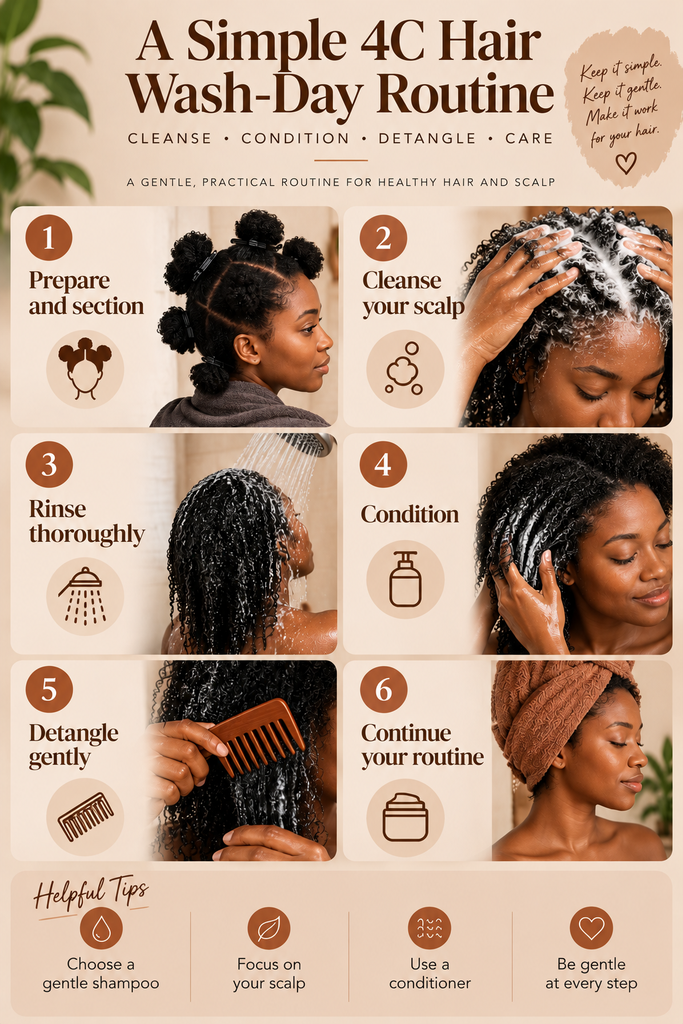
1. Prepare your hair
If your hair is long, densely packed, or prone to tangling, separating it into manageable sections may help.
You do not have to use a particular number of sections. Choose an approach that makes your hair easier to handle without adding unnecessary time or manipulation.
2. Apply shampoo to your scalp
Wet your hair thoroughly, then apply your shampoo primarily to the scalp.
Use your fingertips to work the cleanser over the scalp rather than scratching with your nails or aggressively rubbing the hair lengths together.
Allow the shampoo to rinse through the lengths instead of deliberately scrubbing them.
3. Rinse thoroughly
Rinse until the cleanser has been removed.
If you use substantial styling products or your scalp remains coated after washing, you may need to reassess your cleanser or washing technique. Avoid automatically repeating the process several times if your hair or scalp is becoming uncomfortable.
4. Condition your hair
Apply a suitable conditioner after shampooing.
Conditioner helps improve manageability and detangling, which can make handling your hair easier. Follow the product instructions and focus on the areas that need conditioning.
5. Detangle gently
If detangling is part of your wash day, work through manageable sections and avoid forcing a comb through resistant knots.
Use your fingers or an appropriate tool, along with enough conditioner or detangler to help you work through tangles.
For a more detailed method, follow our guide to detangling 4C hair without breakage.
6. Finish with a manageable routine
After rinsing, gently remove excess water without rough rubbing. Continue with the conditioning, moisturizing, and styling steps that work for your hair.
You do not need to apply every product you own after each wash. Choose products based on what your hair needs and how it responds.
For help putting the steps together, see our guide to building a 4C hair care routine that actually works.
Should You Shampoo or Co-Wash 4C Hair?
Shampoo and co-washing serve different purposes.
Shampoo is designed to cleanse the scalp and remove oil, residue, and other buildup. The strength of the cleansing action varies by formula.
Co-washing means washing with a cleansing conditioner or using conditioner in place of regular shampoo. It may suit some routines, but conditioner-only washing does not necessarily remove all accumulated residue as effectively as an appropriate shampoo.
Neither approach needs to be treated as universally right or wrong.
If you use substantial styling products, have recurring scalp buildup, or experience dandruff, relying exclusively on co-washing may not meet your cleansing needs.
If shampoo leaves your hair feeling uncomfortable, consider whether a gentler formula, better conditioning, or a change in technique would help.
The aim is to choose a cleansing method that suits your scalp and routine—not to avoid shampoo at all costs or to shampoo as frequently as possible.
How Often Should You Wash 4C Hair in Braids or Twists?
You can wash your scalp while wearing braids or twists, provided you use a method that suits the style and allows the hair to dry properly.
How often you wash will depend on your scalp’s needs, the products you use, the type of style, and how easily you can cleanse it.
A few practical considerations can help:
- Follow a realistic cleansing schedule rather than assuming the style means you can ignore your scalp for weeks.
- Use a suitable cleanser and focus on the scalp.
- Avoid rough scrubbing that disrupts the style or creates unnecessary tangling.
- Rinse thoroughly so residue does not remain trapped in the style.
- Allow your hair and scalp to dry properly.
- Avoid styles that pull painfully on your hairline.
DermNet notes that hair can be shampooed while braids are in place and encourages regular shampooing.
Remember that a style is not protective simply because it involves braids or twists. Excessive tension can contribute to traction alopecia, a form of hair loss associated with repeated pulling.
If a style causes pain, persistent pulling, or visible thinning, take those signs seriously.
What If Your Scalp Is Itchy or Flaky?
An itchy or flaky scalp does not always mean you need to wash more often.
Dandruff can cause flakes and itching, and other scalp conditions can produce similar symptoms. Product irritation and other factors may also contribute to discomfort.
The American Academy of Dermatology recommends choosing a dandruff shampoo when appropriate and following its instructions carefully. Depending on the product, the shampoo may need to remain on the scalp for several minutes before rinsing.
For curly or coily hair, the AAD advises washing as needed and using dandruff shampoo about once a week if tolerated, taking care to concentrate it on the scalp because some dandruff treatments can dry the hair.
That guidance is specific to dandruff management; it should not be interpreted as a universal washing schedule for everyone with 4C hair.
If flakes or itching persist, ask a qualified healthcare professional about appropriate treatment. Seek advice sooner if you experience scalp pain, significant inflammation, sores, or unusual hair loss.
Useful sources:
- American Academy of Dermatology: How to Treat Dandruff
- American Academy of Dermatology: Hair Loss in Black Women
A Simple Way to Choose Your 4C Hair Wash Schedule
Rather than copying someone else’s routine, use the following checklist to work out what suits your hair and scalp.
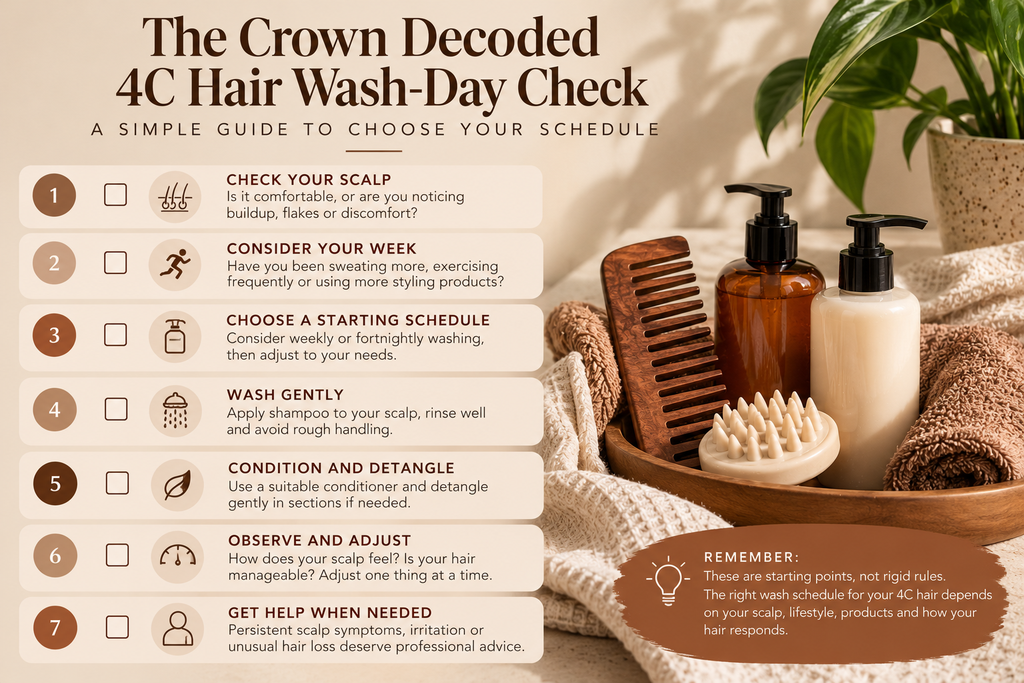
Your wash-schedule check
- Check your scalp. Is it comfortable, or are you noticing recurring buildup, flakes, or discomfort?
- Consider your week. Have you been sweating more, exercising frequently, or using more styling products?
- Choose a starting schedule. Consider weekly or fortnightly washing, then adjust to your needs.
- Review your technique. Are you cleansing your scalp gently and conditioning your hair after washing?
- Observe what changes. Does your scalp feel better? Is your hair easier to manage? Does a particular product appear to cause irritation?
- Adjust one thing at a time. Avoid changing your entire routine when you are still trying to identify what is not working.
- Get help when needed. Persistent scalp symptoms or unusual hair loss deserve appropriate assessment.
You can repeat this check whenever your routine, hairstyle, activity level, or scalp condition changes.
The Crown Decoded wash-day check
At Crown Decoded, the goal is not to follow the strictest schedule or collect the most products. It is to build a routine that is practical, gentle, and responsive to your hair’s needs.
Before your next wash day, ask yourself three questions:
- Does my scalp need cleansing?
- Can I wash and condition my hair without unnecessary pulling or rough handling?
- Is my current schedule helping me maintain a comfortable scalp and manageable hair?
If you can answer those questions clearly, you have a better starting point than a calendar rule that ignores your individual needs.
Final Thoughts
So, how often should you wash 4C hair?
For many people, weekly or fortnightly washing is a reasonable schedule to consider. Dermatology guidance also supports washing textured hair as needed, with recommendations varying according to the situation and the source.
What matters is finding a schedule that cleanses your scalp, fits your lifestyle, and allows you to handle your hair gently.
You do not need to avoid washing because your hair is tightly coiled. Nor do you need to wash more frequently than necessary just because someone else’s routine works for them.
Start with a manageable schedule, pay attention to your scalp and hair, and adjust when your needs change.
The Crown Decoded takeaway: A good wash schedule is one that keeps your scalp comfortable, your hair manageable, and your routine sustainable.
This article is for educational purposes and does not replace individualized medical advice. If you have persistent scalp symptoms, progressive thinning, or unusual hair loss, consult a qualified healthcare professional.