4C Hair Shrinkage: Why It Happens and How to Manage It
If your 4C hair looks much shorter after wash day than it does when you stretch a section, you’re not imagining things. That difference is called hair shrinkage, and it is a familiar part of caring for tightly coiled natural hair.
Shrinkage can make it harder to see your length, achieve a particular style, or understand why your hair looks different from one day to the next. It can also leave you wondering whether you should be doing something to prevent it.
Here’s the reassuring part: shrinkage is not automatically a sign of damage, and you do not have to eliminate it to care for your hair well.
Whether you love your natural shrinkage or prefer to show more length, understanding what causes it can help you make better styling decisions.
In this guide, we’ll explain why 4C hair shrinks, how to distinguish shrinkage from breakage, and how to stretch your hair gently when you want a more elongated style.
Table of Contents
What Is 4C Hair Shrinkage?
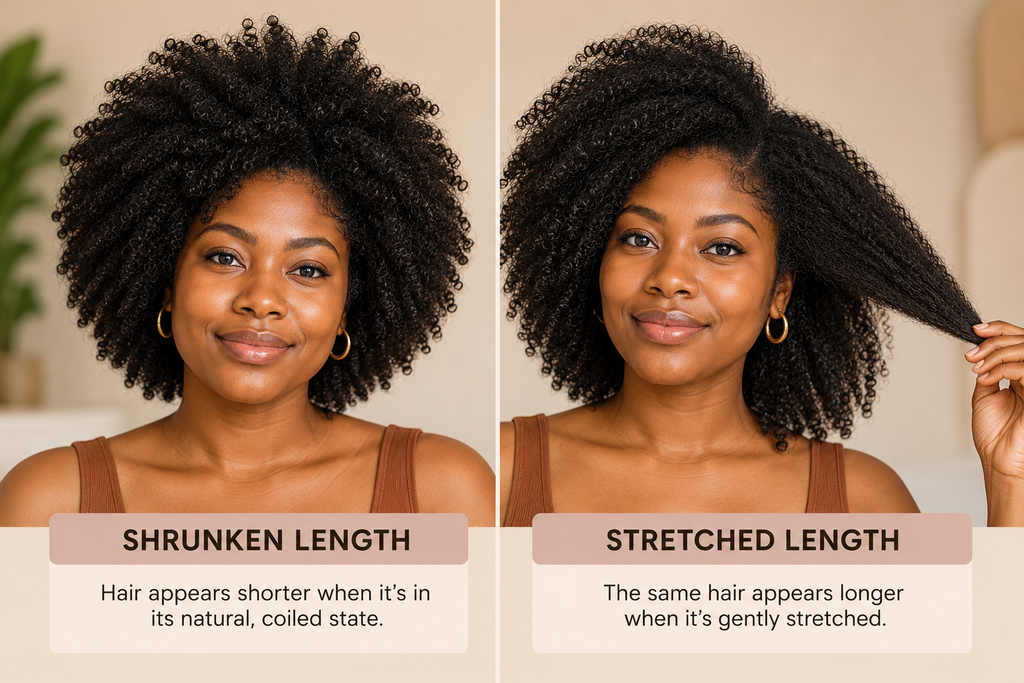
Hair shrinkage is the difference between how long your hair appears in its naturally coiled state and how long it appears when gently stretched.
For example, a section of hair might hang relatively close to your scalp when left to coil naturally, but extend farther when you gently stretch it. The hair has not suddenly grown or lost length. Its visible shape has changed.
This is why your hair can look shorter after washing, even when you have not experienced any breakage.
Shrunken length versus stretched length
Think of these as two different ways your hair can look.
- Shrunken length: How your hair appears when its coils and bends are allowed to sit naturally.
- Stretched length: How your hair appears when those coils are gently elongated through a styling technique or careful measurement.
Neither appearance is better than the other. They simply show different aspects of your hair.
If you are tracking your length, try to compare your hair under similar conditions each time. Measure the same section, use the same method, and avoid pulling your hair forcefully to get a longer measurement.
Does every person with 4C hair experience the same shrinkage?
No. Two people with hair commonly described as 4C can have very different shrinkage patterns.
The amount of visible shrinkage depends on individual hair characteristics, the shape and arrangement of the coils, the way the hair is styled, and environmental conditions.
The 4A–4C classification is a broad descriptive system, not a precise measurement that predicts exactly how much any individual’s hair will shrink.
The practical takeaway: Do not use someone else’s shrinkage percentage, hair length or stretching results as the standard for your own hair.
Why Does 4C Hair Shrink?
The main reason is the shape of the hair.
Tightly coiled strands bend and curve rather than hanging straight down. When the hair is allowed to return to its natural configuration, the distance it occupies from root to tip can be much shorter than the length of the strand when gently extended.
Several factors can influence how shrinkage looks.
1. Your hair’s natural coil pattern
The bends and curves in tightly coiled hair affect how much visible length you see.
When you stretch a section, you temporarily change the arrangement of those bends. When you release it, the hair may return toward its usual shape.
This is a normal feature of coily hair, not evidence that the hair is failing to grow.
2. Washing and drying
You may notice shrinkage most clearly on wash day because your hair’s appearance changes as it gets wet, is conditioned, and dries.
Water can alter how hair behaves and how its strands sit together. As the hair dries, it may settle into a more compact shape.
The exact result varies from person to person and between styles. There is no single shrinkage percentage that applies to everyone with 4C hair.
3. Styling and environmental conditions
Twists, braids, banding and other styling methods can temporarily change how elongated your hair appears.
Humidity and moisture exposure can also affect how a stretched style holds its shape. Hair that looked elongated earlier in the day may gradually return toward its usual coil pattern.
That does not necessarily mean the style has failed. It means the appearance of your hair can change with its environment and how it is worn.
Is Shrinkage Bad for 4C Hair?
No. Shrinkage by itself is not a sign that your hair is unhealthy.
It is also not a reliable standalone test of hair health. You cannot determine whether your hair is strong, damaged or growing well simply by looking at how much it shrinks.
What matters more is the overall condition of your hair and scalp, how your hair responds to handling, and whether you notice persistent changes such as unusual breakage or hair loss.
Shrinkage versus breakage
These two things can look confusingly similar if you are focused only on visible length.
| Shrinkage | Breakage |
|---|---|
| Hair appears shorter because its shape is more compact. | Hair strands have broken, reducing their length. |
| Gently stretching a section reveals more of its existing length. | Stretching does not restore the length of strands that have broken. |
| The appearance can change with washing and styling. | You may notice broken pieces or areas that have become uneven or thinner. |
| It is not automatically a problem that needs fixing. | Repeated breakage deserves attention to handling and styling practices. |
These are useful distinctions, not a diagnostic test. Hair can experience both shrinkage and breakage, and changes in density or length can have several causes.
If you notice persistent or significant hair loss, a changing hairline, bald patches, or ongoing scalp discomfort, consider seeing a qualified healthcare professional or dermatologist rather than assuming shrinkage is responsible.
What about shrinkage as a sign of healthy hair?
You may hear people describe shrinkage as proof that their hair is healthy or has good elasticity.
It is reasonable to observe how your hair behaves when gently stretched and released, but shrinkage alone cannot establish the overall health of your hair.
Avoid trying to create more shrinkage just to prove that your hair is healthy. Equally, you do not need to eliminate shrinkage to demonstrate that you have a good hair-care routine.
How to Manage 4C Hair Shrinkage
The first step is deciding what you actually want your hair to do.
If you enjoy a full, compact afro or a shrunken twist-out, there may be nothing you need to change. If you prefer more visible length, you can experiment with gentle stretching techniques.
Either way, your approach should make your hair manageable without introducing unnecessary tension or manipulation.
1. Decide whether you want to embrace or stretch your shrinkage
Ask yourself what is making you want to change your hair’s appearance.
Are you trying to achieve a particular style? Do you want to make your hair easier to arrange? Or are you worried that shrinkage means your hair is not growing?
If your concern is simply that your hair looks shorter than expected, remember that shrinkage does not tell you how much your hair has grown.
If you want a longer-looking style, a heat-free stretching technique may be enough. If you like your natural shape, there is no need to stretch your hair simply because someone else does.
2. Make detangling manageable
Stretching should not become a reason to pull aggressively at your hair.
Before styling, work through tangles carefully and in manageable sections. Use conditioner or an appropriate detangler when needed, and work from the ends upward rather than forcing a tool through resistant knots.
If you need a more detailed process, read our guide on how to detangle 4C hair without breakage.
3. Keep your routine simple
You do not need a large collection of products to manage shrinkage.
Cleanse, condition, detangle, moisturize as needed, and choose a styling method that works for your hair and lifestyle.
If you are still building your routine, start with our guide to building a 4C hair care routine that actually works.
Adding more products will not necessarily make your hair stretch farther or keep a stretched style in place longer. Focus on manageable hair, comfortable styling and consistent care rather than chasing a particular appearance.
4. Choose low-tension styling
When you want to stretch your hair, choose a method that does not require you to pull tightly at the roots or repeatedly manipulate the same sections.
The American Academy of Dermatology warns that excessive heat can damage hair and that repeated tension from tight hairstyles can contribute to breakage and traction alopecia.
You can read its guidance on hair styling without damage and hairstyles that pull and can lead to hair loss.
A useful rule: your stretching method should not hurt. If your scalp feels sore, your roots feel painfully tight, or the style pulls at your hairline, loosen or remove it.
How to Stretch 4C Hair Without Heat
If your goal is to show more length without using a flat iron or blow-dryer, you have several options.
These methods work differently, and results vary. You may prefer one method for a subtle stretch and another for a more elongated finished style.
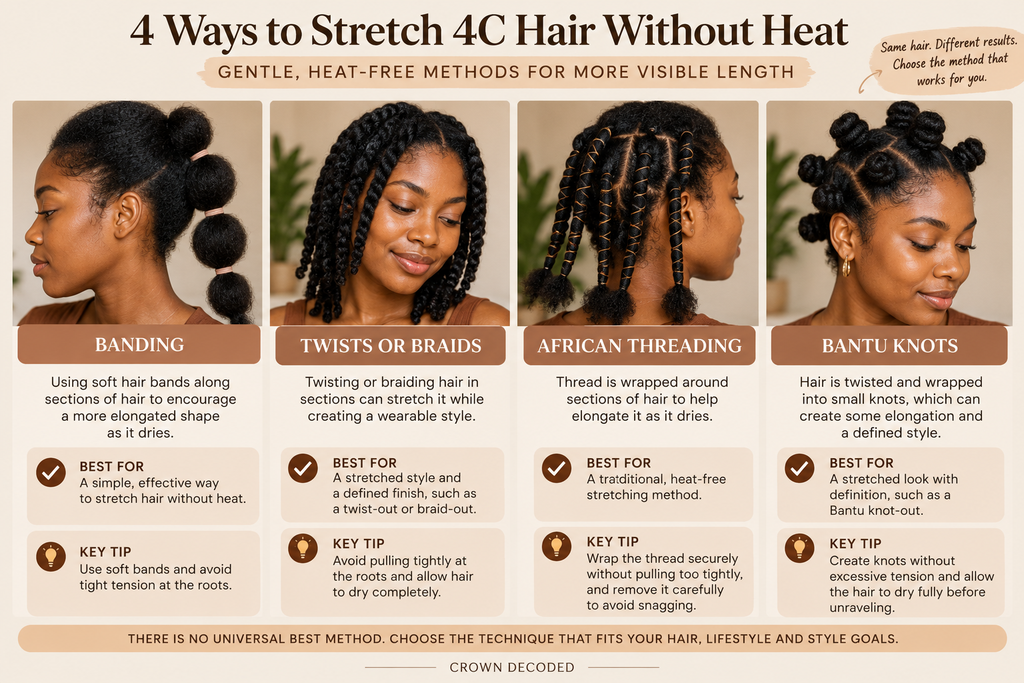
1. Banding
Banding involves placing soft hair bands at intervals along sections of hair to encourage a more elongated shape as the hair dries.
A simple approach:
- Start with gently detangled hair.
- Divide your hair into manageable sections.
- Apply your usual styling product if needed.
- Place soft bands loosely along each section, leaving enough room to avoid squeezing or pulling the hair.
- Allow your hair to dry fully before removing the bands gently.
Banding can be useful when you want to elongate the hair without applying direct heat.
Avoid tight bands, snagging elastics or excessive tension at the roots. If removing a band catches your hair, stop and work it free carefully.
2. Twists or braids
Twists and braids can help stretch hair while creating a different finished style.
How to try it:
- Divide your hair into sections.
- Apply your usual styling product as needed.
- Twist or braid each section without pulling tightly at the roots.
- Allow the hair to dry completely.
- Unravel gently if you want a twist-out or braid-out.
The final result depends on the size of your sections, the technique, the products used and how the hair dries.
This method can be especially convenient if you want an elongated style rather than simply stretching your hair before another hairstyle.
3. African threading
African threading uses thread wrapped around sections of hair to help elongate them as they dry.
It can be a useful option for people who prefer a traditional, heat-free stretching technique.
The key is to wrap the thread securely without pulling too tightly. Avoid excessive tension at the roots and remove the thread carefully so it does not snag or tangle your hair.
If you are new to threading, start with a small section and learn the technique before working through your entire head.
4. Bantu knots
Bantu knots can create a stretched, defined finish, depending on how they are installed and removed.
To try them, divide your hair into sections, twist each section gently, and wrap it into a knot. Secure it without pulling painfully at the roots, allow the hair to dry, and unravel carefully if you want a Bantu knot-out.
Bantu knots are not designed to give exactly the same result as banding. They create their own pattern and may be more suitable when you want both some elongation and a defined style.
A note on drying
Whatever technique you choose, give your hair enough time to dry before removing the set.
Taking down twists, braids or bands while the hair is still damp can change the finished result. More importantly, do not rush the process by pulling at your hair or repeatedly manipulating it to force a particular appearance.
You can experiment with one method at a time to see which is easiest for you to maintain.
How to Choose the Right Stretching Method
There is no universal best method for 4C hair. Start with the result you want and the amount of time you can comfortably spend styling.
| Method | May suit you if you want… | Main consideration |
|---|---|---|
| Banding | A relatively simple way to elongate sections | Use soft bands and avoid excessive tension. |
| Twists or braids | Stretching combined with a twist-out or braid-out style | Allow the hair to dry and unravel gently. |
| African threading | A traditional, heat-free stretching method | Learn a comfortable wrapping technique and avoid tight roots. |
| Bantu knots | A styled finish with some elongation and definition | Expect a different result from a simple stretched style. |
These are practical styling comparisons, not evidence that one method is universally safer or more effective than the others.
If you want a little stretch
Try a method that is easy to install and remove, such as loosely banding sections or using twists.
You do not need to maximize the length of every strand. A modest change in shape may be enough for your intended style.
If you want more visible length
Experiment with a technique that can elongate the sections more noticeably, such as banding or threading. Results will depend on your hair and how you perform the technique.
Avoid pulling harder simply because you want a longer result.
If your hair tangles easily
Prioritize careful detangling and sectioning before you start. Choose a method you can remove without repeatedly pulling, snagging or separating tangled strands.
If a particular technique makes your hair harder to manage, it is fine to try another one.
If you want to minimize manipulation
Choose a style that you can maintain without repeatedly combing, twisting or restyling your hair throughout the week.
Your aim is not to achieve the longest possible appearance every day. It is to find a balance between the look you want and a routine you can sustain.
Common Shrinkage Mistakes to Avoid
Mistake 1: Treating shrinkage as a problem that must be fixed
Shrinkage is a normal characteristic of coily hair. You can embrace it, stretch it or switch between the two depending on your style.
There is no requirement to keep your hair elongated at all times.
Mistake 2: Pulling hair forcefully to make it look longer
Stretching should not hurt. Repeated tension can damage hair, and tight hairstyles can contribute to traction alopecia over time.
If you feel pain or notice pulling around your hairline, loosen the style.
Mistake 3: Using excessive heat to fight shrinkage
Heat can temporarily change how hair looks, but excessive heat can damage the hair shaft.
If you prefer to use heat occasionally, be cautious and follow appropriate heat-styling practices. You do not need to straighten your hair to manage shrinkage.
Mistake 4: Adding more products without a clear reason
A new cream, oil or styling gel is not automatically going to make your hair longer-looking.
Use products for a clear purpose, such as conditioning, detangling or styling. Pay attention to what actually helps your hair rather than layering products in the hope that shrinkage will disappear.
Mistake 5: Comparing your shrinkage with someone else’s
Two people can have similar-looking curl patterns but different hair lengths, densities, styling habits and shrinkage patterns.
Instead of comparing your results with someone else’s, track your own hair under similar conditions if you want to monitor length over time.
Frequently Asked Questions About 4C Hair Shrinkage
Why does my 4C hair shrink after washing?
Washing changes the condition of your hair and how its coils sit together. As your hair dries, it may settle into a more compact shape. This can make it look shorter than it did when stretched.
Is shrinkage a sign of healthy hair?
Not by itself. Shrinkage is a normal characteristic of coily hair, but it cannot diagnose the overall health of your hair or scalp. Consider the wider picture, including breakage, manageability and any persistent scalp symptoms.
Can I reduce shrinkage without heat?
Yes. Techniques such as banding, twists, braids and African threading can help elongate hair without direct heat. The results vary, and the methods should be performed gently.
Does shrinkage mean my hair is not growing?
No. Shrinkage changes how much length is visible; it does not establish whether your hair is growing. If you want to track length, compare the same section under similar conditions over time.
Will stretching my hair cause breakage?
Not necessarily. The risk depends on factors such as how you handle your hair, the tension involved and how carefully you remove the style. Gentle techniques can help minimize unnecessary pulling, but no method guarantees that breakage will never occur.
Why does my stretched hair shrink again?
Your hair may gradually return toward its natural coil pattern after you remove a stretching method or expose it to moisture and humidity. That change in appearance is not automatically a sign of damage.
The Crown Decoded Takeaway
At Crown Decoded, we believe hair care should help you understand your hair rather than pressure you to make it behave like someone else’s.
Shrinkage is part of the way tightly coiled hair looks and behaves. You do not have to fight it, and you do not have to use heat to show more length.
If you want to stretch your hair, start with a gentle method, work in manageable sections, and pay attention to how your hair responds. If you prefer your natural shrunken style, that is just as valid.
The goal is a routine that works with your hair, your preferences and your life.
Bottom Line
4C hair shrinkage is not lost length, and it is not automatically a sign of damage.
Understand the difference between shrinkage and breakage, choose whether you want to stretch your hair, and use techniques that avoid excessive heat and tension.
You can enjoy your natural shrinkage or experiment with more elongated styles. Either way, consistent, gentle care matters more than chasing a particular look.
For more practical guidance, start with How to Build a 4C Hair Care Routine That Actually Works and How to Detangle 4C Hair Without Breakage.
This article is for educational purposes and does not replace individualized advice from a qualified healthcare professional.