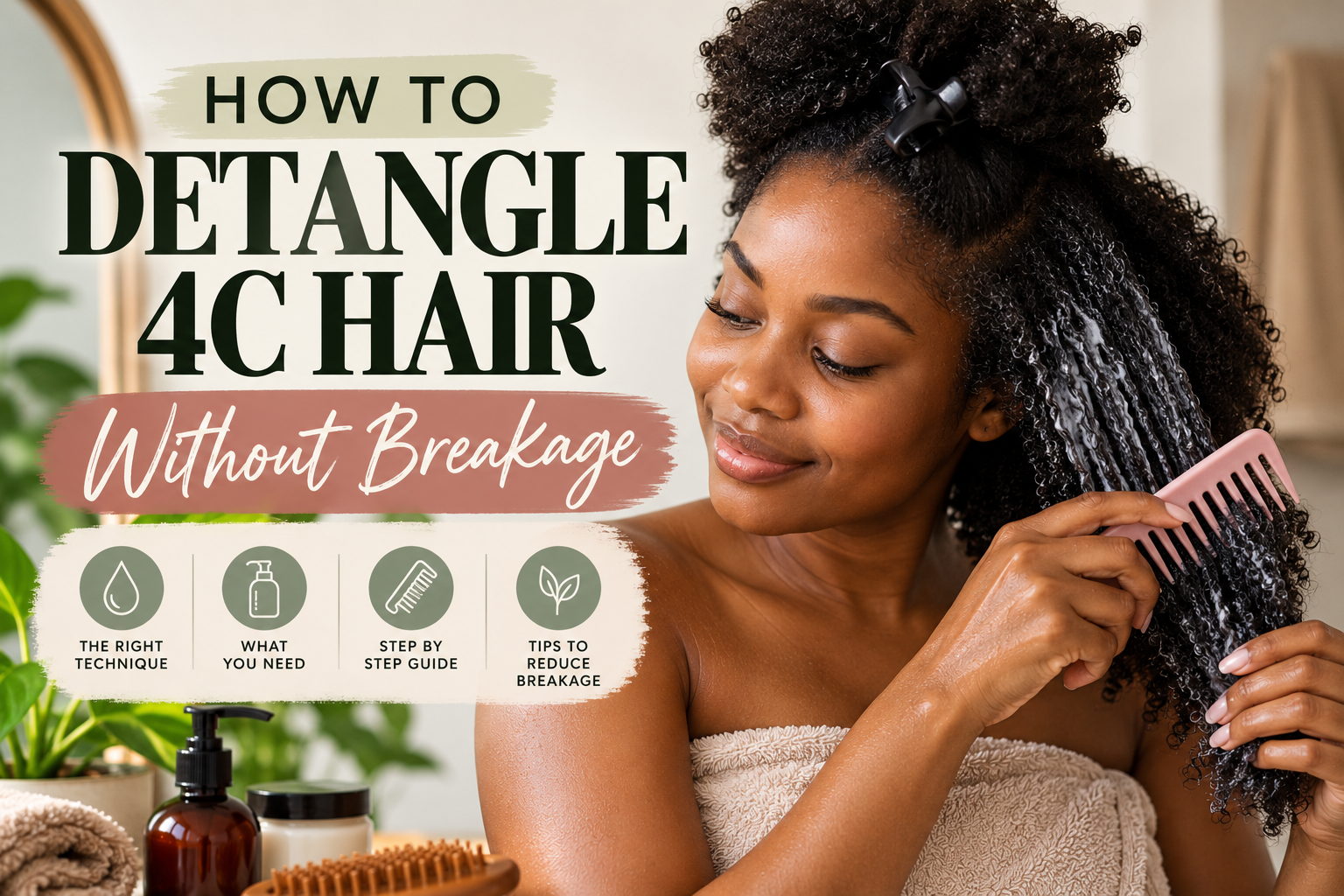
How to Detangle 4C Hair Without Breakage
How to Detangle 4C Hair Without Breakage
If detangling your 4C hair sometimes feels less like hair care and more like a wrestling match, you’re definitely not alone.
Tightly coiled hair can form knots and tangles easily, and rough handling can make the process harder on your strands. The goal isn’t to avoid shedding altogether—some hair shedding is normal—but to remove tangles while minimizing unnecessary pulling, snagging and breakage.
The good news? You don’t need a complicated routine or a bathroom full of products to detangle 4C hair more gently.
A few changes to when you detangle, how you section your hair and how much slip you give your strands can make a big difference.
Here’s a simple approach that you can adapt to your own hair.
Table of Contents
Why Is 4C Hair So Difficult to Detangle?
4C hair has a tightly coiled pattern, which means individual strands can bend and wrap around one another easily.
Afro-textured hair also has structural characteristics that can make it more vulnerable to mechanical damage from certain hair-care and styling practices.
That doesn’t mean 4C hair is “weak” or needs to be handled like glass.
It means the way you handle it matters.
Trying to rip through a dry, tangled section with a small comb is very different from gently separating that same section after adding moisture and conditioner.
The difference is in the technique.
When Is the Best Time to Detangle 4C Hair?
For many people with tightly coiled or textured hair, wash day is an excellent time to detangle because conditioner can provide slip and make the hair easier to manage.
The American Academy of Dermatology recommends that people with thick, curly hair comb through their hair while in the shower before rinsing out conditioner.
You can also detangle between wash days when necessary using water and a suitable leave-in conditioner or detangler.
What you generally want to avoid is repeatedly combing through dry, tightly coiled hair just because you feel like you need to “do something” to it.
Less manipulation can be a good thing.
What You Need Before You Start
You don’t need ten products.
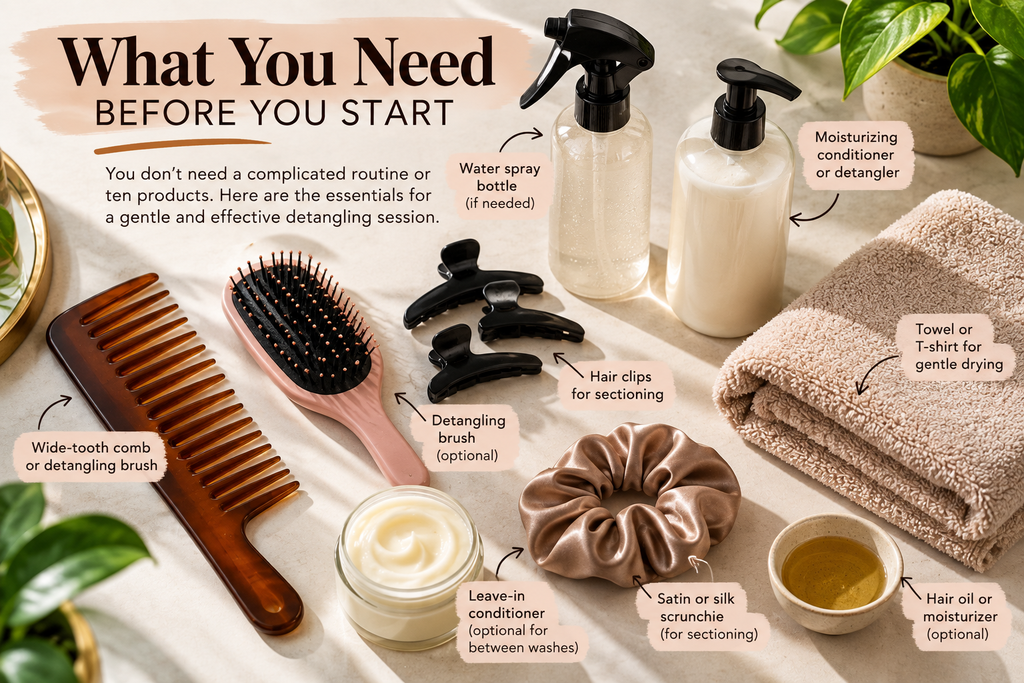
Start with:
- A spray bottle of water, if needed
- A moisturizing rinse-out conditioner or detangler
- Your fingers
- A wide-tooth comb or suitable detangling brush
- Hair clips or scrunchies for sectioning
- A towel or T-shirt for gently removing excess water
The most important thing isn’t having the “perfect” detangling tool.
It’s having enough moisture and slip to allow the tool to move through your hair without excessive pulling.
The AAD notes that conditioner helps moisturize and detangle hair, while leave-in conditioner or detangler can make hair easier to comb and help reduce breakage.
How to Detangle 4C Hair Step by Step
Here’s the process at a glance: section your hair, add slip, gently separate tangles, and work from the ends upward.
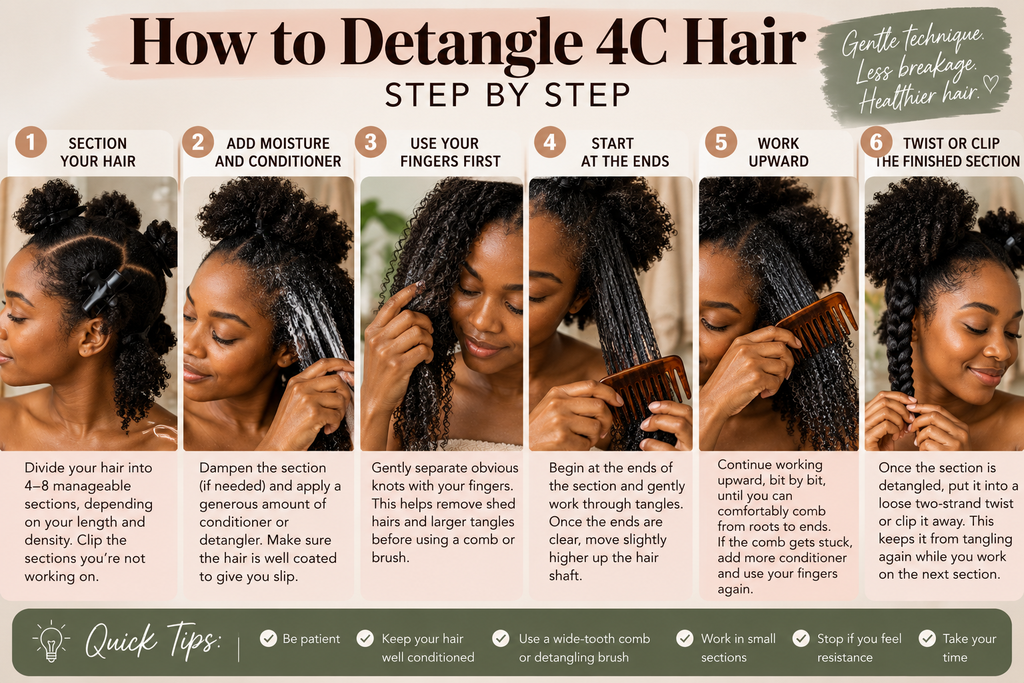
1. Start with manageable sections
Don’t attack your entire head at once.
Divide your hair into 4–8 sections, depending on its length, density and how tangled it is.
Secure the sections you’re not working on.
This gives you a smaller area to focus on and prevents already-detangled hair from becoming tangled again.
If your hair is particularly dense, you may prefer smaller sections.
There is no prize for detangling the biggest section.
2. Add moisture and conditioner
If you’re on wash day, apply your rinse-out conditioner generously enough to give your hair some slip.
If you’re detangling between washes, lightly dampen the section and apply a leave-in conditioner or detangler.
Don’t soak your hair simply because you think “more water = more moisture.” The goal is to make the hair manageable and slippery enough to work through, not to create a dripping mess.
Give the product a moment to distribute through the section.
3. Start with your fingers
Before reaching for a comb, use your fingers to gently separate obvious knots.
This is especially useful when you encounter:
- Large tangles
- Shed hairs wrapped around other strands
- Small knots
- Areas where your comb gets stuck
Don’t pull harder when you meet resistance.
Instead, stop and gently work the knot apart.
Your fingers can give you more control over what you’re actually pulling apart.
4. Start at the ends
This is one of the most important parts of the process.
Don’t start at the roots.
Begin at the ends of the section and gently work your way upward.
Once the ends are relatively clear, move slightly higher.
Continue until you can comfortably work from the roots through to the ends.
The AAD recommends slowly combing the ends first and then progressively working higher to detangle with less damage.
Think:
Ends → middle → roots → full length
Not:
Roots → yank → regret → dramatic bathroom exit.
5. Use your tool gently
Once you’ve removed the biggest tangles with your fingers, you can use your preferred detangling tool.
A wide-tooth comb is one option.
A detangling brush designed for curly or coily hair can also work for some people.
The important part is how you use it.
If the comb or brush repeatedly gets stuck, don’t force it through.
Add more conditioner or detangler, work on a smaller section, and use your fingers again.
The AAD recommends minimizing pulling and tugging during brushing and combing and using a moisturizing conditioner when necessary to help remove tangles gently.
6. Twist or clip the finished section
Once you’ve finished a section, put it into a loose two-strand twist or clip it out of the way.
This keeps the section from shrinking back into itself and tangling again while you work on the rest of your hair.
Repeat the process section by section.
Should You Detangle 4C Hair Wet or Dry?
This is one of those hair-care questions where the answer isn’t simply “wet is always better.”
For tightly coiled or textured hair, dermatologists generally recommend detangling while the hair is wet or damp, particularly with conditioner present. The AAD specifically recommends that people with thick, curly hair comb their hair in the shower before rinsing out conditioner.
That said, your individual hair still matters.
Some people prefer very wet, heavily conditioned hair.
Others prefer damp hair with a leave-in.
The goal is to find the point where your hair has enough slip to detangle without excessive pulling.
If your hair feels rough, catches constantly or snaps whenever you try to comb it, your current method may need adjusting.
7 Ways to Reduce Breakage While Detangling 4C Hair
1. Don’t detangle in a hurry
If you’re already late, this is probably not the moment for an ambitious detangling session.
Rushing usually means more pulling.
2. Work in smaller sections
Smaller sections give you more control and make it easier to find individual knots.
3. Keep your hair conditioned
Conditioner can improve manageability and make detangling easier.
4. Don’t repeatedly comb already-detangled hair
Once a section is done, leave it alone.
Constantly running a comb through your hair isn’t necessary.
5. Don’t force a stubborn knot
If something won’t move, stop.
Add more slip, separate it with your fingers and try again.
6. Be especially gentle with your ends
Your ends are the oldest part of your hair and have experienced the most manipulation over time.
Treat them accordingly.
7. Pay attention to what your hair is telling you
If your current technique consistently leaves you with excessive breakage, change the technique rather than simply accepting it as “normal 4C hair.”
Common 4C Detangling Mistakes
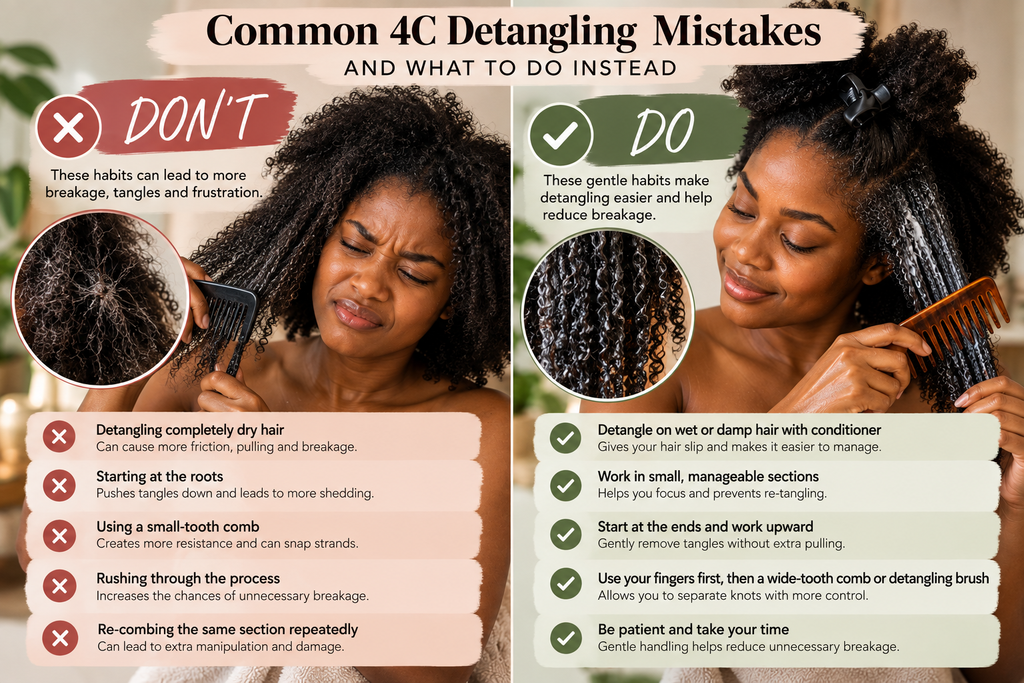
Detangling completely dry hair
Dry detangling isn’t automatically forbidden, but aggressively combing through dry, tightly coiled hair can create unnecessary friction and pulling.
If your hair is difficult to detangle dry, try adding moisture and conditioner or detangler.
Starting at the roots
This forces tangles further down the section to travel through the rest of the hair.
Start at the ends.
Using a tiny-tooth comb
A small-tooth comb can create more resistance when you’re trying to remove significant tangles.
Try a wide-tooth comb or a tool designed for curly/coily hair.
Working on your whole head at once
Your hair doesn’t need to become one giant project.
Section it.
Pulling through knots
If your tool stops, that’s information.
Something is caught.
Don’t turn the volume up on the pulling.
Do You Need a Detangling Brush for 4C Hair?
No.
You do not need a specific brush to have a successful 4C hair routine.
Some people love detangling brushes. Others prefer wide-tooth combs. Others do most of their detangling with their fingers.
Your best tool is the one that allows you to remove tangles while keeping pulling and unnecessary manipulation to a minimum.
And if your fingers are doing the job beautifully?
Congratulations. Your hands have been promoted to professional equipment.
The Crown Decoded Detangling Checklist
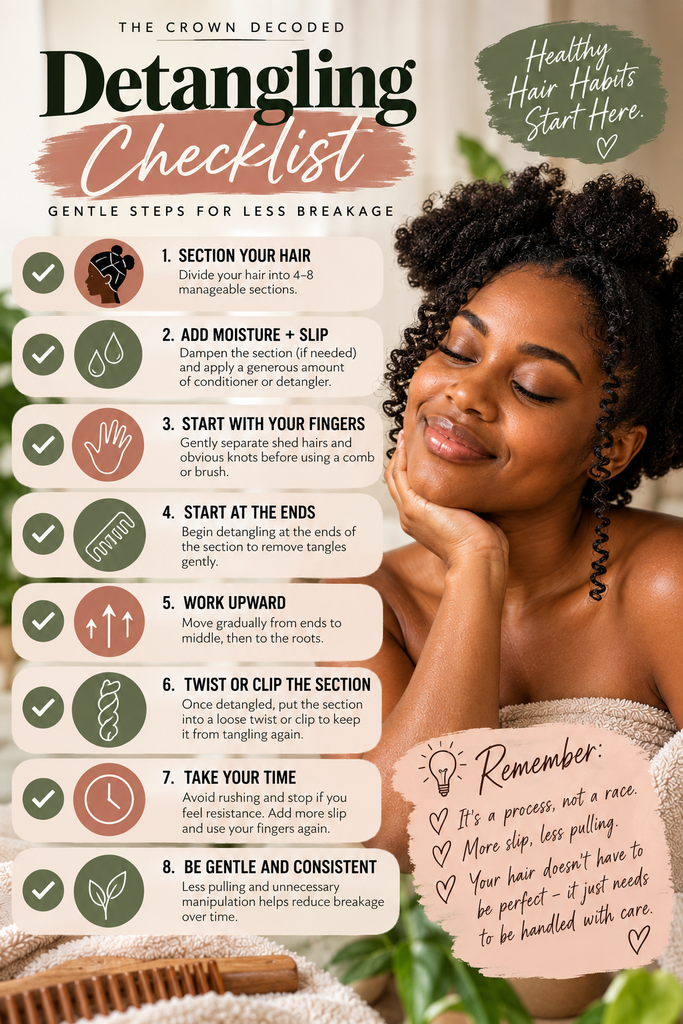
Before you start:
☐ Divide your hair into manageable sections
☐ Add water/moisture if needed
☐ Apply conditioner or detangler
☐ Start with your fingers
☐ Begin at the ends
☐ Work upward gradually
☐ Use your comb or brush gently
☐ Stop when you encounter resistance
☐ Put finished sections away
☐ Avoid unnecessary repeat manipulation
How This Fits Into Your 4C Hair Routine
Detangling shouldn’t exist as a completely separate hair-care ritual.
It’s one part of a bigger routine.
Your overall routine can be as simple as:
Cleanse → Condition → Detangle → Moisturize → Style → Maintain
And you don’t necessarily need a complicated product collection to make it work.
If you want to build the full routine from the beginning, check out our guide:
How to Build a 4C Hair Care Routine That Actually Works
Bottom Line
Detangling 4C hair doesn’t have to mean fighting your hair.
The basic strategy is simple:
Give your hair enough slip. Work in sections. Start at the ends. Use your fingers when necessary. Be gentle when you encounter resistance.
Your goal isn’t to make every single shed strand disappear.
It’s to make detangling more manageable while reducing unnecessary pulling and breakage.
And if a particular technique or product isn’t working for your hair, you don’t have to force it just because it works for somebody else.
Your routine should work with your hair—not against it.
Learn how to detangle 4C hair with less breakage using sections, conditioner, gentle handling and the right detangling technique.