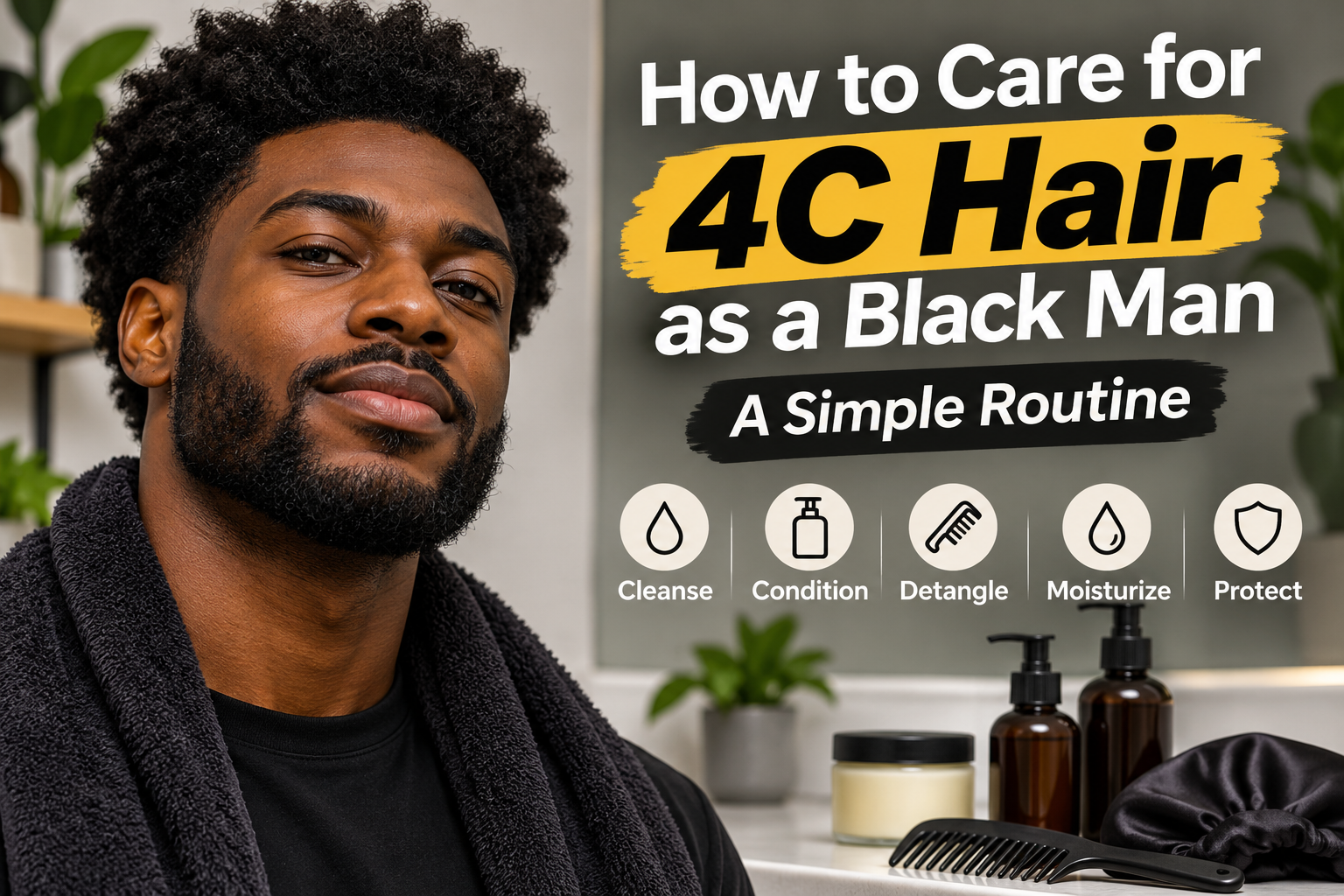
How to Care for 4C Hair as a Black Man: A Simple Routine
Taking care of 4C hair doesn’t have to mean buying a shelf full of products or spending hours in front of the mirror. If you’re looking for practical 4C hair care for men, the good news is that you can build an effective routine around a few consistent habits.
Whether you keep your hair short, wear a fade, maintain a small afro or are growing your hair out, understanding what your hair needs makes it easier to manage.
Start with the basics: cleanse your scalp, condition your hair, detangle gently, moisturize when needed and choose styles that don’t put unnecessary stress on your hair.
You don’t need a complicated system. You need one that works with your hair and your lifestyle.
Table of Contents
A Simple 4C Hair Care Routine for Men
If you’re new to caring for 4C hair, you don’t need to start with complicated techniques. Build your routine around five basic steps.
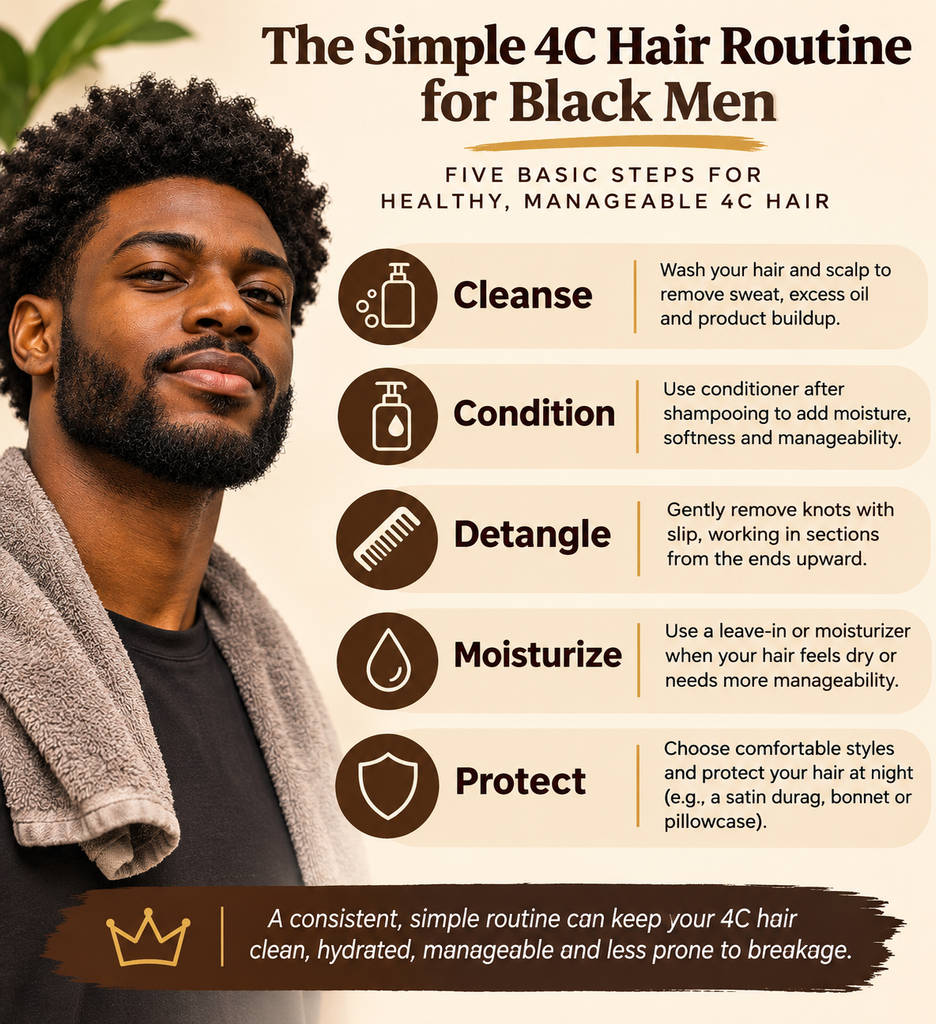
Cleanse your hair and scalp
Washing removes sweat, excess oil, dead skin and product buildup from your scalp and hair.
Choose a shampoo that cleans your scalp without leaving your hair feeling excessively dry or uncomfortable.
When washing, concentrate on your scalp rather than aggressively scrubbing the entire length of your hair. Allow the shampoo to rinse through the strands.
Condition your hair
Conditioner helps improve softness, manageability and slip, making your hair easier to handle.
Apply conditioner after shampooing, following the product instructions. Pay particular attention to the ends if your hair is long enough to have distinguishable ends.
Don’t skip conditioning simply because you keep your hair short. Your hair still benefits from appropriate conditioning.
The American Academy of Dermatology recommends conditioning every time you wash Black hair.
Detangle gently
If your hair is long enough to tangle, don’t rush through this step.
Use a conditioner or detangling product that provides enough slip. Work through manageable sections, starting near the ends and gradually moving upward.
You can use your fingers or a suitable wide-tooth comb, depending on your hair length and what works best.
Avoid forcing a comb through stubborn knots. Add more slip, slow down and work through them carefully.
For a more detailed explanation, see our guide: How to Detangle 4C Hair Without Breakage.
Moisturize when your hair needs it
4C hair can become difficult to manage when it feels dry, but that doesn’t mean you need to apply several products every day.
A leave-in conditioner or suitable moisturizer may help improve manageability. Start with a small amount and see how your hair responds.
You can also use a styling product if you need additional hold or definition.
The goal is to find a manageable balance rather than constantly adding more products.
Style and protect your hair
Choose styles that are comfortable and don’t require excessive pulling, brushing or manipulation.
If you wear an afro, twists or another natural style, avoid repeatedly handling your hair just to maintain its appearance.
At night, consider a satin or silk durag, bonnet or pillowcase if it helps reduce friction and keeps your hair manageable.
Your routine should be comfortable enough to maintain consistently.
How Often Should a Black Man With 4C Hair Wash His Hair?
There isn’t one washing schedule that works for every man with 4C hair.
As a starting point, the American Academy of Dermatology recommends washing Black hair once a week or every other week. This can help prevent product buildup.
However, your routine may need adjusting depending on your scalp, lifestyle and styling habits.
Consider the following:
- You exercise frequently: Sweat and product use may mean you need to cleanse your scalp more often.
- You use styling products regularly: You may need to wash more frequently to manage buildup.
- You keep your hair very short: Washing and conditioning may be relatively straightforward, but your scalp still needs appropriate care.
- Your scalp feels uncomfortable: Persistent itching, flaking or irritation deserves attention rather than simply adding more moisturizer.
Pay attention to how your scalp and hair respond.
If your current schedule leaves your scalp uncomfortable or your hair difficult to manage, reconsider it rather than following a rigid timetable.
A Simple Wash-Day Routine for 4C Hair

Wash day doesn’t have to be complicated.
Here is a practical sequence you can follow.
Before washing
- Gather your shampoo, conditioner and any styling products you plan to use.
- Separate longer hair into manageable sections if necessary.
- Make sure you have a clean towel or T-shirt ready.
During washing
- Wet your hair thoroughly.
- Apply shampoo to your scalp and gently cleanse.
- Rinse thoroughly.
- Apply conditioner according to the product instructions.
- Gently detangle if your hair needs it.
- Rinse as directed.
After washing
- Gently squeeze out excess water.
- Avoid vigorously rubbing your hair with a towel.
- Apply leave-in conditioner or moisturizer if needed.
- Style your hair using a method that doesn’t cause unnecessary tension.
- Allow your hair to dry appropriately.
If your hair is short, you may not need to section or detangle it at all.
Keep the process proportional to your hair length and needs.
How to Care for Short 4C Hair
Many Black men keep their hair relatively short, and that can make maintaining a routine easier.
However, short hair still needs appropriate cleansing, conditioning and gentle handling.
If you keep a very short haircut
Your routine can be straightforward:
- Cleanse your scalp regularly.
- Use conditioner after shampooing.
- Avoid aggressive brushing.
- Apply moisturizer if your hair feels dry.
- Pay attention to scalp comfort.
You probably don’t need multiple styling products or elaborate detangling techniques.
If you wear a short afro
As your hair gets longer, tangling and shrinkage may become more noticeable.
You may find it helpful to:
- Condition consistently.
- Detangle gently when necessary.
- Avoid excessive brushing.
- Use a suitable moisturizer when needed.
- Protect your hair at night.
Don’t assume that every short afro needs daily manipulation to look presentable.
If you’re growing your hair out
Growing your hair longer means paying more attention to how you handle it.
As your hair gains length, tangles may become more difficult to manage, particularly when strands catch against one another.
Focus on:
- Gentle detangling.
- Consistent conditioning.
- Reducing unnecessary manipulation.
- Avoiding excessive heat.
- Choosing comfortable styles.
Remember that a hair-care routine supports healthy-looking hair and length retention. It doesn’t guarantee faster biological hair growth.
What About 4C Hair With a Fade?
A fade with natural hair on top is a common hairstyle for Black men.
The longer section on top may need more attention than the closely cut sides.
For this style:
- Cleanse your scalp and hair appropriately.
- Condition the longer section.
- Avoid excessive brushing to maintain the top.
- Use a small amount of styling product if needed.
- Protect the longer hair at night when practical.
If you’re visiting your barber regularly, remember that your hair-care routine continues between appointments.
A fresh haircut doesn’t replace cleansing, conditioning or appropriate scalp care.
Also, be mindful of repeated irritation from close shaving or grooming. If you develop persistent bumps, inflammation or discomfort around the hairline or neck, seek appropriate medical advice.
How to Care for 4C Hair Between Wash Days
What you do between wash days matters, but you don’t need to restart your entire routine every morning.
The goal is to maintain manageable hair without unnecessary manipulation.
Refresh your hair when needed
If your hair feels comfortable and manageable, you may not need to add anything.
If it feels dry or difficult to handle, a little water or a suitable leave-in product may help.
Start with a small amount rather than layering several products.
Avoid unnecessary brushing and combing
Constantly brushing or combing your hair can create unnecessary mechanical stress.
If your hairstyle looks fine, leave it alone.
When you need to detangle or restyle, work gently.
Protect your hair at night
A satin or silk durag, bonnet or pillowcase can be a practical option.
Choose something comfortable that doesn’t pull tightly on your hairline.
You don’t need an elaborate nighttime routine. The important thing is finding a method that works with your sleeping habits and hairstyle.
What if you work out frequently?
You don’t necessarily need to shampoo after every workout.
However, regular exercise, sweating and styling-product use can influence how often your scalp needs cleansing.
Pay attention to scalp comfort and buildup.
If you exercise frequently, you may find that your usual washing schedule needs adjusting.
How to Reduce Breakage in 4C Hair
Breakage can make it difficult to retain length, particularly when your hair is already prone to tangling or requires careful handling.
You cannot prevent every broken strand, but you can reduce unnecessary stress on your hair.
Start with these habits:
Detangle gently. Avoid forcing combs through knots or repeatedly pulling at tangled sections.
Condition consistently. Conditioner helps improve manageability and makes handling easier.
Limit unnecessary manipulation. Constant brushing, twisting and restyling can create avoidable mechanical stress.
Be careful with heat. Frequent or excessive heat styling can damage hair. Use lower heat settings when heat styling is necessary.
Avoid tight hairstyles. Pain, pulling or persistent tension around the hairline are warning signs that a style needs to change.
Pay attention to patterns. Notice whether breakage appears around the hairline, crown, ends or another area.
If you’re experiencing persistent or increasing breakage, consider whether your washing, styling or grooming habits need to change.
For more practical guidance, read How to Detangle 4C Hair Without Breakage.
You can also explore our broader 4C Hair Care Routine Guide.
Do You Need a Lot of Products for 4C Hair?
No.
A simple routine can work with a relatively small collection of products.

You can start with:
| Product | Purpose |
|---|---|
| Shampoo | Cleanses the scalp and hair |
| Conditioner | Improves softness and manageability |
| Leave-in conditioner or moisturizer | Helps with manageability between washes |
| Styling product | Helps achieve your preferred hairstyle |
Some products are optional.
For example, you may find that you don’t need a separate styling cream, oil or deep conditioner for every wash day.
Oils can have a place in some routines, but applying oil is not the same as cleansing or conditioning your hair.
Likewise, you don’t have to follow the LOC or LCO method simply because someone else recommends it.
Start with the basics. Introduce additional products only when you understand what problem they are supposed to solve.
The Crown Decoded rule: More products do not automatically mean better hair care.
Common 4C Hair Care Mistakes Black Men Should Avoid
A few everyday habits can make maintaining 4C hair unnecessarily difficult.
Watch out for these mistakes:
Skipping conditioner
Shampooing without following up with conditioner can leave hair harder to manage.
Washing too aggressively
Focus on cleansing the scalp without rough scrubbing or excessive friction.
Brushing too frequently
You don’t need to brush your hair repeatedly throughout the day.
Forcing a comb through tangles
Slow down, add slip and work through knots carefully.
Applying too many products
More layers can mean more buildup without necessarily improving manageability.
Assuming oil replaces moisturizer
Different products serve different purposes. Don’t treat every oil as a complete moisturizing routine.
Ignoring scalp discomfort
Persistent itching, irritation or pain shouldn’t automatically be treated as a dryness problem.
Wearing styles that pull
Tight styles and repeated tension can contribute to hair breakage and traction-related hair loss.
Using excessive heat
Frequent heat styling can damage hair. Limit unnecessary exposure.
Copying someone else’s routine exactly
Your hair length, scalp condition, styling preferences and lifestyle may be different.
Build a routine around your own needs.
A Simple Weekly 4C Hair Care Checklist
If you’re new to 4C hair care, use this checklist to keep things manageable.
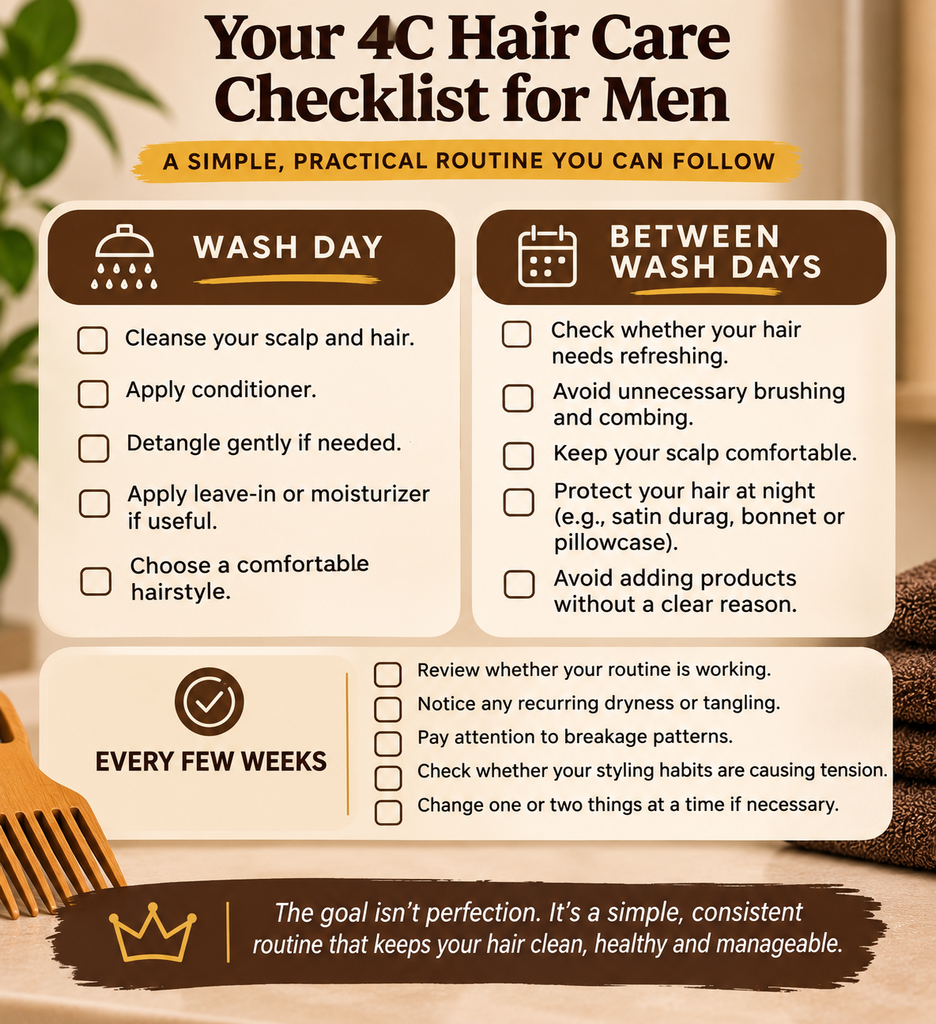
Wash day
- Cleanse your scalp and hair.
- Apply conditioner.
- Detangle gently if needed.
- Apply leave-in or moisturizer if useful.
- Choose a comfortable hairstyle.
Between wash days
- Check whether your hair needs refreshing.
- Avoid unnecessary brushing and combing.
- Keep your scalp comfortable.
- Protect your hair at night if practical.
- Avoid adding products without a clear reason.
Every few weeks
- Review whether your routine is working.
- Notice any recurring dryness or tangling.
- Pay attention to breakage patterns.
- Check whether your styling habits are causing tension.
- Change one or two things at a time if necessary.
The objective isn’t to achieve a perfect routine overnight.
It’s to build habits you can repeat.
When to See a Dermatologist
Not every hair or scalp concern can be solved by changing your products.
Consider seeing a board-certified dermatologist if you notice:
- Sudden or significant hair loss.
- Noticeable thinning or a receding hairline.
- Bald patches.
- Persistent scalp itching or inflammation.
- Pain, sores or recurring irritation.
- Changes in your hair’s texture or appearance.
Some forms of hair loss can become more difficult to treat when diagnosis is delayed.
For example, repeated tension from hairstyles can contribute to traction alopecia, a form of hair loss associated with prolonged pulling on the hair.
If a hairstyle causes pain, stinging or persistent scalp discomfort, don’t simply tolerate it.
The American Academy of Dermatology recommends seeking professional advice when you notice changes in your hair or signs of hair loss.
See the AAD guide to Black hair care for additional guidance.
The Crown Decoded 4C Hair Routine for Men
If you remember only one thing from this guide, remember these five steps:
Cleanse: Keep your scalp and hair clean.
Condition: Make your hair easier to manage.
Detangle: Handle knots gently and avoid unnecessary pulling.
Moisturize: Use products according to what your hair needs.
Protect: Choose comfortable styles and reduce unnecessary manipulation.
Your routine can be simple whether you have a close cut, a fade, a short afro or longer natural hair.
You don’t need to follow every trend or buy every product recommended online.
Pay attention to how your hair responds, make adjustments gradually and stick with the habits that work.
Bottom Line
Caring for 4C hair as a Black man doesn’t need to be complicated.
Start with regular cleansing, conditioning, gentle handling, appropriate moisture and comfortable styling.
Adjust your routine as your hair grows or your lifestyle changes.
Most importantly, don’t confuse having more products with taking better care of your hair.
Healthy-looking hair care starts with consistent habits, not a complicated product collection.
Further Reading
Medical and Educational Sources
- American Academy of Dermatology: Black Hair — Tips for Everyday Care
- American Academy of Dermatology: Hair Styling Without Damage
- American Academy of Dermatology: Hairstyles That Pull Can Lead to Hair Loss
- Afro-textured Hair Care: A Narrative Review and Recommendations for Dermatologists
This article is for educational purposes and is not a substitute for individualized medical advice.