How to Properly Wash 4C Hair: A Simple Step-by-Step Guide
Washing 4C hair can feel like a whole project. Between sectioning, detangling, shampooing, conditioning and styling, it’s easy to turn wash day into a long list of steps that leave you wondering whether you’re doing too much or missing something important.
The good news? You don’t need an elaborate routine to wash your hair properly.
The goal is to cleanse your scalp, condition your hair, manage tangles gently and finish with a routine that works for your hair and lifestyle. A few thoughtful habits can make wash day easier without requiring a cupboard full of products.
In this guide, you’ll learn how to wash 4C hair step by step, how to reduce unnecessary tangling during the process, and which wash-day extras you can treat as optional rather than essential.
Table of Contents
- What You Need to Wash 4C Hair
- How to Wash 4C Hair Step by Step
- Should You Wash 4C Hair in Sections?
- Common 4C Hair Washing Mistakes to Avoid
- How Often Should You Wash 4C Hair?
- Do You Need to Pre-Poo or Deep-Condition Every Wash Day?
- Your Simple 4C Hair Wash-Day Checklist
- How Washing Fits Into Your Overall 4C Hair Care Routine
- The Crown Decoded Takeaway
Quick Answer: How Do You Properly Wash 4C Hair?
To wash 4C hair, wet your hair and scalp thoroughly, gently massage shampoo into your scalp, and rinse well. Apply conditioner, detangle carefully with enough slip, rinse according to the product directions, and gently remove excess water before applying any post-wash products you need.
Sectioning can make the process easier, especially if your hair is long, dense or prone to tangling. Pre-poo treatments and deep conditioners can be useful additions for some people, but you don’t automatically need every treatment at every wash.
The most important thing is to cleanse your scalp effectively while avoiding unnecessary pulling, rubbing and manipulation.
What You Need to Wash 4C Hair
You can wash 4C hair with a small collection of products and tools. Start with the essentials, then add other products only if they serve a clear purpose in your routine.
1. Shampoo
Shampoo removes excess oil, dirt, dead skin and product buildup from the scalp. Choose one that suits your scalp and hair-care needs.
A shampoo marketed for curly or coily hair may be a useful starting point, but you don’t need to assume that every product in that category will work equally well for you.
If your scalp is uncomfortable, persistently flaky or unusually oily, consider whether your current cleansing routine is appropriate rather than automatically adding more oils or styling products.
2. Rinse-out conditioner
Conditioner helps improve manageability and makes detangling easier. It’s an important part of a routine that involves washing textured hair.
Look for a conditioner that gives your hair enough slip to work through tangles without excessive pulling. You can begin with a basic rinse-out conditioner before deciding whether you need additional treatments.
3. A suitable detangling tool
Your fingers, a wide-tooth comb or a suitable detangling brush can help you work through tangles.
You don’t need to buy every type of tool. Choose one you can use gently and comfortably with your hair.
4. A towel or clean T-shirt
Have something ready to absorb excess water after washing. The goal is to remove water without vigorously rubbing your hair.
Optional products
Depending on your routine, you may also choose to use:
- A pre-shampoo treatment, often called a pre-poo.
- A deep conditioner.
- A leave-in conditioner.
- A styling product.
These products have different purposes. You don’t need to use all of them simply because they’re available.
How to Wash 4C Hair Step by Step
Here’s a practical wash-day process you can adapt to your hair’s length, density, condition and styling routine.
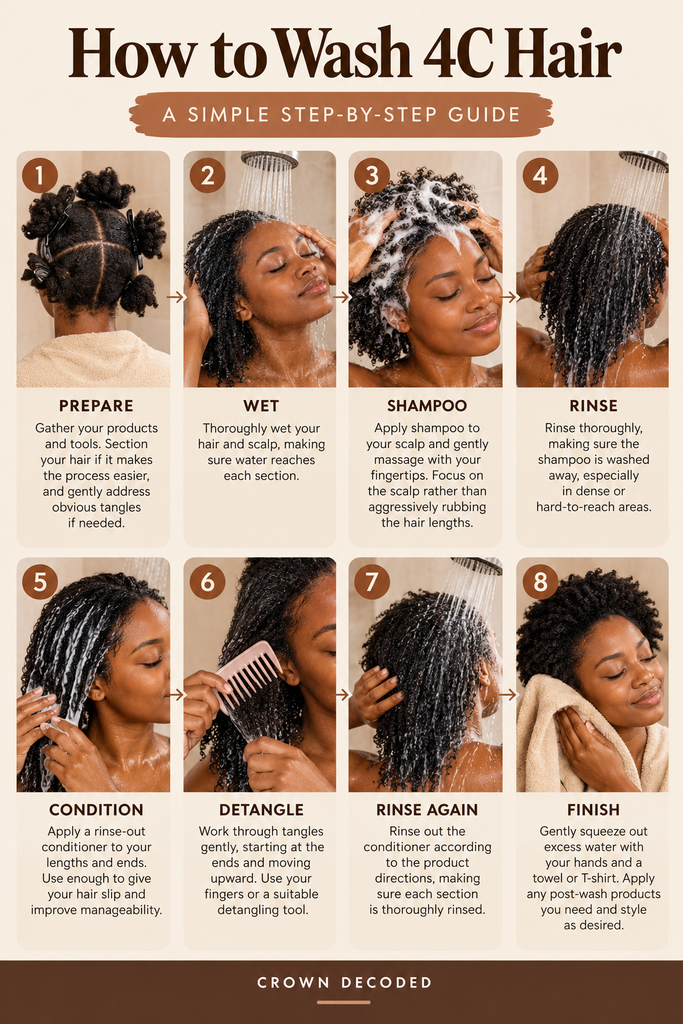
Step 1: Prepare Your Hair Before Washing
Before turning on the water, gather your shampoo, conditioner, detangling tool and any products you plan to use afterward.
If your hair is long, dense or easily tangled, divide it into manageable sections. You can secure the sections loosely with suitable clips or bands while you work.
Next, consider whether your hair needs some detangling before shampooing.
If you can gently separate obvious tangles, doing so may make washing easier. If your hair is difficult to detangle while dry, you can wait until you’ve applied conditioner. There isn’t one pre-wash method that works best for everyone.
Avoid forcing a comb through knots just to get your hair ready for washing. If a section resists, slow down and use a method that allows you to handle it more comfortably.
Crown Decoded tip: Prepare for wash day before you start. Having your products and tools within reach makes it easier to work patiently instead of rushing through tangles.
Step 2: Wet Your Hair and Scalp Thoroughly
Allow water to reach your scalp and the full length of your hair before applying shampoo.
If you’re washing in sections, work methodically so that water reaches each section. Dense hair can take a little patience to wet evenly.
Use a comfortable water temperature and give yourself enough time to wet the hair thoroughly. You don’t need to make the process complicated with a strict soaking time.
Step 3: Apply Shampoo to Your Scalp
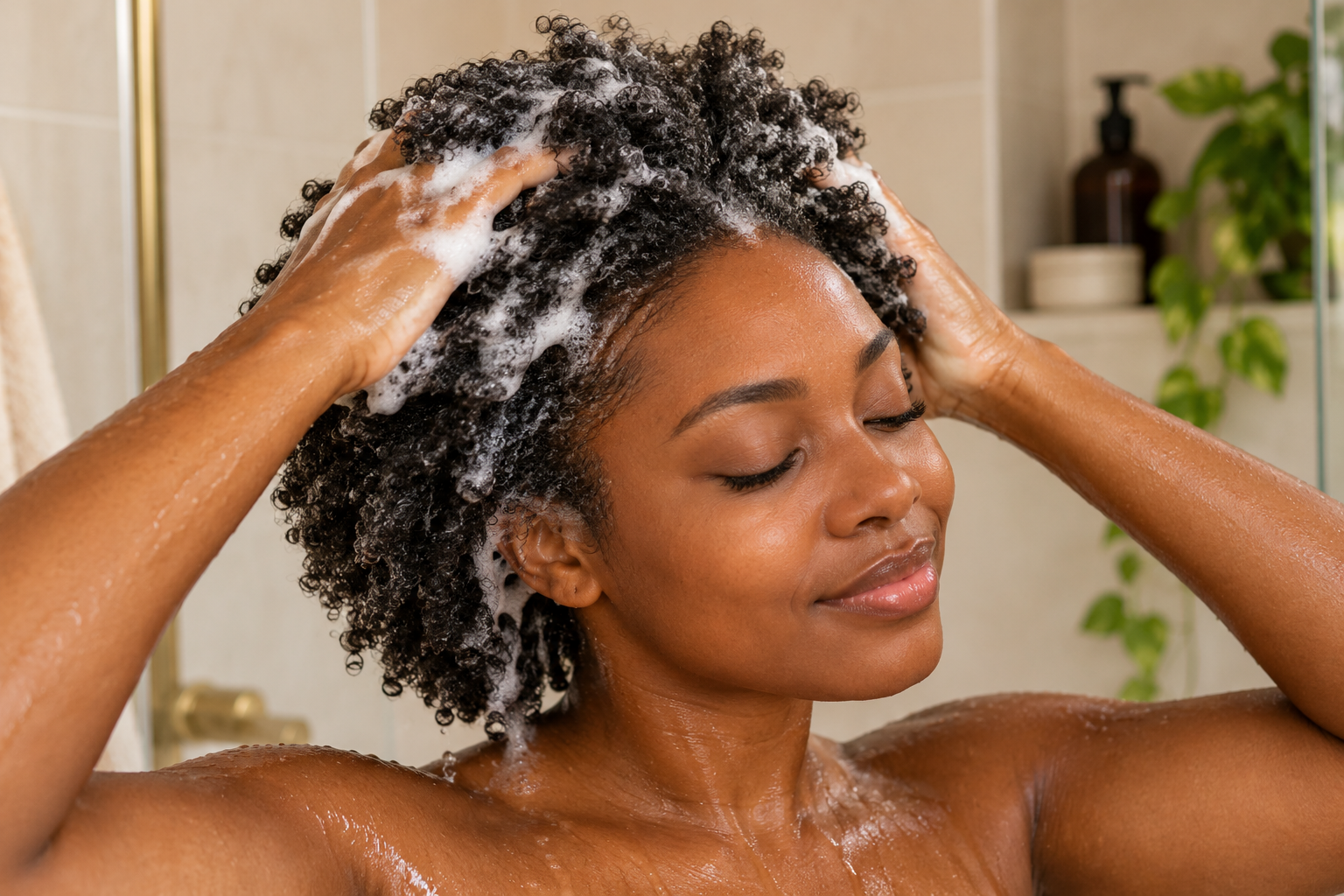
Apply your shampoo to the scalp and gently massage it using your fingertips.
Work across the scalp rather than aggressively rubbing the lengths of your hair together. The American Academy of Dermatology recommends focusing shampoo on the scalp and allowing it to rinse through the lengths, which helps cleanse the scalp without unnecessarily drying the hair.
If you’ve divided your hair into sections, you can work through each section to make the scalp easier to reach.
Use your fingertips rather than scratching with your nails. If you’re using a medicated shampoo for a scalp condition, follow its specific directions.
You don’t need to create a huge amount of foam or vigorously scrub your hair for the wash to count.
Step 4: Rinse Thoroughly
Rinse away the shampoo, making sure water reaches your scalp and all sections of your hair.
Pay attention to areas that are harder to reach, particularly if your hair is dense or sectioned.
Should you shampoo twice? Not automatically.
If your scalp and hair feel adequately cleansed after the first wash, another round may not be necessary. If you use substantial amounts of styling products or have noticeable buildup, a second cleanse may be appropriate depending on your shampoo and its directions.
Let your scalp and hair-care needs guide the decision rather than treating two shampoo rounds as a universal rule.
Step 5: Apply Conditioner
After rinsing out the shampoo, apply your rinse-out conditioner according to the product instructions.
Distribute it through your hair, paying attention to the lengths and ends. Use enough to help you work through your hair without needing to tug repeatedly at tangles.
Conditioner can improve manageability and help make detangling easier. That matters because repeatedly pulling at knots can contribute to unnecessary mechanical stress.
Give the conditioner the time recommended on its packaging. You don’t need to leave every conditioner on for an unusually long period to make it work.
Step 6: Detangle Gently
For many people with 4C hair, detangling is the part of wash day that requires the most patience.
If your hair is tangled, work in manageable sections while it has enough conditioner or detangling product to provide slip.
Start at the ends and gradually work upward. Use your fingers to locate stubborn knots when that helps, and avoid repeatedly dragging a comb through a section that won’t release.
If you encounter a difficult tangle:
- Pause instead of pulling harder.
- Add a little more conditioner if needed and appropriate for the product.
- Gently separate the knot with your fingers.
- Continue working from the ends toward the roots.
- Move on only when you can handle the section comfortably.
The aim isn’t to rush through every knot. It’s to work through your hair with as little unnecessary pulling as possible.
For more detailed instructions, read our guide on how to detangle 4C hair without breakage.
Step 7: Rinse Out the Conditioner
Once you’ve finished conditioning and detangling, rinse according to the product’s instructions.
Make sure you’ve rinsed each section thoroughly. If you use several sections, check that none has been missed.
Some products are designed to remain in the hair, while rinse-out conditioners are meant to be washed away. Follow the directions for the product you’re using rather than assuming all conditioners work the same way.
Step 8: Remove Excess Water and Finish Your Routine
Use your hands to gently squeeze out excess water. Then blot or wrap your hair in a clean T-shirt or suitable towel rather than vigorously rubbing it.
The American Academy of Dermatology advises gently absorbing water because rough towel-drying can damage hair.
Next, apply any post-wash products that suit your routine. Depending on your hair and chosen style, that might mean a leave-in conditioner, a styling product or simply moving on to styling.
You don’t need to layer several products just because you’ve finished washing.
Choose a manageable style, handle your hair gently and avoid adding unnecessary manipulation immediately after wash day.
Should You Wash 4C Hair in Sections?
Washing in sections can make wash day easier, particularly if your hair is long, dense or prone to tangling. It allows you to focus on a smaller amount of hair at a time and may make it easier to reach the scalp.
However, sectioning isn’t a strict requirement for every person with 4C hair.
When sectioning helps
Consider washing in sections if you find that:
- Your hair tangles easily when wet.
- You struggle to reach your scalp through the full density of your hair.
- You lose track of which areas you’ve washed or conditioned.
- Detangling your whole head at once feels overwhelming.
- You prefer working through smaller portions of hair.
How many sections should you use?
Start with a number that makes your hair manageable. You might need only a few sections, while longer or denser hair may be easier to handle in more.
There is no universal number of sections that everyone must use.
If four sections work for you, keep using four. If you need more, adjust. The goal is to make washing easier, not to follow a particular number.
Do you need to keep your hair sectioned throughout wash day?
Not necessarily. Some people find it helpful to maintain their sections during shampooing, conditioning and detangling. Others prefer to release a section after completing a particular step.
Choose the approach that helps you keep track of your hair and handle it comfortably.
The American Academy of Dermatology also recommends sectioning long or thick curly hair when doing so helps reduce damage or tangling.
Common 4C Hair Washing Mistakes to Avoid
A few small adjustments can make your wash-day routine more manageable.
1. Rubbing shampoo aggressively through the hair lengths
Concentrate shampoo on the scalp and allow the rinse water to carry it through the lengths. Avoid unnecessary rubbing or friction between sections of hair.
2. Forcing a comb through tangles
More force isn’t the answer to a stubborn knot. Slow down, add appropriate slip and work through the tangle gradually.
If a method repeatedly causes pain or excessive pulling, change the method.
3. Skipping conditioner
Conditioner helps improve manageability and makes detangling easier. Use an appropriate rinse-out conditioner after shampooing and follow the product directions.
4. Assuming you must shampoo twice
A second cleanse may be useful in some circumstances, but it isn’t automatically necessary every wash day.
Consider your scalp, product buildup and whether the first cleanse was effective.
5. Treating every extra treatment as compulsory
Pre-poo treatments, deep conditioners and other add-ons can have a place in a routine. They don’t all need to be used every time you wash.
Start with the basic process and add treatments when you have a clear reason to use them.
6. Rubbing your hair vigorously with a towel
Use a towel or T-shirt to gently absorb excess water. Avoid rough rubbing, particularly when your hair is wet.
7. Ignoring persistent scalp symptoms
An uncomfortable scalp isn’t always a sign that you need another moisturizing product.
If you have persistent itching, significant flaking, scalp pain, visible thinning or a sudden change in hair loss, seek advice from a qualified healthcare professional or dermatologist rather than relying on routine changes alone.
How Often Should You Wash 4C Hair?
There isn’t one schedule that suits every person with 4C hair.
The American Academy of Dermatology’s guidance for Black hair suggests washing once a week or every other week, while its broader healthy-hair guidance advises washing textured, curly or thick hair as needed, with at least once every two to three weeks as needed.
These recommendations are guidance, not a personalized prescription. Your scalp condition, product use and lifestyle can affect how often you need to wash.
If you’re unsure where to start, consider how your scalp feels, whether you use products that build up, and how manageable your hair is between washes.
For a more detailed discussion, read our guide to how often you should wash 4C hair.
Do You Need to Pre-Poo or Deep-Condition Every Wash Day?
No. Both can be useful additions, but neither needs to be an automatic requirement for everyone.
What is a pre-poo treatment?
A pre-poo is a treatment applied before shampooing. People use different products and methods for this step, often to help prepare the hair for washing or make it easier to manage.
Some people find pre-shampoo conditioning helpful when their hair is very dry or difficult to detangle. Others may find that they can wash their hair comfortably without it.
If you try a pre-poo, pay attention to how your hair responds and whether the extra step actually helps.
When might deep conditioning be useful?
Deep conditioning is an additional conditioning treatment that some people incorporate into their routines.
Whether you need it, and how often you use it, depends on your hair-care practices, the products involved and how your hair responds. Follow the product directions instead of assuming that every deep conditioner should be used at every wash.
A deep conditioner also doesn’t replace cleansing your scalp.
What can you skip if you want a simpler wash day?
If you’re trying to simplify your routine, begin with the essentials:
- Shampoo your scalp.
- Rinse thoroughly.
- Condition your hair.
- Detangle gently.
- Rinse and finish with the products you actually need.
You can then decide whether an additional treatment makes a meaningful difference for you.
Crown Decoded reminder: A longer routine isn’t automatically a better routine. Keep the steps that serve your hair and simplify the ones that don’t.
Your Simple 4C Hair Wash-Day Checklist
Save or revisit this checklist when you’re preparing for your next wash day.
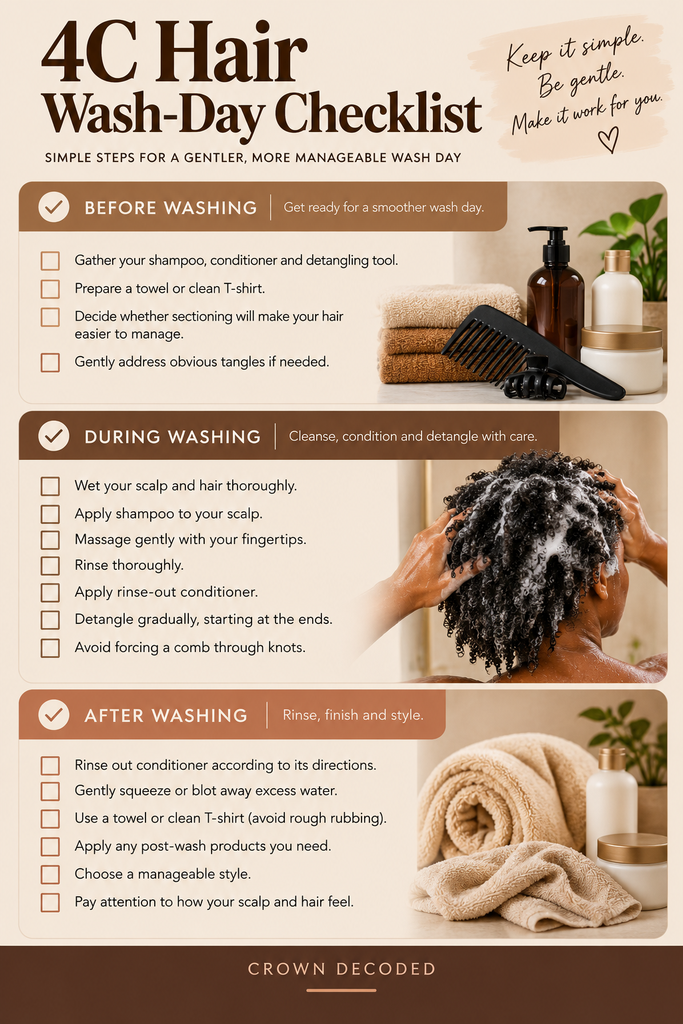
Before washing
- Gather your shampoo, conditioner and detangling tool.
- Prepare a towel or clean T-shirt.
- Decide whether sectioning will make your hair easier to manage.
- Gently address obvious tangles if needed.
During washing
- Wet your scalp and hair thoroughly.
- Apply shampoo to the scalp.
- Massage gently with your fingertips.
- Rinse thoroughly.
- Apply rinse-out conditioner.
- Detangle gradually, starting at the ends.
- Avoid forcing a comb through knots.
After washing
- Rinse out conditioner according to its directions.
- Gently squeeze or blot away excess water.
- Apply any appropriate post-wash products.
- Choose a manageable style.
- Pay attention to how your scalp and hair feel.
Your personal wash-day check
After washing, ask yourself:
- Did I cleanse my scalp thoroughly?
- Was I able to detangle without excessive pulling?
- Did my hair feel reasonably manageable afterward?
- Did I use products because I needed them, or simply because I had them?
- Is there one step I could make easier next time?
Use your answers to adjust your routine gradually. Changing one or two things at a time makes it easier to identify what actually helps.
How Washing Fits Into Your Overall 4C Hair Care Routine
Washing is one part of a broader routine that includes conditioning, detangling, moisture management and styling.
The goal is to make those steps work together without creating unnecessary work.
If you’re still figuring out the bigger picture, read our guide on how to build a 4C hair care routine that actually works.
It will help you connect wash day to the rest of your routine, including how to manage your hair between washes.
You can also explore the free Crown Decoded 4C Hair Routine Guide for a simple framework to help you organize your own routine.
The Crown Decoded Takeaway
Properly washing 4C hair doesn’t have to mean completing a long list of treatments.
Focus on cleansing your scalp, conditioning your hair, detangling gently and removing excess water without rough handling. Section your hair if it makes the process easier, and treat extra products as options rather than obligations.
Your routine should suit your hair, your scalp and your lifestyle. If a step repeatedly causes unnecessary pulling, discomfort or frustration, reconsider the method instead of assuming you need another product.
The bottom line
A good 4C wash day is one you can repeat comfortably and consistently. Keep the essentials, handle your hair gently, and adjust the routine according to what works for you.
This article is for educational purposes and does not replace individualized advice from a qualified healthcare professional.