How to Reduce Breakage in 4C Hair
How to reduce breakage in 4C hair is less about finding one miracle product and more about reducing the repeated stress your hair experiences.
If you are seeing short broken hairs in your sink, on your clothes, or around your hairline, it is easy to assume your hair simply “doesn’t grow.”
But sometimes the issue isn’t how fast your hair is growing. It’s how much of that growth you’re able to retain.
Breakage can happen when hair is repeatedly exposed to mechanical stress from detangling, styling, friction, heat, chemical processing, or excessive tension. Research on Black and Afro-textured hair has specifically examined the relationship between hair structure, grooming practices and breakage. PubMed
The good news is that reducing breakage usually isn’t about finding one magical product.
It starts with making your routine gentler, more manageable and less stressful for your hair.
Table of Contents
Quick answer: How do you reduce breakage in 4C hair?
Focus on reducing the amount of unnecessary stress your hair experiences.
That means:
- Detangle gently and in manageable sections.
- Give your hair enough slip during detangling.
- Avoid repeatedly pulling through stubborn knots.
- Reduce unnecessary manipulation between wash days.
- Avoid hairstyles that cause pain or excessive tension.
- Be careful with frequent high-heat styling.
- Handle your hair gently while washing and drying.
- Pay attention to where and when breakage happens.
- Keep your routine simple enough to follow consistently.
You don’t need to change everything at once. In fact, changing one or two habits at a time can make it easier to figure out what is actually helping.
What causes breakage in 4C hair?
There isn’t always one single cause.
Breakage can be the result of repeated stress on the hair shaft. Research on Black hair has found that hair breakage is influenced by both the characteristics of the hair fibre and hair-care practices. PubMed
Common sources of stress include:
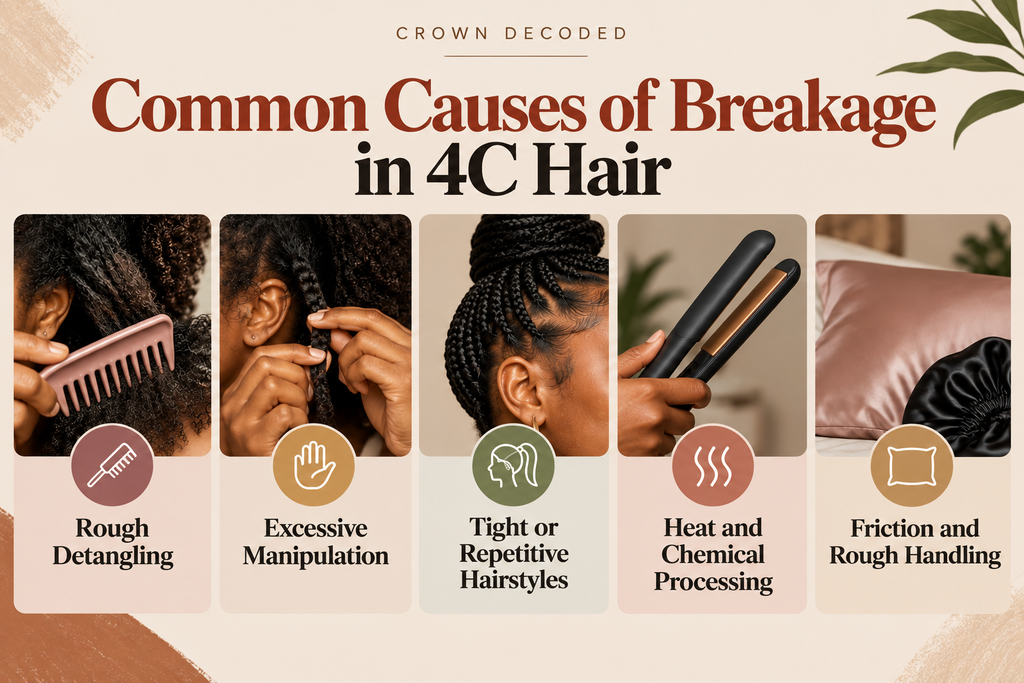
1. Rough detangling
Detangling can put significant mechanical stress on the hair, particularly when knots are forced apart or a comb is repeatedly pulled through resistance.
This is why technique matters.
Instead of trying to get through your entire head quickly, work in sections and give yourself enough time to deal with tangles gradually.
2. Excessive manipulation
Every time you comb, brush, restyle, pull, separate or otherwise manipulate your hair, you are handling the hair fibre.
That doesn’t mean you should avoid touching your hair altogether.
It means you want to avoid unnecessary handling.
If you are constantly restyling your hair because it won’t stay manageable, the better solution may be to rethink the routine or hairstyle rather than simply adding more products.
3. Tight or repetitive hairstyles
A hairstyle can look beautiful and still put too much stress on your hair.
Tight braids, cornrows, ponytails, buns and extensions can create repeated tension. Dermatologists warn that prolonged or repetitive pulling can contribute to traction alopecia, a form of hair loss caused by tension on the hair and scalp. AAD
And you don’t have to wait for obvious hair loss to take the style seriously.
Pain, stinging or significant discomfort are signs that something needs to change. AAD
4. Heat and chemical processing
Frequent heat styling and chemical processing can contribute to hair damage and fragility.
The American Academy of Dermatology recommends limiting excessive heat and taking care with practices such as chemical straightening, coloring and relaxing when trying to reduce hair damage. AAD
This doesn’t mean you can never straighten, blow-dry or chemically process your hair.
It means these processes should be approached thoughtfully, particularly if your hair is already showing signs of damage.
5. Friction and rough handling
Your hair doesn’t only experience stress on wash day.
Friction can happen during drying, sleeping, dressing, styling and everyday movement.
Repeated physical injury is recognized as an important contributor to hair-shaft fragility. DermNet®
Small changes in how you handle your hair can therefore add up over time.
How to Reduce Breakage in 4C Hair: 7 Practical Steps
You don’t need a 17-step routine.
Start here.
1. Detangle in sections
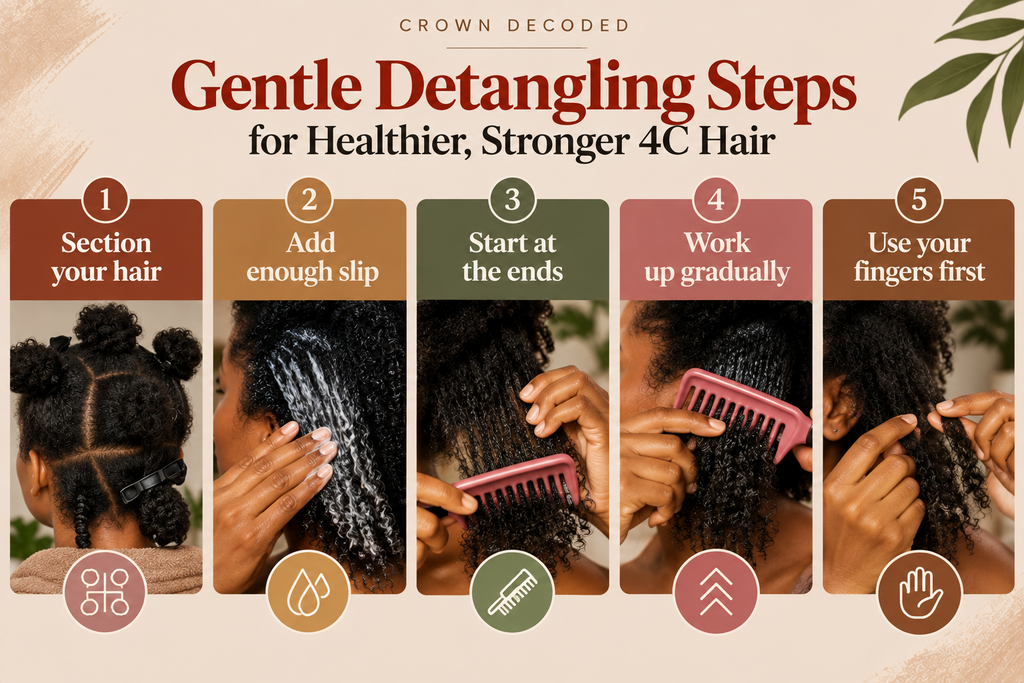
Trying to detangle your entire head at once can make the process unnecessarily difficult.
Divide your hair into manageable sections.
Then work through one section at a time.
If you encounter a stubborn knot, don’t keep pulling harder.
Pause.
Add more slip if needed, use your fingers to separate the area, and gradually work through the tangle.
This approach is consistent with the Crown Decoded routine framework: the goal isn’t to remove every knot as quickly as possible. It’s to make the process controlled and gentle.
For a more detailed walkthrough, read How to Detangle 4C Hair Without Breakage.
2. Give your hair enough slip before detangling
Conditioner or a suitable detangling product can make hair easier to handle.
The goal isn’t to find the most expensive detangler.
It’s to create enough slip that you can work through tangles without constantly fighting the hair.
The American Academy of Dermatology also recommends conditioning and using leave-in conditioner or detangler as part of practices that can help reduce breakage. AAD
Your hair should feel manageable enough that you’re not repeatedly forcing a tool through resistance.
3. Stop treating pain as part of the process
This one deserves its own section.
A hairstyle should not have to hurt in order to look neat.
If a new style causes:
- scalp pain
- stinging
- significant tightness
- tenderness
- excessive pulling around the hairline
- headaches or persistent discomfort
don’t simply assume you need to “get used to it.”
Tight hairstyles can contribute to traction-related hair loss, particularly when tension is repeated over time. AAD
If it hurts, rethink the style.
4. Reduce unnecessary manipulation between wash days
Your hair doesn’t need to be restyled every day.
If your current routine involves frequent combing, brushing, reshaping or redoing your style, look for ways to simplify it.
For example, you might:
- choose a style that lasts without constant adjustment
- refresh only when your hair actually needs it
- keep nighttime handling simple
- avoid repeatedly combing the same areas
- use your hands instead of a tool when appropriate
The goal isn’t zero manipulation.
The goal is less unnecessary manipulation.
5. Be gentler on wash day
Wash day can involve a surprising amount of handling.
Cleansing, detangling, conditioning, drying and styling can all create opportunities for unnecessary pulling.
A simpler approach is:
Cleanse → condition → detangle carefully → moisturize if needed → choose a manageable style.
When washing, focus cleanser primarily on the scalp rather than aggressively rubbing the lengths of your hair. The AAD recommends gentle washing practices and minimizing damaging handling. AAD
And when drying, avoid rough towel rubbing.
Your hair doesn’t need to be wrestled into submission.
6. Be thoughtful about heat
Heat styling isn’t automatically forbidden.
But repeated or excessive heat can damage the hair shaft and contribute to fragility. AAD
If you’re trying to reduce breakage, consider:
- reducing how often you use hot tools
- avoiding unnecessarily high temperatures
- minimizing repeated passes over the same section
- allowing hair to air-dry when practical
- being especially careful with already damaged hair
If your hair is breaking more after frequent heat styling, that’s useful information.
You may not need a new product.
You may need less heat.
7. Pay attention to patterns
This is one of the most useful things you can do.
Instead of simply thinking:
“My hair keeps breaking.”
Ask:
Where is it breaking?
When does it break?
What am I doing immediately beforehand?
For example:
| Where you notice breakage | Things worth examining |
|---|---|
| Hairline | Tight styles, repeated pulling, edge manipulation |
| Nape | Friction, tangling, collars, frequent manipulation |
| Ends | Detangling, dryness, friction, accumulated damage |
| Around a protective style | Installation tension, weight, takedown technique |
| Throughout the hair | General handling, heat, chemical processing or another underlying issue |
This isn’t a way to diagnose yourself.
It’s simply a way to spot patterns in your routine.
Does moisturizing prevent 4C hair breakage?
Moisture can be an important part of making hair more manageable, but moisture alone isn’t a complete breakage-prevention strategy.
Your hair can still experience mechanical damage from rough detangling, excessive tension, heat or repeated manipulation even if you moisturize regularly.
That’s why Crown Decoded’s approach is to think about the entire routine:
cleanse → condition → detangle → moisturize → protect
rather than treating one product as the solution to every hair problem.
And more product isn’t automatically more moisture.
If your hair feels manageable with a simple routine, there’s no prize for adding five more layers.
What about protein treatments?
Protein treatments are frequently recommended when people talk about breakage, but they don’t need to become an automatic part of everyone’s routine.
Hair-care products and treatments should be chosen based on what your hair actually needs and how it responds.
If you’re experiencing significant breakage, especially if the cause isn’t obvious, it is better to look at the whole picture rather than assuming you simply need “more protein.”
The evidence-backed fundamentals remain important: reduce damaging mechanical practices, use appropriate conditioning, and protect the hair from further stress.
Protective styling can help—but only when the style is actually protective
A protective style isn’t automatically protective because somebody calls it one.
Braids, twists, cornrows, wigs and updos can reduce daily manipulation, but installation, tension, weight and maintenance still matter.
A style that keeps your hands out of your hair but constantly pulls on your hairline isn’t solving the problem.
This is why low manipulation and low tension are more useful concepts than simply asking whether a particular hairstyle is “protective.”
The AAD specifically advises avoiding hairstyles that repeatedly pull on the hair and changing styles regularly to reduce ongoing stress. AAD
For more on this, see What Actually Makes a Protective Style Protective?
Breakage vs. shedding: they’re not the same thing
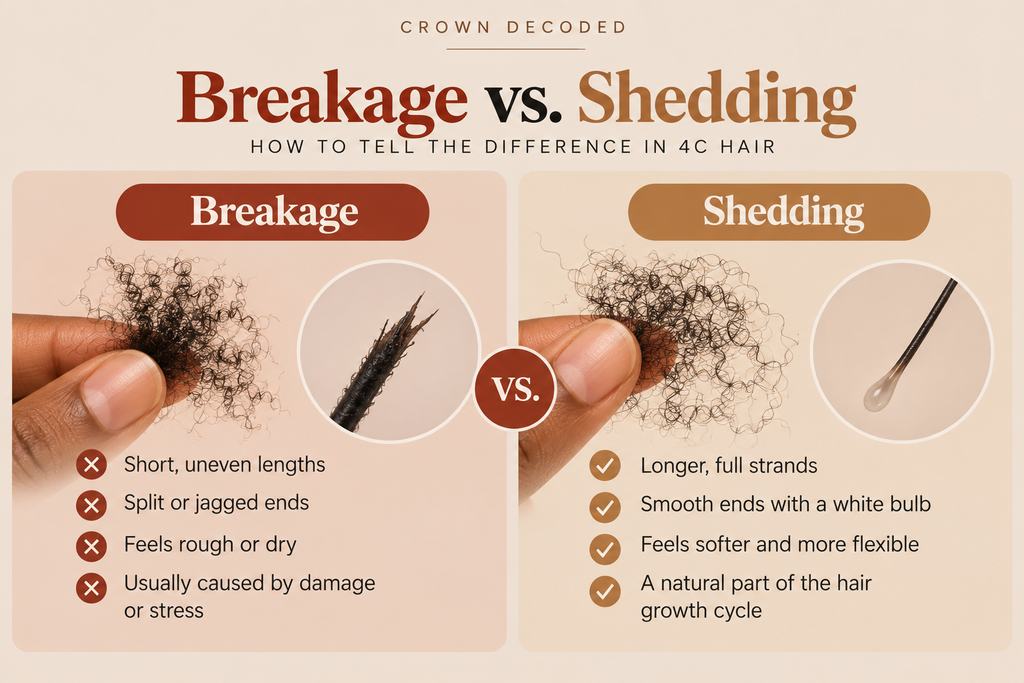
Seeing hair in your comb doesn’t automatically mean you’re experiencing breakage.
Hair naturally sheds as part of its growth cycle.
Breakage happens when the hair shaft snaps.
If you’re seeing a sudden or significant change in hair loss, noticeable thinning, bald patches, scalp symptoms or other changes that concern you, don’t assume it’s simply a hair-care problem.
Hair loss can have many causes, and a dermatologist or other qualified healthcare professional can help determine what’s happening. AAD
Crown Decoded’s 4C Hair Routine Guide makes the same distinction: a sudden or significant change in hair loss, scalp symptoms or hair condition is a reason to seek professional care.
A simple breakage-reduction checklist
Before changing your entire routine, run through this list:
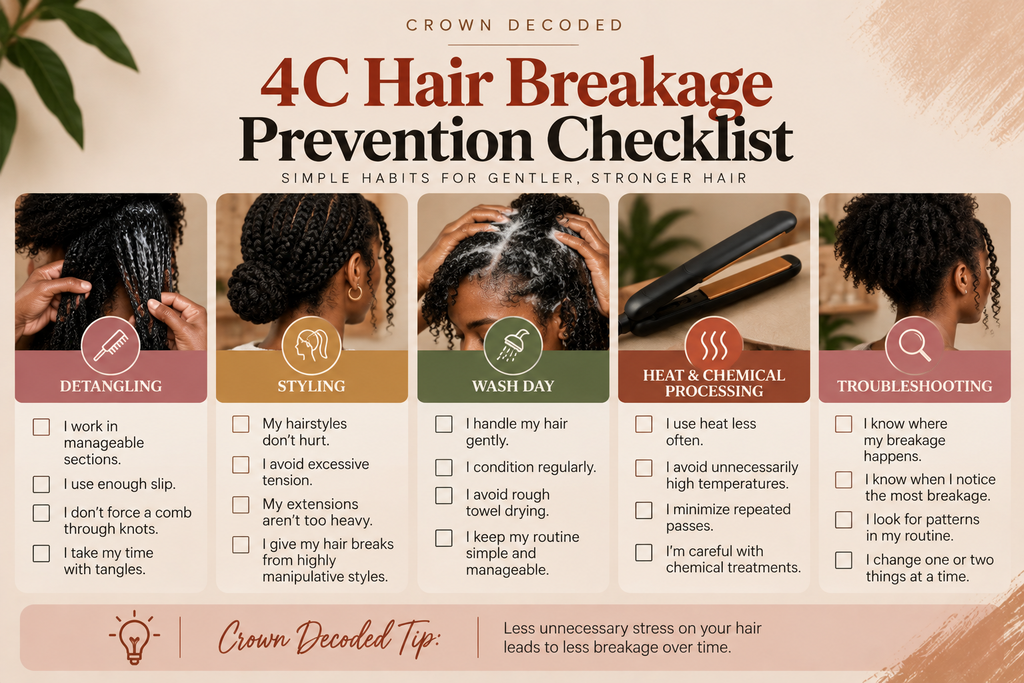
Detangling
- I work in manageable sections.
- I use enough slip.
- I don’t repeatedly force a comb through knots.
- I slow down when I encounter resistance.
Styling
- My hairstyles don’t consistently hurt.
- I’m not repeatedly pulling the same areas.
- My extensions or added hair aren’t unnecessarily heavy.
- I give my hair breaks from prolonged or highly manipulative styling.
Wash day
- I’m handling my hair gently.
- I’m conditioning regularly enough for my routine.
- I’m not aggressively rubbing or drying my hair.
- I’m not adding products simply because it’s wash day.
Heat and chemical processing
- I’m paying attention to how often I use heat.
- I’m avoiding unnecessary high temperatures.
- I’m noticing whether breakage increases after chemical or heat treatments.
Troubleshooting
- I know where my breakage is happening.
- I know when I notice the most breakage.
- I’m changing one or two things at a time.
The Crown Decoded check
If your hair is breaking, don’t immediately buy another product.
Ask:
What is my hair repeatedly being asked to tolerate?
Maybe you’re detangling too aggressively.
Maybe your style is too tight.
Maybe you’re manipulating your hair every morning.
Maybe heat has become a little too frequent.
Maybe your wash day has become a three-hour wrestling match.
Find the repeated source of stress first.
Then change that.
Your routine doesn’t need to be complicated. It needs to be manageable enough to repeat and gentle enough to support your hair over time.
Bottom line
Learning how to reduce breakage in 4C hair isn’t about finding one perfect product or following a complicated routine.
Start with the fundamentals:
gentler handling + better detangling + less unnecessary manipulation + lower tension + thoughtful heat use + a routine you can actually maintain.
And don’t try to change everything at once.
Choose one or two habits that may be contributing to the problem, change them consistently, and pay attention to what happens next.
That’s much more useful than constantly starting over.