Best Natural Hair Products for 4C Hair: What to Buy and How to Choose
Finding the best natural hair products for 4C hair can feel overwhelming. One person swears by a rich hair butter, another recommends layering three moisturizers, and someone else insists that you need a different product for every step of wash day.
But building a good routine doesn’t have to mean buying an entire shelf of products.
If you have 4C hair, the most useful products are the ones that help you cleanse your scalp, condition your strands, detangle with less pulling, manage dryness and create the styles you want. Which formulas work best for you will depend on your hair’s response, your styling habits and your budget.
The goal isn’t to find the thickest cream, the most expensive treatment or a product with the longest ingredient list. It’s to find a few products that perform their jobs well.
In this guide, we’ll look at the product categories worth considering, the ingredients that can help you make informed choices, and how to build a simple 4C hair product routine without unnecessary spending.
Table of Contents
What Are the Best Natural Hair Products for 4C Hair?
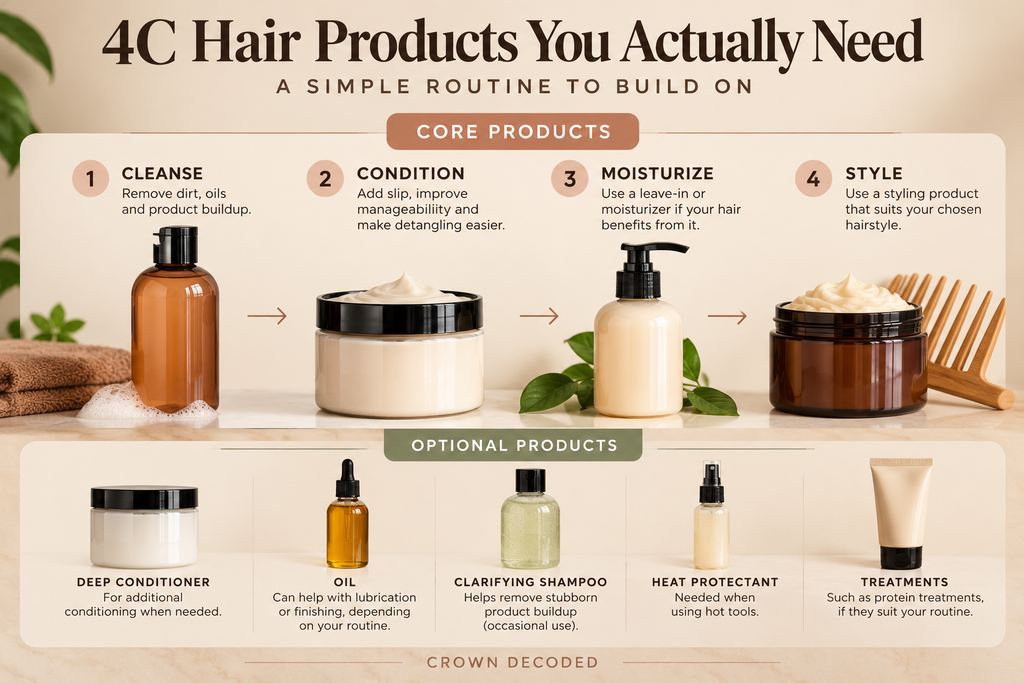
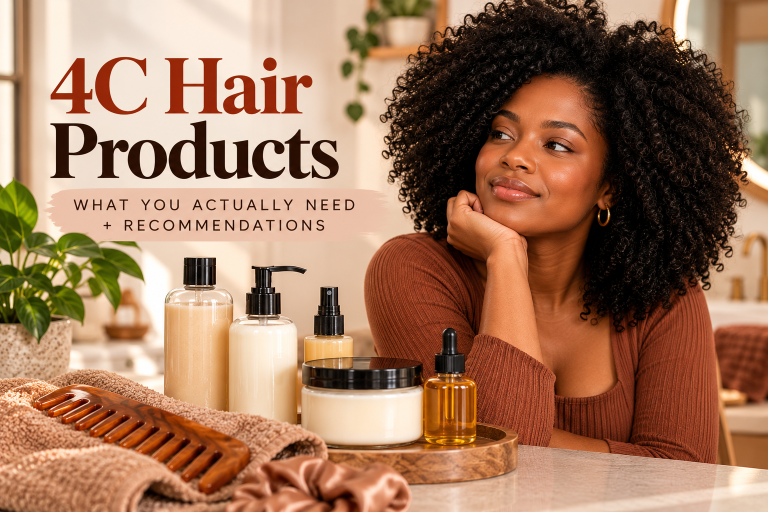
Most people can start with a cleanser, a rinse-out conditioner, a leave-in conditioner or moisturizer if needed, and a styling product suited to their preferred hairstyle. Other products can be added when they solve a specific problem.
You don’t automatically need a separate oil, butter, curl cream, styling milk, protein treatment and deep conditioner just because you have 4C hair.
Here’s a practical starting point.
| Product | Main purpose | Essential or optional? |
|---|---|---|
| Shampoo or cleanser | Cleans the scalp and hair | Core |
| Rinse-out conditioner | Conditions hair and improves manageability | Core |
| Leave-in conditioner or moisturizer | Provides additional conditioning and helps with manageability | Useful for many routines |
| Styling product | Helps create or hold your chosen style | Depends on your hairstyle |
| Deep conditioner or treatment mask | Provides additional conditioning | Optional |
| Oil | Can provide lubrication or help reduce friction, depending on use and formula | Optional |
| Clarifying shampoo | Helps remove stubborn product buildup | Occasional, as needed |
| Heat protectant | Helps reduce heat-related damage when using hot tools | Needed when heat styling |
The American Academy of Dermatology recommends conditioning Black hair and using appropriate heat-protective practices. Its guidance also emphasizes avoiding damaging tension and handling hair carefully. Read the AAD’s Black hair care advice.
That doesn’t mean everyone needs every product listed above. Your routine should reflect what you do with your hair and what your hair responds to.
The Crown Decoded rule: Start with the basics, identify what each product contributes, and add something new only when you have a reason.
What Makes a Product a Good Choice for 4C Hair?
A product isn’t automatically a good match because it says “for natural hair” or “for 4C hair” on the label.
Look beyond the marketing and consider the following.
1. It performs a clear job
Before buying anything, ask what you want it to do.
Do you need a cleanser because your scalp feels coated? A conditioner because detangling is difficult? A styler because your twist-out won’t hold? A leave-in because your hair feels harder to manage after washing?
Naming the problem makes it easier to choose the right product category.
2. It makes your hair easier to manage
Pay attention to how your hair feels during and after use.
A conditioner that helps you work through tangles gently may be more useful than a heavily marketed product that leaves your hair difficult to handle. A styler that gives you the hold you want without requiring constant restyling may also be a good fit.
Manageability matters because rough handling, repeated pulling and damaging styling practices can contribute to breakage.
3. Its weight suits your hair and hairstyle
Some people prefer rich creams and butters. Others find them too heavy or notice that their hair becomes coated when they layer several products.
Neither experience means that one person is caring for 4C hair correctly and the other isn’t.
Start with a modest amount, assess the result and adjust. You may need a richer formula for one style and a lighter one for another.
4. It fits your budget and routine
A product is not useful if you cannot afford to replace it or if using it makes wash day unnecessarily complicated.
You also don’t need to buy an entire matching product line. A shampoo from one brand and a conditioner from another may work perfectly well together if they suit your needs.
5. It doesn’t repeatedly cause discomfort or irritation
A product that consistently causes scalp itching, burning, redness or other irritation deserves a second look. Stop using a suspected irritant and seek professional advice if symptoms persist or are severe.
Hair and scalp reactions can have different causes, including allergic contact dermatitis. “Natural” ingredients can cause reactions too.
For more context, see this peer-reviewed review of hair-care practices and allergic contact dermatitis.
Best Product Types for 4C Hair
Rather than searching for one universal winner, choose the best type of product for the job you need done.
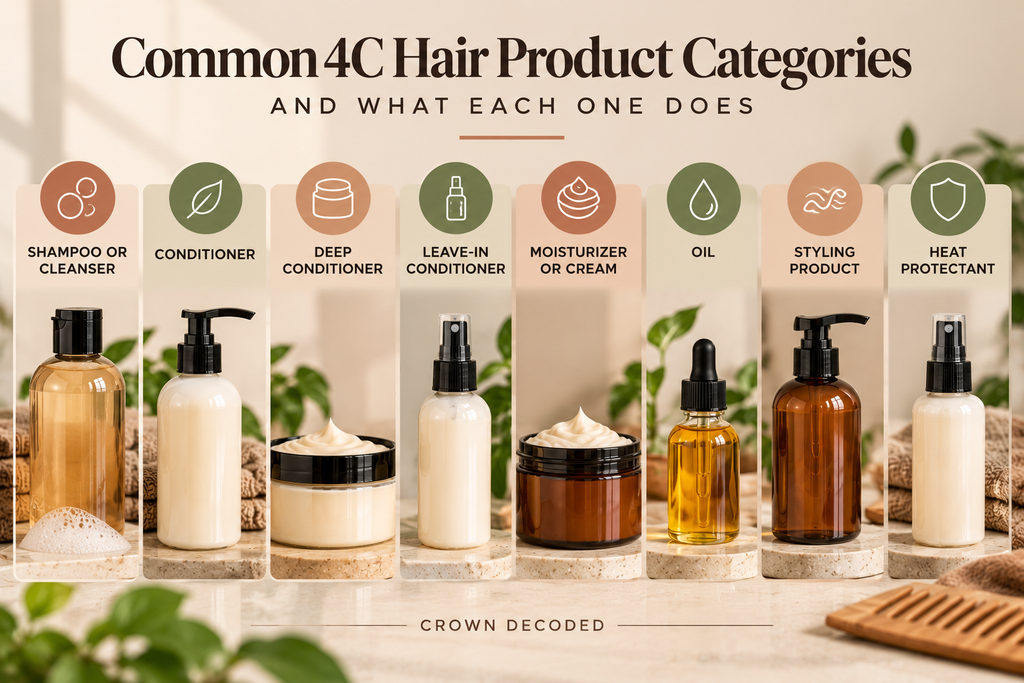
1. Best shampoo or cleanser for 4C hair
Look for a cleanser that removes dirt, sweat and product residue while leaving your scalp comfortable and your hair manageable.
A few things to consider:
- For regular washing: Choose a cleanser that leaves your scalp clean without making your hair unnecessarily difficult to handle.
- For frequent product buildup: Consider whether an occasional clarifying wash is appropriate.
- For a dry-feeling scalp or hair: Review how often you wash and how your current cleanser performs before assuming that you need an oil or heavier cream.
A sulfate-free shampoo may suit your preferences, but sulfate-free does not automatically mean that a product is better. Cleansing performance depends on the complete formula and how you use it.
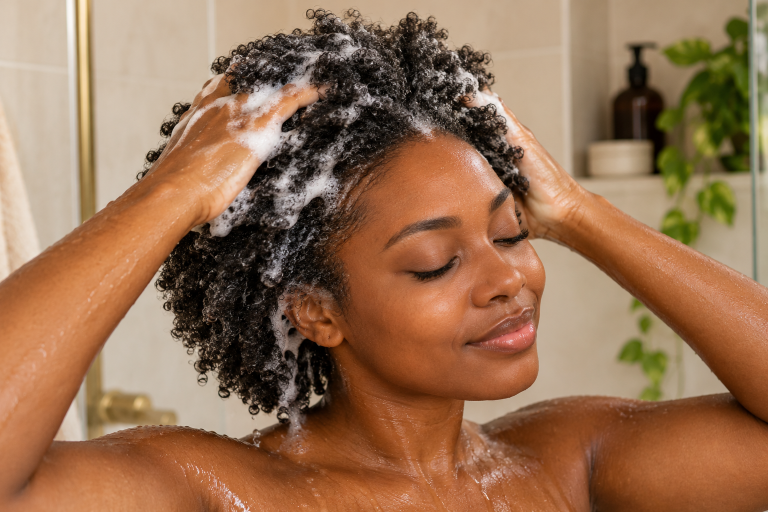
When washing, focus on gently cleansing the scalp rather than aggressively rubbing the lengths of your hair.
If you need help establishing a schedule, read our guide to building a 4C hair care routine.
2. Best conditioner for 4C hair
A good rinse-out conditioner is one of the most useful products to prioritize.
Look for a formula that leaves your hair easier to handle and helps you detangle without excessive pulling. Conditioning ingredients can improve the feel and manageability of hair, although results vary by formula and individual.
Pay particular attention to the ends, which have usually experienced more handling and environmental exposure than newly grown hair.
When using conditioner:
- Apply it according to the product directions.
- Give it the recommended time to work.
- Work through tangles gently, using your fingers or a suitable detangling tool.
- Add more slip or divide your hair into smaller sections if needed.
- Rinse according to the directions.
If detangling is your biggest challenge, our guide on how to detangle 4C hair without breakage explains the process in more detail.
3. Best deep conditioner for 4C hair
A deep conditioner or treatment mask can be useful when your usual conditioning step isn’t giving you the feel or manageability you want.
But deep conditioning doesn’t need to become a complicated ritual with several overlapping masks.
Choose a product designed for conditioning, follow its instructions and evaluate the result. If your regular conditioner already leaves your hair comfortable and manageable, you may not need an additional treatment every wash day.
Also, distinguish between conditioning masks and protein-focused treatments. They are not interchangeable in every situation, and not everyone needs a separate protein treatment on a fixed schedule.
4. Best leave-in conditioner for 4C hair
A leave-in conditioner is worth considering if your hair benefits from additional conditioning after washing.
The right formula may help your hair feel easier to manage, reduce friction during handling and support your styling routine.
When choosing one, consider:
- Whether you prefer a light lotion or a richer cream.
- Whether it spreads easily through your hair.
- Whether your hair feels manageable after application.
- Whether it leaves a heavy coating or unwanted residue.
- Whether it works with the styling product you use afterward.
Start with a modest amount and follow the label instructions. Adding more products isn’t automatically the answer if your hair still feels dry.
The American Academy of Dermatology’s hair-care guidance explains that leave-in conditioners and detanglers can help reduce friction-related problems such as breakage and split ends.
5. Best moisturizer or hair cream for 4C hair
Moisturizers, lotions and creams can help make hair more manageable, but they don’t all work the same way.
Some formulas are relatively light. Others contain richer oils, butters and conditioning agents that leave a more substantial coating.
The best choice depends on how your hair responds.
Consider a richer cream if lighter products don’t provide the feel or styling support you want. Consider a lighter product if rich layers repeatedly leave your hair coated or difficult to restyle.
Most importantly, don’t assume that every dry-feeling moment requires another layer of cream. Check whether your hair needs water, conditioning, cleansing or simply less manipulation before adding more product.
6. Best oil for 4C hair
Oils are popular in natural hair routines, but it’s helpful to understand their role.
Oil is not the same thing as water, and applying oil does not replace washing or conditioning.
Depending on the oil, formula and application, it may help lubricate the hair, reduce friction or contribute to the finish of a style. It may also be unnecessary if your other products already do what you need.
Coconut oil has some specific research behind it. A published study found that coconut oil reduced protein loss from hair under the tested conditions. That finding is useful, but it does not prove that coconut oil is the best choice for every person with 4C hair or that every oil has the same effect.
Read the coconut oil hair-damage study on PubMed.
If you want to try an oil:
- Start with a small amount.
- Consider whether you prefer using it before washing or as part of styling.
- Notice whether it improves manageability or leaves unwanted residue.
- Avoid treating it as a cure for breakage or a proven hair-growth treatment.
You do not need to use castor oil, coconut oil and several other oils together simply because they’re popular in natural hair care.
7. Best styling products for 4C hair
Your styling product should suit the hairstyle you’re trying to create.
For example:
- Twists and twist-outs: A cream or styling product that provides the finish and definition you prefer.
- Wash-and-go styles: A suitable gel or curl styler if you want definition and hold.
- Braids and other low-manipulation styles: A product that supports manageability without requiring excessive retouching.
- Sleek styles: A suitable styling product that provides the level of hold you want.
No product can guarantee a particular result on every head of hair. Technique, drying time, humidity, hair condition and the formula itself can all affect the outcome.
Choose styling products for their intended purpose. A gel that provides hold doesn’t necessarily replace a conditioner, and a rich butter isn’t automatically the best product for defining every style.
8. Best heat protectant for 4C hair
If you blow-dry, straighten or otherwise use hot tools, include a heat protectant appropriate for your styling method.
Follow its instructions, use a suitable heat setting and avoid repeatedly applying excessive heat. A heat protectant should not be treated as permission to use unlimited temperatures or frequent heat styling.
The American Academy of Dermatology’s Black hair guidance recommends using heat protection and being careful with thermal styling.
If you rarely or never use hot tools, this may not be a product you need to purchase right now.
Ingredients Worth Knowing
Ingredient lists can help you understand what a product is designed to do. They are not a simple scorecard that tells you whether a product is good or bad.
A dermatology review of hair-care products used by women of African descent discusses the benefits and drawbacks of commonly used ingredients, including surfactants, silicones, oils and parabens. Its central lesson is worth remembering: ingredients should be evaluated in context, not divided automatically into “good” and “bad” groups.
Read the review in Cutis via PubMed.
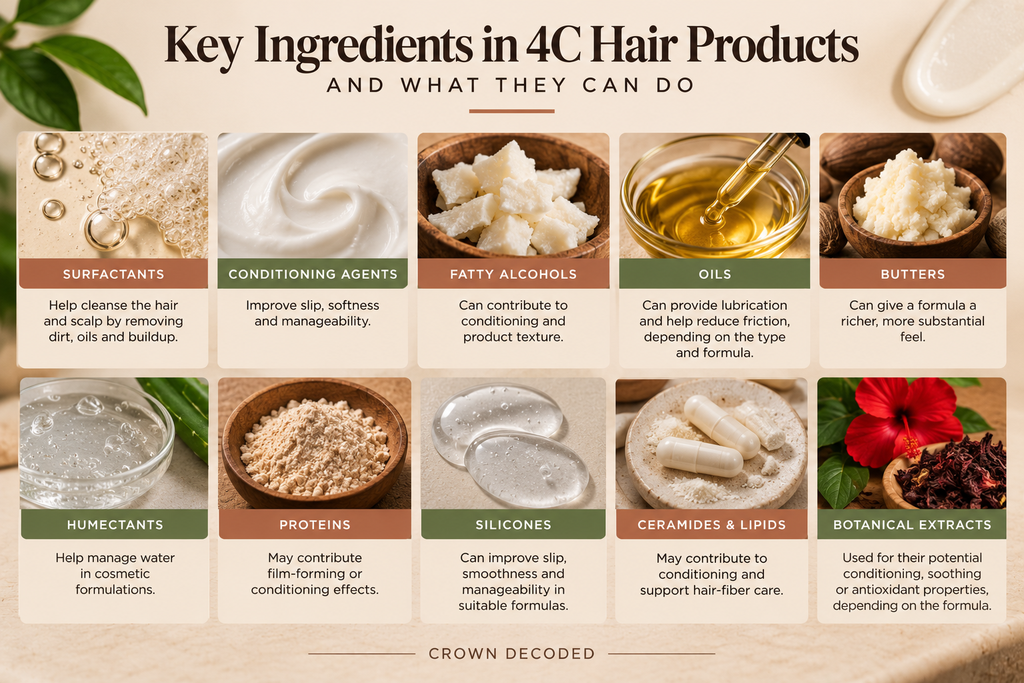
Here are some useful categories to recognize.
| Ingredient or category | Why it may be included |
|---|---|
| Surfactants | Help cleanse hair and scalp |
| Conditioning agents | Improve slip, feel and manageability |
| Fatty alcohols | Can contribute to conditioning and product texture |
| Oils | Can provide lubrication or contribute to conditioning and finish |
| Butters | Can give a formula a richer, more substantial feel |
| Humectants | Help manage water in cosmetic formulations |
| Proteins and protein derivatives | May contribute film-forming or conditioning effects |
| Silicones | Can improve slip, smoothness and manageability in suitable formulas |
| Ceramides and other lipids | May contribute to conditioning and hair-fiber care |
These descriptions are general functions, not guarantees. An ingredient’s effect depends on the overall formula, concentration, application and individual response.
Are sulfates bad for 4C hair?
Not automatically.
Some people prefer sulfate-free products, especially when they find a particular cleanser too harsh for their routine. But the absence of sulfates alone doesn’t tell you how well a shampoo cleanses or how comfortable your hair and scalp will feel afterward.
Choose based on performance and your own needs rather than a blanket rule.
Are silicones bad for natural hair?
Not automatically.
Some silicones can improve slip and reduce friction, which may be useful when handling hair. Depending on the formula and how products accumulate, you may need to adjust your cleansing routine.
If a product leaves your hair feeling coated, review the amount you use and the products you’re layering before deciding that an entire ingredient category is the problem.
Is mineral oil bad for 4C hair?
Not simply because it is mineral oil.
Ingredients have different properties, and their usefulness depends on the formulation and purpose. The dermatology review above discusses mineral oil alongside other commonly used hair-care ingredients and cautions against treating ingredients as universally good or bad.
If you prefer to avoid mineral oil for personal reasons, you can choose another formula. You don’t need to assume that its presence automatically makes a product unsuitable.
Are natural ingredients always better?
No.
“Natural,” “plant-based,” “organic” and “clean” are not interchangeable terms, and none of them alone proves that a product is safer or more effective for your hair.
Plant-derived ingredients can still irritate some people. Synthetic ingredients can have useful cosmetic functions. What matters is the complete formulation, your preferences and how the product performs for you.
You can choose products based on ingredient preferences without assuming that everything natural is beneficial or everything synthetic is harmful.
How to Choose Products Based on Your Hair’s Needs
Instead of shopping for every product category at once, start with the problem you want to solve.
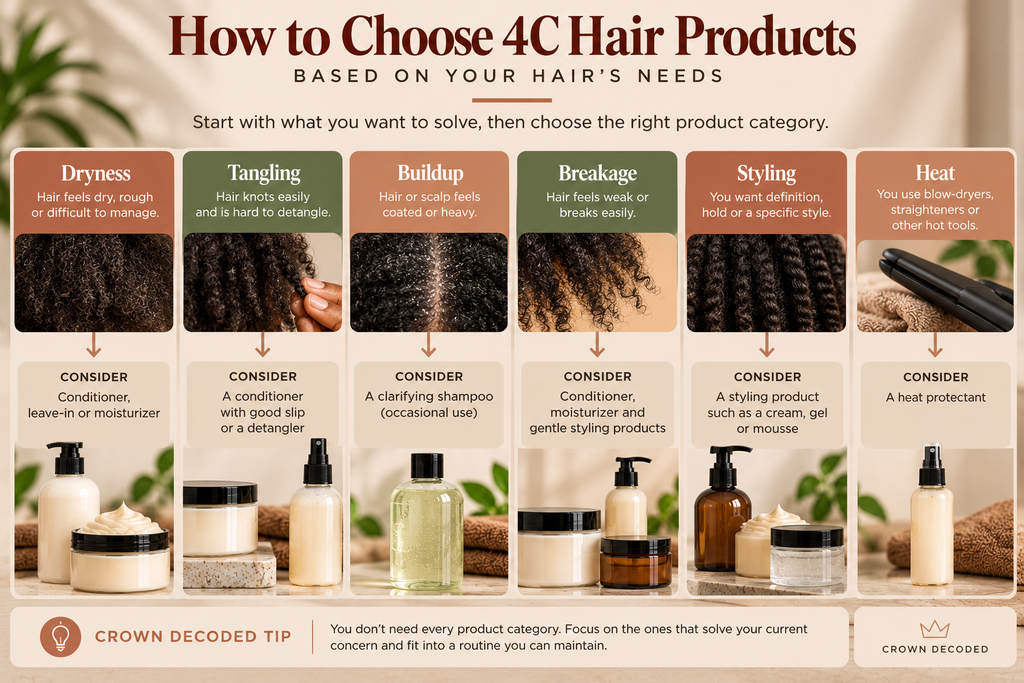
If your biggest concern is dryness
Review your cleansing and conditioning routine first.
Consider whether your cleanser leaves your hair unnecessarily difficult to manage, whether your conditioner provides enough slip and whether a leave-in or moisturizer helps after washing.
You may benefit from a richer product, but don’t assume that adding several oils and creams will automatically solve the problem.
If detangling is difficult
Prioritize a conditioner or detangler that helps your hair move more easily as you work through knots.
Detangle in manageable sections, start at the ends and work upward gradually. Slow down when you encounter resistance instead of repeatedly forcing a comb through a knot.
See our full guide to detangling 4C hair without breakage.
If your hair feels heavy or coated
Before buying a lighter product, look at your complete routine.
Are you layering a leave-in, cream, oil and butter every wash day? Are you using more product than you need? Could buildup be contributing to the feeling?
Simplify the routine and cleanse appropriately. Then reintroduce products selectively if necessary.
If you’re concerned about breakage
Products can support conditioning and manageability, but breakage prevention also depends on how you handle and style your hair.
Prioritize:
- Conditioner that provides useful slip.
- Gentle detangling.
- Less repeated manipulation.
- Styles that do not cause persistent pain or excessive tension.
- Careful heat use, if applicable.
The AAD recommends gentle hair care and avoiding tight hairstyles that repeatedly pull on the hair. If you’re experiencing ongoing breakage, thinning or changes in your scalp, consider seeking advice from a qualified dermatologist.
For more practical steps, read how to reduce breakage in 4C hair.
If your products aren’t cleansing effectively
If your scalp or hair feels persistently coated, consider whether your cleansing routine is adequate for the products you use.
An occasional clarifying product may be useful for some routines, but the need and frequency vary. Follow the product directions and avoid using a stronger cleanser more often than your hair and scalp tolerate.
Persistent itching, flaking, soreness or other scalp symptoms may need professional assessment rather than another product.
If you use heat
Choose an appropriate heat protectant and pay attention to your technique, temperature and frequency of use.
If you don’t use heat, you can leave this category off your shopping list.
A Simple 4C Hair Product Routine
You don’t need to own every product discussed in this article. Use this framework to build a routine around the products you actually need.
The minimalist routine
1. Cleanse. Use a shampoo or cleanser that suits your scalp and hair.
2. Condition. Use a rinse-out conditioner to improve manageability and support gentle detangling.
3. Add a leave-in or moisturizer if useful. Choose one that helps your hair feel and behave the way you want.
4. Style. Use a product suited to your chosen hairstyle, if needed.
That’s a reasonable starting point. You can adjust the products and order of application according to their directions and how your hair responds.
The expanded routine
Add other products only when there’s a clear reason:
- A deep conditioner if you want additional conditioning.
- A clarifying shampoo if buildup needs attention.
- An oil if you find it useful for lubrication or finishing.
- A treatment product for a specific, appropriate purpose.
- A heat protectant when using hot tools.
Your routine may be different from someone else’s and still work well.
For a complete step-by-step framework, read How to Build a 4C Hair Care Routine That Actually Works.
How to Tell If a Product Isn’t Working
Don’t judge a product solely by its popularity, texture or first impression. Pay attention to how it performs in your routine.
Possible signs that you need to reassess a product or how you’re using it include:
- Your hair repeatedly becomes more difficult to detangle.
- It leaves an unwanted heavy or coated feeling.
- It doesn’t provide the styling result you expected.
- You notice persistent residue or buildup.
- Your scalp becomes irritated after use.
- You have to add several other products to compensate for it.
These signs don’t always mean the product itself is unsuitable. The amount, application method, combination of products and cleansing routine may also matter.
Try changing one variable at a time. If you replace five products simultaneously, it becomes much harder to identify what helped or caused a problem.
Stop using a product that appears to cause irritation. Persistent scalp symptoms, sudden changes in shedding or noticeable thinning warrant advice from a qualified healthcare professional.
Do You Need Expensive Products for 4C Hair?
No. A higher price does not guarantee a better result for your hair.
A reasonably priced cleanser and conditioner that you use consistently may serve you better than a premium product that doesn’t suit your routine.
When comparing products, consider:
- The amount of product you receive.
- Whether it performs the job you need.
- Whether it suits your hair and scalp.
- Whether you’ll use it regularly.
- Whether it fits your budget.
- Whether you already own something that performs the same function.
If you’re starting from scratch, buy the essentials first. You can test additional products later rather than investing in a complete collection before you know what you need.
Common 4C Hair Product-Buying Mistakes
Buying products because they’re trending
A popular product may work well for one person and poorly for another. Look for a clear reason to try it rather than assuming popularity guarantees results.
Buying an entire product line at once
You may discover that you like one product but not the others. Start with the category you need most and build from there.
Assuming thicker products are always better
Rich creams and butters can suit some routines, but more product doesn’t automatically mean more moisture or better manageability.
Treating oil as a substitute for conditioning
Oil and conditioner do different jobs. If your hair needs better conditioning or detangling, adding oil alone may not address the issue.
Choosing products solely because they’re labelled natural
Use ingredient preferences as one factor, not as proof of effectiveness or safety.
Changing everything at once
If you change several products and techniques together, it becomes difficult to work out what made a difference. Make adjustments gradually.
Expecting a hair product to guarantee growth
A cosmetic product may improve manageability or help reduce some forms of damage, but that is not the same as proving that it makes hair grow faster. Be cautious about growth promises, particularly when the evidence is unclear.
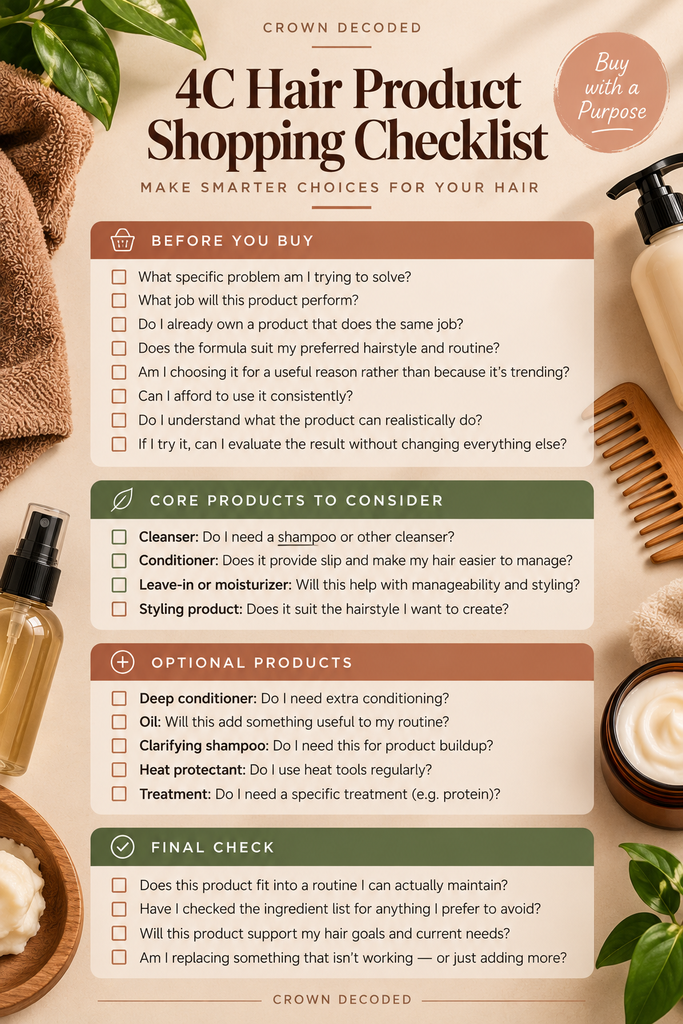
4C Hair Product Shopping Checklist
Before adding something to your basket, ask yourself:
- What specific problem am I trying to solve?
- What job will this product perform?
- Do I already own a product that does the same job?
- Does the formula suit my preferred hairstyle and routine?
- Am I comfortable with how it feels and performs?
- Can I afford to use it consistently?
- Am I choosing it for a useful reason rather than because it’s trending?
- Do I understand what the product can realistically do?
- If I try it, can I evaluate the result without changing everything else?
You can also keep a simple record of what you use and how your hair responds. This makes it easier to spot patterns in manageability, buildup, tangling and styling.
The Crown Decoded Check: Does Every Product Have a Job?
Before buying another product, look at your current routine.
Cleanse: Does your cleanser leave your scalp comfortable and your hair manageable?
Condition: Does your conditioner help you handle your hair gently?
Moisturize: Does your leave-in or moisturizer contribute something useful, or are you layering products out of habit?
Style: Does your styling product suit the look you want and the amount of maintenance you’re willing to do?
Protect: Are your styling and handling habits helping you avoid unnecessary tension and repeated manipulation?
If a product doesn’t have a clear job, you may not need it.
The aim is not to own the fewest products possible at all costs. It’s to have a routine that works without unnecessary steps, repeated spending or constant troubleshooting.
Bottom Line
The best natural hair products for 4C hair are the ones that meet your needs, work with your preferred styles and fit into a routine you can maintain.
Start with a suitable cleanser and conditioner. Add a leave-in or moisturizer if it helps, then choose styling products based on what you want your hair to do. Treat oils, deep conditioners and other treatments as options rather than automatic requirements.
Look beyond the words “natural,” “moisturizing” and “for 4C hair.” Consider what the formula is designed to do, how your hair responds and whether the product genuinely makes your routine easier.
You don’t need a bigger product collection. You need a clearer reason for every product you use.
For your next step, read our guide to building a 4C hair care routine that actually works and create a routine around the products that earn their place.