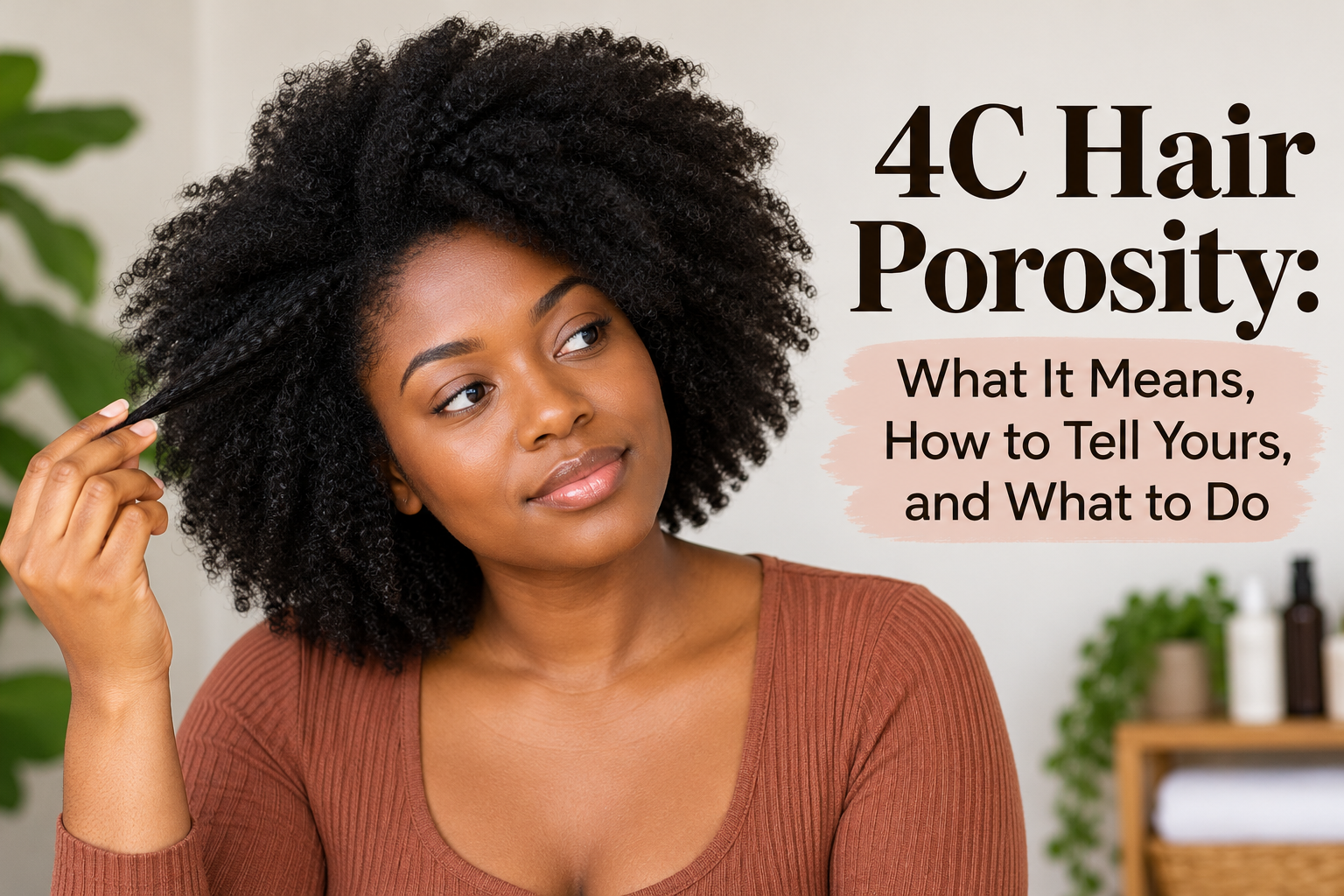
4C Hair Porosity: What It Means, How to Tell Yours, and What to Do
If your 4C hair seems to take forever to get wet, feels dry shortly after moisturizing, or responds differently to products than you expected, you may have come across the term hair porosity.
Porosity is often discussed in natural hair care as the missing piece of a good routine. You might hear that low-porosity hair needs lightweight products, high-porosity hair needs heavy creams, or that a simple glass-of-water test can tell you exactly what your hair needs.
But hair care is rarely that straightforward.
Your 4C hair is not automatically low, medium, or high porosity because of its curl pattern. Understanding porosity can help you make better decisions about your routine, but it is only one part of the picture.
In this guide, we’ll explain what hair porosity means, how to recognize patterns in your own hair, what the popular float test can and cannot tell you, and how to use what you learn without buying an entirely new shelf of products.
Table of Contents
- What Is Hair Porosity?
- The Three Common Hair Porosity Categories
- How to Tell Your 4C Hair Porosity
- What Porosity Means for Your 4C Hair Routine
- Can Hair Porosity Change?
- Common 4C Hair Porosity Mistakes
- A Simple 4C Hair Porosity Checklist
- How Porosity Fits Into Your Overall 4C Hair Routine
- When Your Hair Problem May Not Be About Porosity
- Frequently Asked Questions
- The Bottom Line
What Is Hair Porosity?
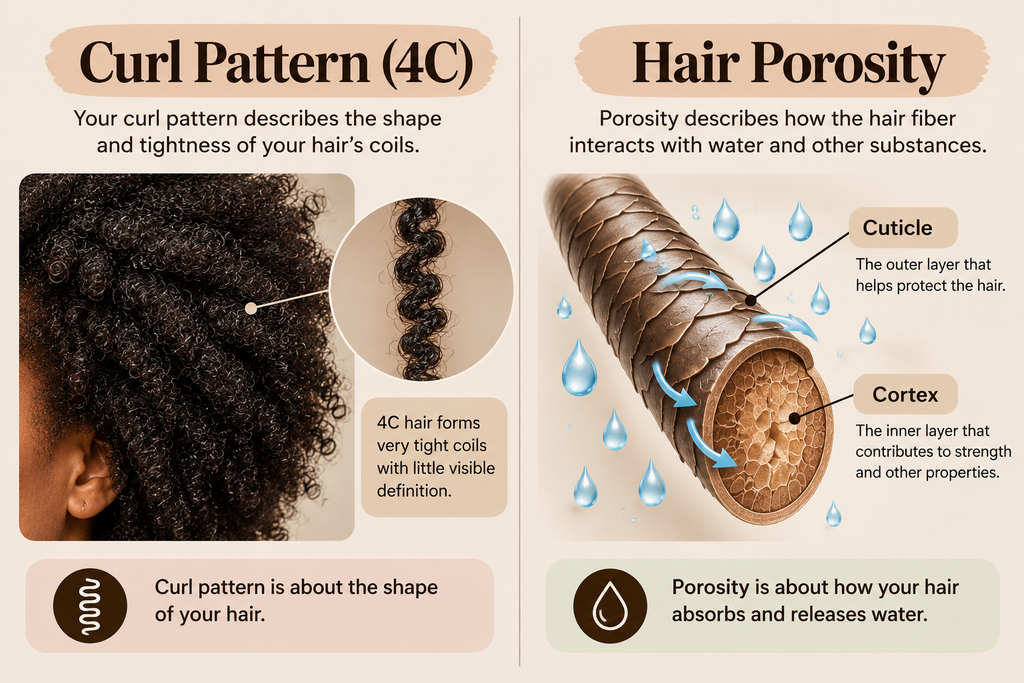
Hair porosity describes how readily hair absorbs and releases water. It is related to the structure and condition of the hair fiber, including its cuticle and the changes that occur as hair is exposed to chemical treatments, heat, weathering, and everyday handling.
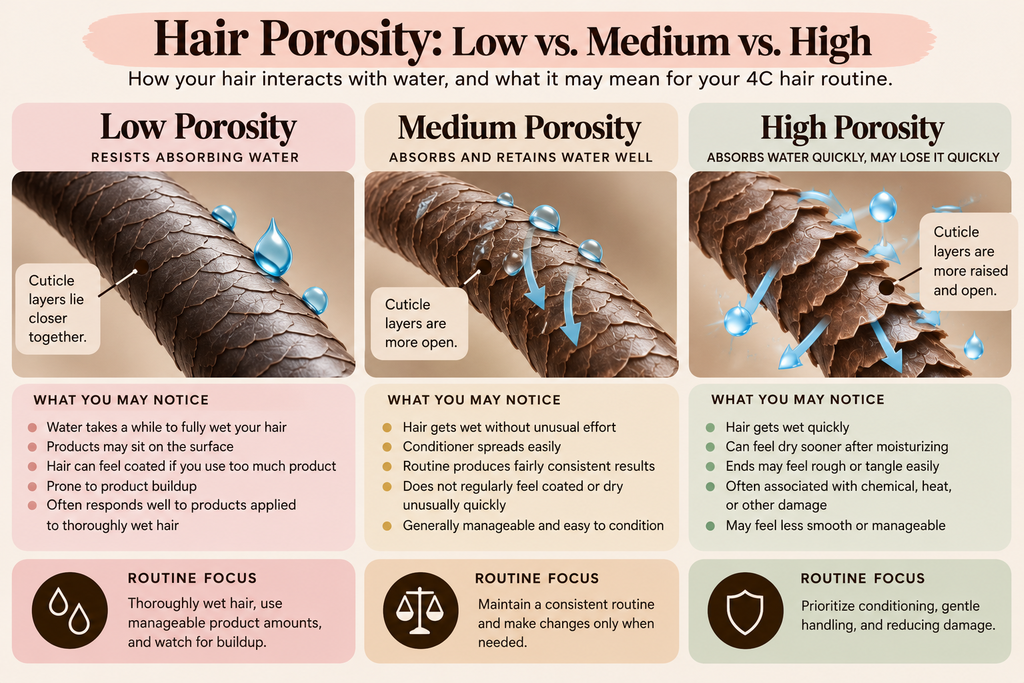
You will usually see hair porosity discussed in three broad categories:
- Low porosity: Hair may be slower to become thoroughly wet, and some products may seem to sit on the surface.
- Medium porosity: Hair may wet and condition without presenting the same recurring difficulties associated with the other categories.
- High porosity: Hair may absorb water readily but can also lose moisture quickly, particularly when the hair fiber is damaged.
These categories can be useful starting points, but they are simplified descriptions. Hair does not always fit neatly into one category, and the way your hair behaves is influenced by more than porosity alone.
For example, if your hair feels dry shortly after applying a moisturizer, that does not automatically mean you have high-porosity hair. The product itself, how you apply it, buildup, the condition of your ends, and how you handle your hair can all influence the result.
Similarly, hair that takes a while to become fully wet is not automatically low porosity. Your hair’s density, the way it is sectioned, and how thoroughly water reaches the strands can affect your wash-day experience.
Is 4C hair naturally low porosity?
No. The 4C label describes a curl pattern, not a porosity category.
Two people with 4C hair can have very different experiences with water, conditioners, oils, and styling products. Even one person’s hair may behave differently in different areas, particularly if some sections have experienced more heat or chemical processing than others.
Instead of choosing products based on what you have heard about 4C hair in general, start by observing what your own hair does.
That is a more useful foundation for building a routine.
The Three Common Hair Porosity Categories
Let’s look at what the three categories generally mean and how you might use them as practical guides.
1. Low-porosity hair
Low-porosity hair is commonly described as hair that resists becoming thoroughly wet or seems to have difficulty taking in certain products.
You might notice that:
- Water takes a while to spread through your hair.
- Some conditioners or creams appear to remain on the surface.
- Your hair feels coated when you layer several products.
- Product buildup becomes noticeable when you use too much of a heavy formula.
- Your hair responds better when you apply products to thoroughly damp hair and distribute them carefully.
These observations can suggest that your routine needs adjustment, but they do not confirm low porosity on their own.
What may help: Start with a manageable amount of conditioner or moisturizer, work in sections, and make sure your hair is adequately wet before applying products. If your hair feels coated, consider whether you need a more thorough wash rather than another layer of moisturizer.
You do not need to avoid every rich product. The best formula depends on how your hair responds, how much you use, and what you want the product to do.
2. Medium-porosity hair
Medium porosity is often described as hair that absorbs water and responds to conditioning without consistently showing the difficulties associated with low or high porosity.
You might notice that:
- Your hair becomes wet without unusual effort.
- Conditioner spreads through your sections reasonably well.
- Your routine produces fairly consistent results.
- Your hair does not regularly feel coated or become dry unusually quickly under similar conditions.
This category is sometimes treated as the ideal, but there is no need to chase a particular porosity label.
If your hair is comfortable, manageable, and retaining length well, you do not need to change your routine simply because you suspect your hair belongs to a different category.
What may help: Keep using a routine that cleanses your scalp, conditions your hair, supports gentle detangling, and fits your lifestyle. Adjust individual products when you notice a recurring problem rather than changing everything at once.
3. High-porosity hair
High-porosity hair is commonly described as hair that takes in water readily and may lose water readily, too. Damage to the hair fiber can contribute to increased porosity.
You might notice that:
- Your hair becomes wet quickly.
- Your hair feels dry sooner than you would like after washing or moisturizing.
- Your ends feel rough or tangle easily.
- Your hair has been exposed to substantial bleaching, chemical processing, or repeated heat.
- Your hair feels less smooth or manageable than it used to.
These signs are not exclusive to high-porosity hair. Rough ends, tangling, and dryness can have several causes, including friction, product buildup, split ends, and the condition of the hair fiber.
What may help: Focus on consistent conditioning, gentle handling, reducing unnecessary friction, and limiting damaging treatments. A leave-in conditioner may help with manageability, while a cream or another styling product may help your hair feel softer for longer.
You do not have to use the heaviest butter or oil you can find. A product that leaves your hair greasy or coated without improving manageability is not doing you any favors.
A quick comparison
| Category | What you may notice | A practical starting point |
|---|---|---|
| Low porosity | Water or products seem slow to spread through the hair | Work on thoroughly wet hair, use manageable product amounts, and watch for buildup |
| Medium porosity | Water and conditioner distribute without recurring difficulty | Maintain a consistent routine and make changes only when needed |
| High porosity | Hair may wet quickly and feel dry or rough sooner | Prioritize conditioning, gentle handling, and reducing damage |
Treat this table as a general guide, not a diagnostic test. Your observations matter more than fitting yourself perfectly into a category.
How to Tell Your 4C Hair Porosity
There is no need to rush out and buy a porosity test kit. Start by paying attention to how your hair behaves during your normal wash-day routine.
The most useful approach is to look for patterns across several wash days instead of drawing conclusions from one observation.
1. Notice how your hair gets wet
During your next wash, pay attention to how water moves through your hair.
Does it spread through each section reasonably easily, or do you repeatedly have to work to get the hair thoroughly wet?
Make sure you are giving water access to the hair itself. Dense hair can take time to wet thoroughly, particularly when it is not separated into manageable sections.
If water seems to bead on the surface, consider whether your hair has product buildup or whether you are rinsing it thoroughly. Do not assume that this observation alone proves you have low porosity.
2. Pay attention to how conditioner spreads
Notice how your usual conditioner behaves on clean, wet hair.
Does it spread easily when you work in small sections? Do you need to add a little water to distribute it? Does your hair feel coated even after you rinse?
These details can help you identify whether you are using too much product, applying it under the wrong conditions, or dealing with buildup.
They may also contribute to your understanding of porosity, but they cannot establish a precise porosity category by themselves.
3. Observe how your hair feels after washing
Once you have rinsed your conditioner, notice how your hair feels.
Is it reasonably soft and manageable? Does it feel rough, tangled, or unusually coated? Are the ends behaving differently from the roots?
Try to separate the condition of your hair from the condition of your scalp. A scalp that feels oily or has product residue does not necessarily tell you your hair’s porosity.
Also, remember that wet hair and dry hair behave differently. Hair that feels slippery under conditioner may not feel the same after rinsing and drying.
4. Track how long your hair stays manageable
After washing and styling, notice how your hair feels over the following days.
Does it remain manageable until your next planned wash? Does it become coated after repeated product application? Do the ends become tangled or rough even when the rest of your hair feels fine?
These observations help you evaluate your overall routine, not just porosity.
For example, hair that feels dry on day two might need a different application method, a better-fitting leave-in, less friction, or a change in wash-day practices. Adding more oil may not solve the underlying problem.
5. Consider your hair’s history
Think about whether your hair has been bleached, chemically straightened, repeatedly exposed to high heat, or subjected to practices that cause significant friction or breakage.
These factors can affect the condition and structure of the hair fiber. Hair that has experienced damage may behave differently from less-damaged new growth.
Your hair’s history can provide helpful context, but you do not need to label all your hair high porosity just because you have used heat or chemicals in the past.
What about the glass-of-water hair porosity test?
The float test is popular in natural hair communities. It usually involves placing a loose strand of hair in a glass of water and observing whether it floats, remains suspended, or sinks.
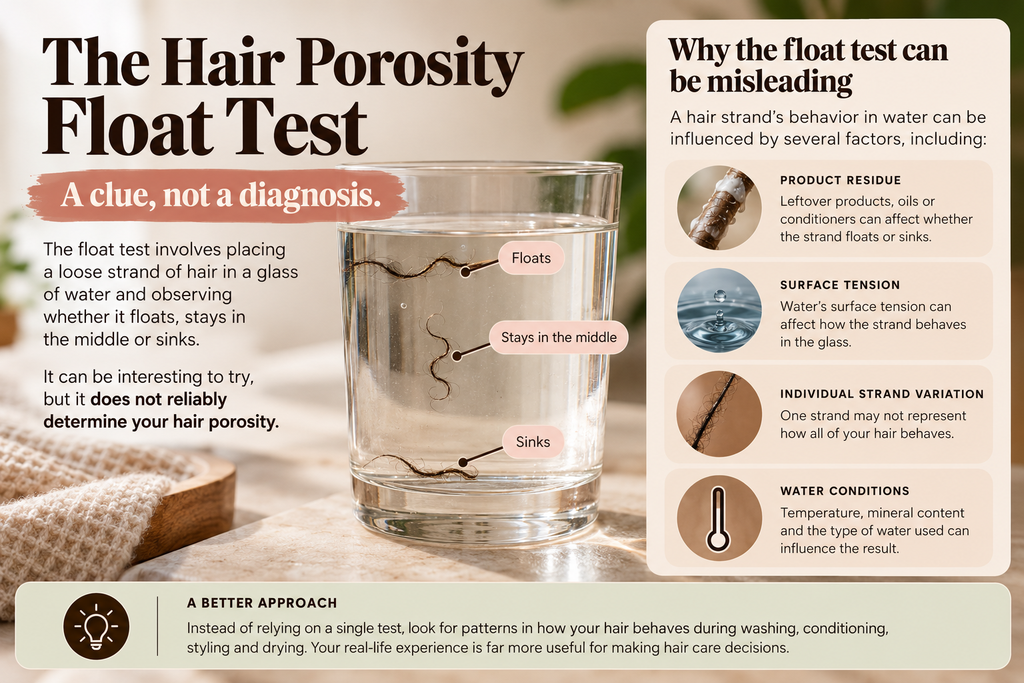
The usual interpretation is that floating hair is low porosity and sinking hair is high porosity.
The problem is that a strand’s behavior in a glass of water is not a reliable standalone way to determine your hair’s porosity.
The result can be influenced by factors such as residue on the strand, how the test is performed, and the conditions of the water. A single strand also may not represent the behavior of all your hair.
You can try the test out of curiosity, but do not use its result as the sole reason to replace your products or rebuild your routine.
Repeated observations during washing, conditioning, and styling are more useful for making everyday hair care decisions.
What Porosity Means for Your 4C Hair Routine
Understanding porosity is most useful when it helps you make a practical adjustment.
It should not become another set of rigid rules about what you are allowed to use on your hair.
If your hair seems slow to get wet
Try these steps:
- Divide your hair into manageable sections before washing.
- Give each section enough water to become thoroughly wet.
- Use your fingertips to help water reach the hair rather than rushing through the wash.
- Cleanse your scalp and hair appropriately to remove excess product and residue.
- Apply conditioner to wet hair and distribute it carefully.
If your hair repeatedly feels coated, review how much product you are using and whether your cleansing routine is adequate.
You may find that changing your technique makes more difference than buying a product marketed specifically for low-porosity hair.
If your hair feels dry soon after moisturizing
First, consider what you mean by dry.
Does your hair feel rough? Is it stiff or tangled? Does it feel coated but not soft? Or is your scalp itchy or uncomfortable?
Those are different experiences and may need different solutions.
You can start by:
- Applying your leave-in or moisturizer to clean, damp hair as directed.
- Using enough product to distribute it through your sections without automatically layering more.
- Choosing a conditioner or leave-in that improves softness and manageability.
- Reducing friction from rough fabrics, tight styles, and unnecessary manipulation.
- Reviewing how often you cleanse and whether product buildup is affecting your hair.
If your hair feels coated, adding another layer of product may make the problem worse.
And if your ends remain rough or keep tangling, they may need extra attention. Product application alone cannot repair every form of existing hair-fiber damage.
If your hair seems to absorb water quickly
You do not need to prevent your hair from absorbing water. Water is a normal part of washing and conditioning.
Instead, focus on how your hair feels after washing and styling.
A consistent conditioner and, where useful, a leave-in product may improve softness and manageability. You can also reduce practices that contribute to damage, such as excessive heat, harsh chemical processing, and rough detangling.
If your hair has experienced chemical or heat damage, improving your routine may help reduce additional damage, but it will not restore a severely damaged strand to its original structure.
Do you need different oils for different porosity levels?
Not necessarily.
Oils can serve different purposes in a routine, including helping to reduce friction or supporting the feel of a finished style. However, an oil does not replace water or a rinse-out conditioner, and using more oil is not a guaranteed solution to persistent dryness.
If an oil makes your hair feel softer or helps with styling, it may be useful. If it leaves your hair coated or difficult to cleanse, you may need to use less or choose a different product.
Judge products by what they actually do for your hair, not only by the porosity category printed in a social media recommendation.
Do you need heat to moisturize low-porosity hair?
You do not automatically need heat because you have 4C hair or suspect you have low porosity.
Follow the instructions for your conditioner or treatment. If a product is designed to be used with gentle heat, follow the manufacturer’s directions and use equipment safely.
Avoid excessive heat, particularly if your hair is already fragile or has experienced chemical processing. More heat is not always better, and it should not become a requirement for every wash day.
The aim is to find a routine that leaves your hair clean, conditioned, manageable, and comfortable without adding unnecessary steps.
Can Hair Porosity Change?
Hair porosity can be affected by changes to the hair fiber.
Chemical processing, bleaching, repeated heat exposure, and everyday weathering can alter the hair’s structure. Research on hair fibers has examined changes associated with damage and chemical treatments, including changes to the cuticle and internal structure.
That does not mean your porosity category will suddenly change every time you wash your hair. It means the condition of your hair can change over time, and its behavior may change with it.
You may also notice differences between sections. For example, your new growth may feel different from older ends that have experienced years of styling and manipulation.
If your hair used to feel manageable but now tangles easily, feels rough, or breaks more often, consider the full picture:
- Have you changed your styling practices?
- Are you using more heat or chemical treatments?
- Have you started layering more products?
- Are you cleansing thoroughly?
- Are you detangling gently and in manageable sections?
- Are your ends showing signs of damage?
These questions are more useful than immediately deciding that your entire head of hair has moved from one porosity category to another.
Common 4C Hair Porosity Mistakes
Porosity can be helpful, but it is easy to turn it into another source of confusion. Here are a few common mistakes to avoid.
Mistake 1: Assuming all 4C hair is low porosity
Curl pattern and porosity describe different things. Do not assume your hair’s porosity based on its appearance or texture alone.
Mistake 2: Treating the float test as a diagnosis
A strand floating or sinking in water does not provide a definitive porosity diagnosis. Use your regular hair care experience to guide practical decisions instead.
Mistake 3: Buying an entirely new routine based on a label
You may not need separate shampoos, conditioners, oils, and creams for every porosity category.
Start with the basics: cleansing, conditioning, gentle detangling, and a suitable styling or leave-in product if needed. Change products when you have a clear reason to do so.
Mistake 4: Using more product whenever hair feels dry
More product is not always the answer. Your hair might need water, a better-fitting conditioner, less buildup, gentler handling, or a change in styling practices.
If your hair feels coated, adding more layers may make it harder to manage.
Mistake 5: Ignoring damage because you think it is a porosity issue
Persistent tangling, rough ends, and breakage can have several causes. Porosity may be part of the picture, but it is not a complete explanation for every hair problem.
If breakage is your main concern, read our guide to how to reduce breakage in 4C hair.
Mistake 6: Changing several things at once
If you replace your shampoo, conditioner, leave-in, oil, and styling method in the same week, it becomes difficult to tell what helped.
Make one practical adjustment at a time, then observe the result across a few wash days. This gives you a clearer idea of what works for your hair.
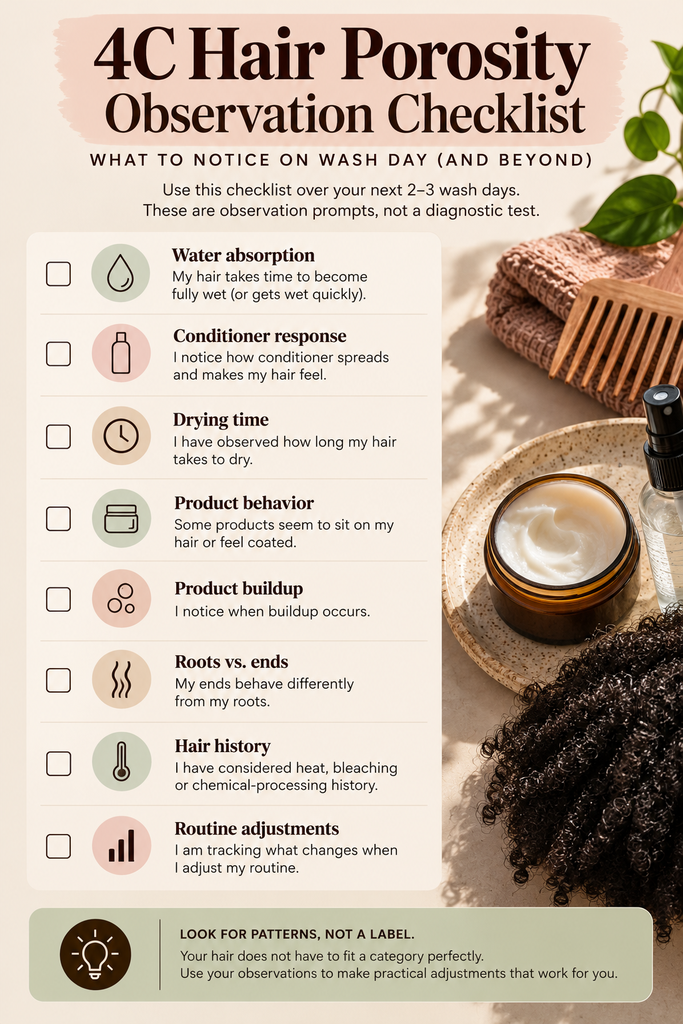
A Simple 4C Hair Porosity Checklist
Use this checklist during your next few wash days. It is designed to help you observe your hair’s behavior, not assign a medical or scientific diagnosis.
- I noticed how easily water spread through my hair.
- I checked whether my hair was thoroughly wet before applying conditioner.
- I observed how easily my conditioner spread through each section.
- I noticed whether my hair felt soft, rough, tangled, or coated after rinsing.
- I paid attention to how my hair felt after styling and over the next few days.
- I considered whether product buildup might be affecting the results.
- I thought about heat, chemical treatments, friction, and my handling habits.
- I identified one change to try instead of replacing my entire routine.
After two or three wash days, review your notes.
Look for recurring patterns. If water consistently takes time to reach your hair, for example, improve your washing technique and see whether the experience changes. If your hair feels coated after layering products, try simplifying your application.
You may eventually find that one porosity category describes some of your hair’s behavior better than the others. You may also find that the label does not explain much about your routine.
Either outcome is fine. The purpose is to make hair care simpler and more effective, not to earn a perfect porosity label.
How Porosity Fits Into Your Overall 4C Hair Routine
Porosity is one useful consideration, but it should not take priority over the fundamentals of caring for your hair.
A practical routine usually includes:
1. Cleansing. Wash your scalp and hair regularly enough to manage sweat, oil, and product buildup. Your ideal frequency depends on your scalp, lifestyle, products, and hair needs.
2. Conditioning. Use a suitable rinse-out conditioner to improve softness and manageability. Distribute it carefully, especially if you have dense hair.
3. Gentle detangling. Work in manageable sections and avoid forcing a comb through knots. For a step-by-step approach, see how to detangle 4C hair without breakage.
4. Moisturizing and styling. If a leave-in conditioner or styling product helps your hair remain manageable, include it in an amount that works for you. You do not need to use every type of product.
5. Low-friction care. Pay attention to tight styles, repeated manipulation, rough fabrics, and other sources of friction that can contribute to damage.
6. Consistency. Give your routine time to show patterns before changing everything. A manageable routine you can maintain is more useful than a complicated routine you constantly have to troubleshoot.
For the bigger picture, start with our guide to building a 4C hair care routine that works for you.
The aim is not to create a routine around a label. It is to create a routine around your hair’s actual needs.
When Your Hair Problem May Not Be About Porosity
It is easy to attribute every frustrating hair experience to porosity, especially when the term appears in so many product recommendations.
But persistent dryness, tangling, and breakage can have several explanations.
For example:
- Product buildup may leave hair feeling coated or difficult to wet.
- Rough handling may increase tangling and breakage.
- Split or damaged ends may continue to catch on neighboring strands.
- Inadequate conditioning may leave hair less manageable.
- Heat or chemical damage may change the condition of the hair fiber.
- Scalp concerns may need attention separate from your hair’s porosity.
If you are experiencing ongoing breakage, visible thinning, scalp pain, persistent itching, or sudden changes in hair density, do not rely on a porosity assessment to explain the problem. Consider seeking advice from a qualified dermatologist or other appropriate health professional.
Porosity is a hair-care concept, not a diagnosis for scalp or hair-loss conditions.
Frequently Asked Questions
Is 4C hair usually low porosity?
Not necessarily. The 4C label describes curl pattern, while porosity describes aspects of how the hair fiber interacts with water. People with 4C hair can have different porosity characteristics, and hair condition can vary between sections.
How can I tell if my 4C hair is low or high porosity?
Observe how your hair gets wet, how conditioner spreads, and how your hair feels after washing and styling. Look for recurring patterns across several wash days. These observations can help guide your routine, but they cannot establish a precise porosity measurement.
Is the hair porosity float test accurate?
The float test is not a reliable standalone way to determine hair porosity. A strand’s behavior in water can be influenced by several factors, and one strand may not represent your whole head. Treat it as a popular experiment rather than a definitive test.
What products are best for low-porosity 4C hair?
There is no single product list that works for everyone with low-porosity 4C hair. Start with a suitable shampoo, rinse-out conditioner, and a leave-in or styling product if needed. If your hair feels coated, review product amounts and cleansing before adding more products.
What products are best for high-porosity 4C hair?
Start with consistent conditioning and products that improve your hair’s softness and manageability. A leave-in conditioner or cream may be useful, but the right choice depends on your hair’s condition and how it responds. Reducing damage and handling hair gently are also important.
Does high-porosity hair always mean damaged hair?
No. Hair porosity is influenced by the structure and condition of the hair fiber, and damage can increase porosity. However, the terms are not interchangeable, and you cannot determine the full condition of your hair from a porosity label alone.
Can I have different porosity levels on the same head?
Hair can vary in condition from one area to another. Older ends may have experienced more wear, heat, or chemical processing than newer growth. This can contribute to differences in how sections behave, so your entire head may not respond uniformly.
Does oil moisturize 4C hair?
Oil can help with certain aspects of hair care, such as reducing friction or influencing how hair feels, but oil is not a substitute for water or a rinse-out conditioner. Whether it belongs in your routine depends on how your hair responds and what you want the product to do.
Should I change my entire routine after discovering my porosity?
No. Start with what you already use and identify a specific problem you want to address. Change one thing at a time and observe the results. You may find that a small adjustment to your washing, conditioning, or application technique is enough.
The Crown Decoded Porosity Check
Before buying another product, ask yourself three questions:
1. What am I actually noticing?
Be specific. Is your hair slow to get wet, coated after styling, rough at the ends, or difficult to detangle? These are different observations.
2. What else could explain it?
Consider buildup, product amount, washing technique, damage, friction, and how you handle your hair. Do not assume porosity explains everything.
3. What is the smallest useful change I can test?
Try one adjustment during your next wash day. Give yourself enough time to observe whether it helps before making another change.
This approach keeps porosity in perspective and helps you avoid spending money on products you may not need.
The Bottom Line
Hair porosity can help you understand how your hair behaves, but it is not a rulebook for caring for 4C hair.
Your curl pattern does not automatically determine your porosity. The popular float test cannot give you a definitive answer, and no single product category is right for everyone with the same porosity label.
Pay attention to how your hair gets wet, how it responds to conditioning, and how manageable it feels over time. Consider buildup, damage, and handling habits alongside porosity.
Most importantly, let your hair’s actual behavior guide your routine—not assumptions about what 4C hair is supposed to need.
If you are still building your routine, start with our guide to 4C hair care and make adjustments from there.
At Crown Decoded, the goal is practical hair care that makes sense for your hair, your habits, and your life.