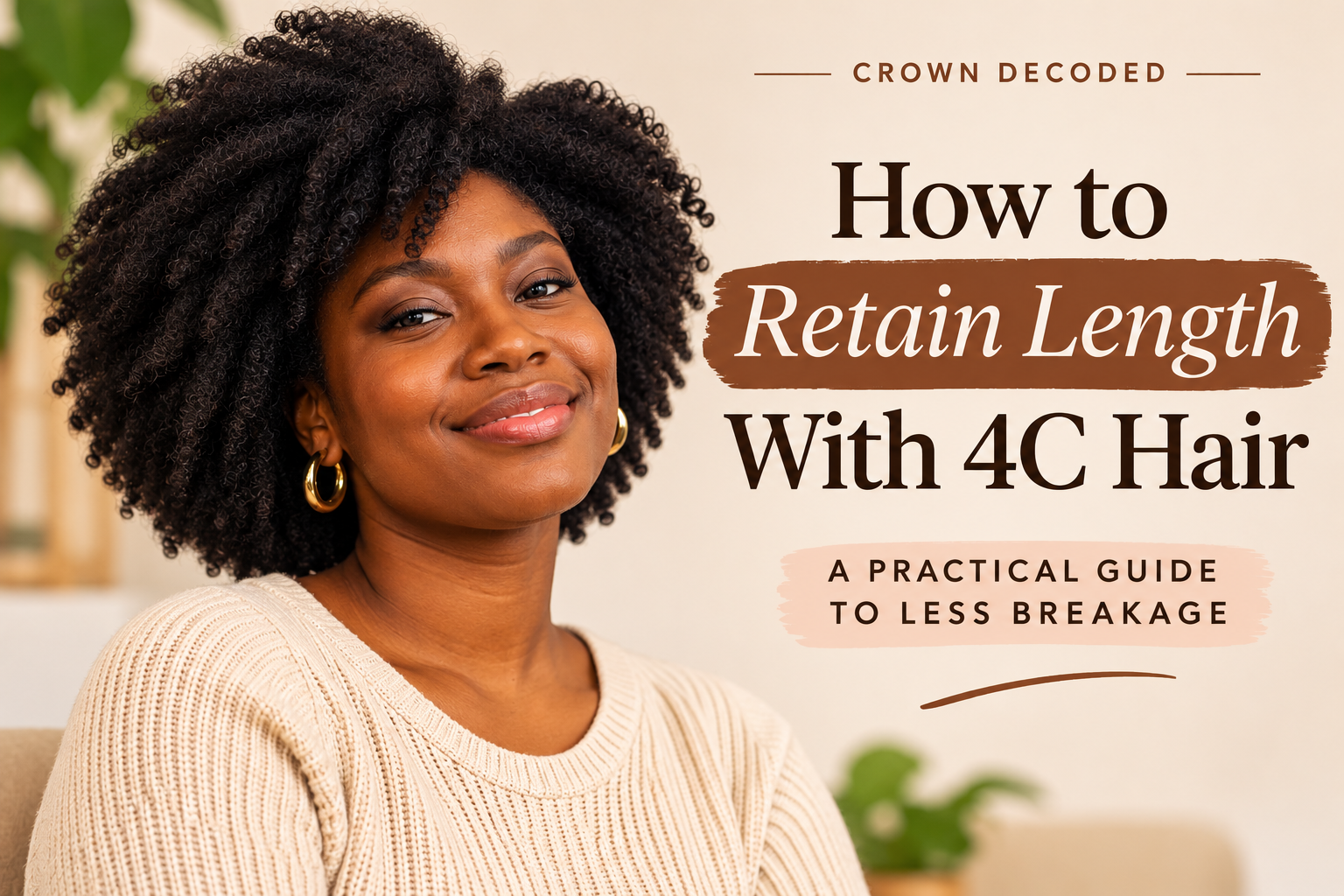
How to Retain Length With 4C Hair: Understanding the Basics
If you’ve been wondering how to retain length with 4C hair, you’re not alone. You moisturize, try protective styles, buy products that promise stronger strands, and make an effort to follow a routine. Yet when you stretch your hair or look at your ends, you don’t seem to see much progress.
Here’s something worth understanding: hair growth and length retention are two different things.
Your hair can grow from the scalp while you lose some of that length through breakage, damage and everyday handling. This means you might not need a complicated growth routine. You may need to identify where your hair is experiencing unnecessary stress and make it easier to maintain the length you’re already gaining.
The good news is that length retention doesn’t have to involve expensive products or wearing protective styles all year.
It starts with understanding your hair, handling it gently and building habits you can maintain.
In this guide, we’ll look at what affects length retention, how to reduce avoidable breakage and how to build a practical 4C hair routine that supports healthier-looking, more manageable hair.
Table of Contents
- How to Retain Length With 4C Hair: Understanding the Basics
- Why Your 4C Hair May Seem Stuck at One Length
- 8 Habits That Can Help You Retain More Length
- What About Moisture?
- How to Use Protective Styles for Length Retention
- A Simple 4C Length-Retention Routine
- Your 4C Length-Retention Checklist
- How to Audit Your 4C Hair Breakage
- When Length Retention May Not Be the Real Problem
- The Crown Decoded Length-Retention Check
- Frequently Asked Questions
- The Bottom Line
How to Retain Length With 4C Hair: Understanding the Basics
Length retention means keeping as much of your hair’s existing length as possible while it continues to grow.
Your hair grows from follicles in your scalp. The visible length of your hair depends not only on that growth but also on how much of the hair shaft remains intact over time.
For example, imagine your hair is growing, but the ends repeatedly break during detangling, styling or everyday handling.
You may continue gaining new length near the roots, but the breakage can make your overall hair length appear unchanged.
That’s why focusing exclusively on hair growth can miss an important part of the picture.
Hair growth and length retention are not the same thing
Think of it this way:
- Hair growth: New hair length develops from the follicle.
- Length retention: You keep the length your hair has gained instead of repeatedly losing it to breakage or damage.
You cannot completely eliminate normal hair wear and breakage. However, you can make changes that reduce avoidable damage.
The aim isn’t to make every strand indestructible. It’s to create a routine that treats your hair gently enough to help preserve its length.
Why 4C hair can make length retention challenging
4C hair has a tightly coiled structure, and individual strands can have considerable variation in curl pattern.
Depending on your hair, you may experience:
- Shrinkage that makes your hair appear shorter than it is.
- Tangling when strands wrap around one another.
- Single-strand knots.
- Difficulty separating sections during detangling.
- Increased handling when changing hairstyles.
- Breakage associated with rough manipulation, heat or excessive tension.
These experiences are not identical for everyone with 4C hair.
The important distinction is that tightly coiled hair isn’t a problem that needs to be fixed. Your routine simply needs to work with your hair’s characteristics.
Why Your 4C Hair May Seem Stuck at One Length
Before changing your entire routine, consider what might be happening.
There are several possible explanations for a lack of visible length progress.
1. You’re experiencing more breakage than you realize
Breakage can happen during ordinary activities such as:
- Detangling.
- Removing hairstyles.
- Combing.
- Styling.
- Washing.
- Separating tangled sections.
You might not notice it immediately, particularly when you handle your hair frequently.
Pay attention to when you notice short broken pieces and whether certain activities seem to cause more breakage than others.
2. Your ends are taking most of the wear
The ends are the oldest portions of your hair.
They have experienced more washing, styling, friction and handling than the newer hair closer to your scalp.
If your ends are dry, damaged, split or repeatedly tangling, they may need more careful handling.
This doesn’t mean you should constantly trim your hair. It means paying attention to its condition and dealing with visibly damaged ends appropriately.
3. You’re manipulating your hair too often
Sometimes the problem isn’t your products. It’s how frequently you’re handling your hair.
Repeatedly combing, restyling, separating and changing hairstyles can create additional opportunities for mechanical damage.
Consider whether every styling session is necessary.
If your hair is already manageable, you don’t need to keep manipulating it simply because you feel you should be doing something.
4. Your hairstyles may be creating too much tension
A hairstyle can look neat and still place excessive stress on your hair.
Tight braids, ponytails, cornrows and extensions can pull on the hair, particularly around the hairline.
Repeated tension can contribute to breakage and traction alopecia, a form of hair loss caused by persistent pulling.
If your style causes pain, stinging or noticeable pulling, don’t ignore it.
5. Tangling is creating repeated mechanical stress
Tangled hair can become difficult to separate, especially when several strands have wrapped around one another.
Trying to force a comb through these sections can cause unnecessary pulling and breakage.
This is why detangling technique matters.
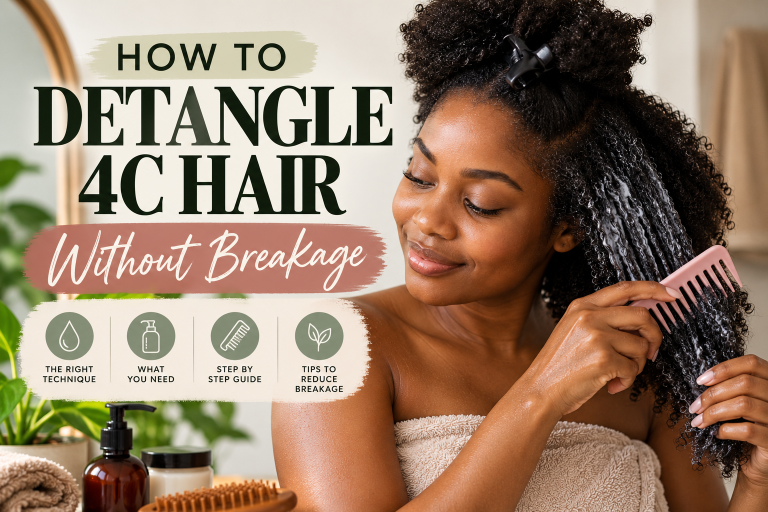
Read our guide: How to Detangle 4C Hair Without Breakage.
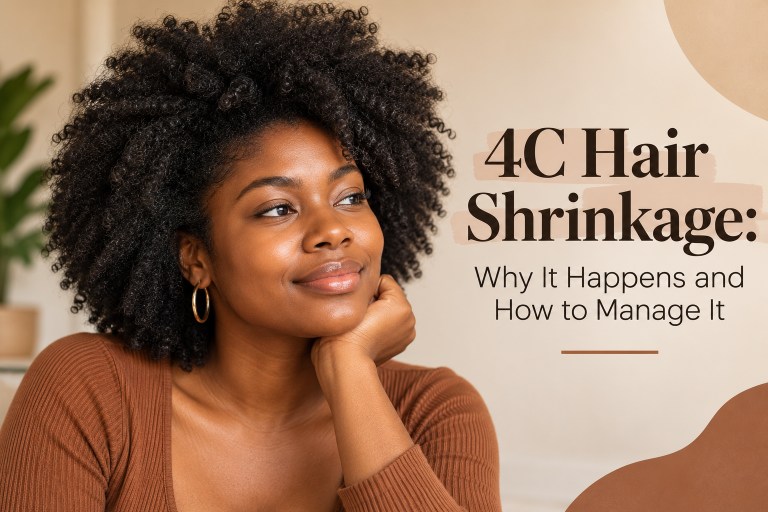
6. Shrinkage is hiding your actual length
Shrinkage is a normal characteristic of tightly coiled hair.
Your hair may look considerably shorter in its natural state than when gently stretched.
This can make it difficult to judge length progress by appearance alone.
If you want to track your length, compare your hair under similar conditions rather than comparing a stretched hairstyle with a shrunken one.
8 Habits That Can Help You Retain More Length
You don’t need eight new products or eight complicated steps.
These are eight practical habits that can help reduce avoidable stress on your hair.
1. Make gentle handling the foundation of your routine
Start by changing how you handle your hair.
Instead of rushing through detangling or styling, give yourself enough time to work in manageable sections.
A few useful habits include:
- Separate your hair into sections when necessary.
- Avoid pulling through stubborn knots.
- Use your fingers to loosen difficult tangles when helpful.
- Avoid repeatedly combing the same section.
- Handle your hair gently during washing and styling.
Gentle handling should not be limited to wash day. It should be part of your everyday routine.
2. Detangle with enough slip
Detangling is one of the moments when unnecessary breakage can occur.
For many people with tightly coiled hair, using a conditioner or suitable detangling product can make the process easier.
Try this approach:
- Divide your hair into manageable sections.
- Apply enough conditioner or detangling product to help the strands move against one another.
- Work through the ends first.
- Gradually move upward.
- Use your fingers to investigate stubborn knots.
- Stop and add more slip if a section becomes difficult.
Avoid forcing a comb through a knot just to finish quickly.
The goal is to remove tangles with as little unnecessary pulling as possible.
For a more detailed walkthrough, see our 4C hair detangling guide.
3. Pay attention to your ends
Your ends deserve attention because they have experienced more wear than the rest of your hair.
You can make them easier to manage by:
- Detangling carefully.
- Avoiding repeated pulling.
- Limiting unnecessary manipulation.
- Reducing friction where possible.
- Addressing visibly split or damaged ends.
If your ends are severely split or damaged, trimming the affected portions may help prevent continued splitting along the strand.
However, trimming doesn’t make hair grow faster from the scalp.
You also don’t need to trim simply because a certain number of weeks has passed. Consider the condition of your ends and your styling needs.
4. Reduce unnecessary manipulation between wash days
Your hair doesn’t need to be restyled every day.
If you’ve already created a manageable hairstyle, allow it to remain in place when appropriate.
Instead of repeatedly combing and restyling, consider:
- Leaving established styles alone when they’re still comfortable.
- Refreshing only the areas that need attention.
- Avoiding unnecessary parting and separating.
- Choosing styles that remain manageable for your lifestyle.
Reducing unnecessary handling can be more useful than adding another product to your routine.
5. Choose low-manipulation styles
Low-manipulation styles help reduce how often you need to handle your hair.
Examples include:
- Two-strand twists.
- Simple flat twists.
- Loose buns.
- Braid-outs.
- Twist-outs.
- Other comfortable styles that don’t require frequent restyling.
The best option depends on your hair, lifestyle and styling preferences.
Remember that low manipulation doesn’t automatically mean a style is protective. A style can still create tension, tangling or friction.
Choose something you can comfortably maintain and remove without excessive pulling.
6. Be careful with tension
This deserves special attention.
Repeatedly wearing tight hairstyles can damage the hair and contribute to traction alopecia.
Pay attention to:
- Braids that feel excessively tight.
- Heavy extensions.
- Ponytails that pull on your hairline.
- Cornrows that cause discomfort.
- Styles that create persistent tension in the same areas.
A hairstyle should not hurt.
If you experience pain, stinging, crusting or visible pulling around your hairline, loosen or remove the style rather than trying to tolerate it.
Persistent or progressive hairline thinning should be assessed by a dermatologist.
7. Use heat thoughtfully
You don’t have to declare war on every heat-styling tool.
However, frequent or excessive heat exposure can damage hair.
If you use blow-dryers, flat irons or other heated tools:
- Avoid unnecessarily frequent heat styling.
- Use an appropriate heat protectant.
- Follow the product’s instructions.
- Choose a suitable temperature rather than automatically using the highest setting.
- Avoid repeatedly applying heat to the same sections.
If you notice changes in your hair’s texture, unusual dryness or increased breakage after heat styling, consider reducing or pausing its use.
8. Build a routine you can actually repeat
An elaborate routine is not necessarily a better routine.
You need a manageable approach that covers the basics:
- Cleansing.
- Conditioning.
- Detangling.
- Moisturizing when needed.
- Styling and protecting.
Your routine should fit your hair’s needs and your lifestyle.
If a particular step repeatedly causes frustration, discomfort or unnecessary manipulation, reconsider how you’re doing it.
You can also revisit our guide to building a 4C hair care routine that actually works.
What About Moisture?
For additional guidance, see the American Academy of Dermatology’s recommendations for caring for Black hair.
Moisture is an important part of caring for 4C hair, but adding more products doesn’t automatically mean better length retention.
A common mistake is assuming that hair must be moisturized every single day or that applying more oil will prevent all breakage.
Neither approach is universally necessary.
Does more moisture automatically mean better length retention?
No.
Your goal should be to keep your hair manageable and comfortable, not to keep adding products without a clear reason.
A practical moisture routine might include:
- Using conditioner during wash day.
- Applying a leave-in conditioner if your hair benefits from one.
- Refreshing sections when they feel dry or difficult to manage.
- Avoiding unnecessary product layering.
- Paying attention to buildup and scalp comfort.
Products should serve a purpose in your routine.
How to tell when your hair needs attention
Instead of following a rigid schedule, pay attention to how your hair behaves.
Ask yourself:
- Does my hair feel unusually dry?
- Is it becoming difficult to manipulate?
- Are the ends tangling more than usual?
- Does a light refresh help?
- Am I adding products without knowing why?
You may discover that your hair needs a small refresh rather than a complete restyling session.
You can also refer to the moisture guidance in our 4C hair care routine.
How to Use Protective Styles for Length Retention
The American Academy of Dermatology explains how tight hairstyles can contribute to traction alopecia, making comfortable, low-tension styling an important consideration.
Protective styling is often recommended as a way to retain length.
The reasoning is understandable: a manageable style can reduce the amount of daily handling your hair experiences.
However, protective styling isn’t automatically beneficial.
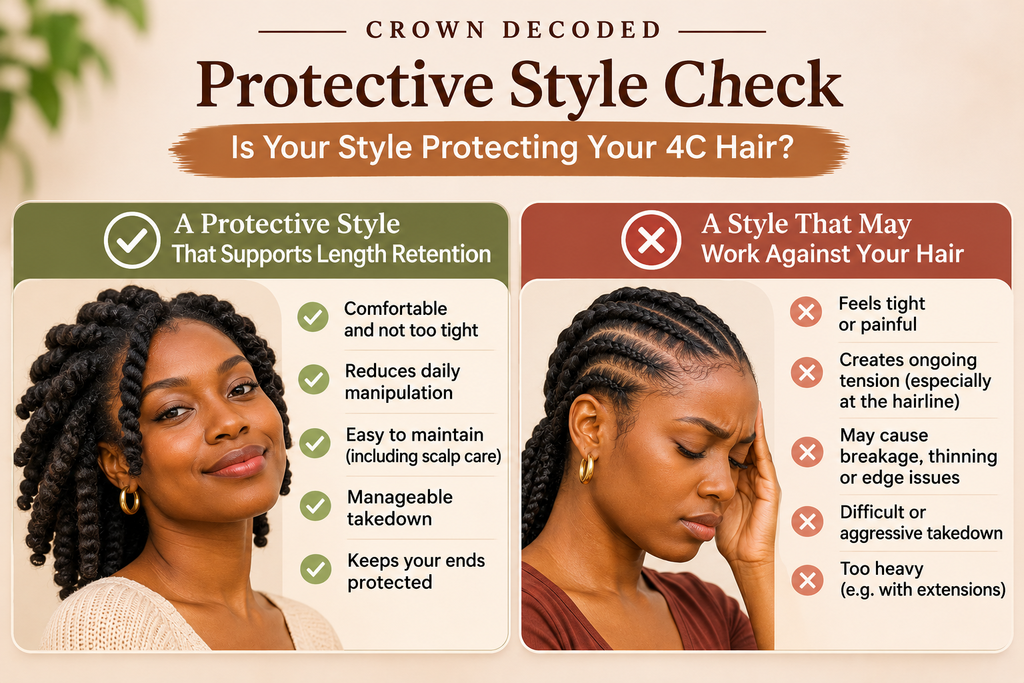
What makes a protective style actually protective?
A style should help reduce unnecessary manipulation without introducing excessive tension or making your hair difficult to maintain.
Look for styles that are:
- Comfortable.
- Not excessively tight.
- Manageable to maintain.
- Appropriate for your hair’s condition.
- Easy to remove without aggressive detangling.
You should also be able to maintain reasonable scalp hygiene while wearing the style.
Signs your protective style may be working against you
Watch for:
- Pain during installation.
- Persistent scalp stinging.
- Excessive pulling around your hairline.
- Heavy extensions.
- Hair breakage around the edges.
- Difficult or aggressive takedown.
The American Academy of Dermatology warns that repeated pulling from tight hairstyles can lead to traction alopecia. Some forms of traction-related hair loss can become permanent if the damage continues.
If your hairstyle hurts, it is too tight.
Protective-style maintenance matters too
Don’t treat a protective style as permission to forget about your hair.
Depending on the style, you may still need to:
- Keep your scalp reasonably clean.
- Avoid excessive product buildup.
- Follow appropriate maintenance instructions.
- Protect your hair at night.
- Remove the style before it becomes difficult to manage.
Give your hair breaks from repeated high-tension styling.
A comfortable, simple style that you can maintain is more useful than an elaborate style that repeatedly stresses your hair.
A Simple 4C Length-Retention Routine
A consistent routine is one of the practical foundations of how to retain length with 4C hair. Rather than adding more products or complicated steps, focus on gentle handling, manageable styling and reducing unnecessary breakage.
You don’t need a completely new routine to start retaining more length.
You can begin with the basic habits you already need for healthy hair care.
Wash day
Follow a manageable sequence:
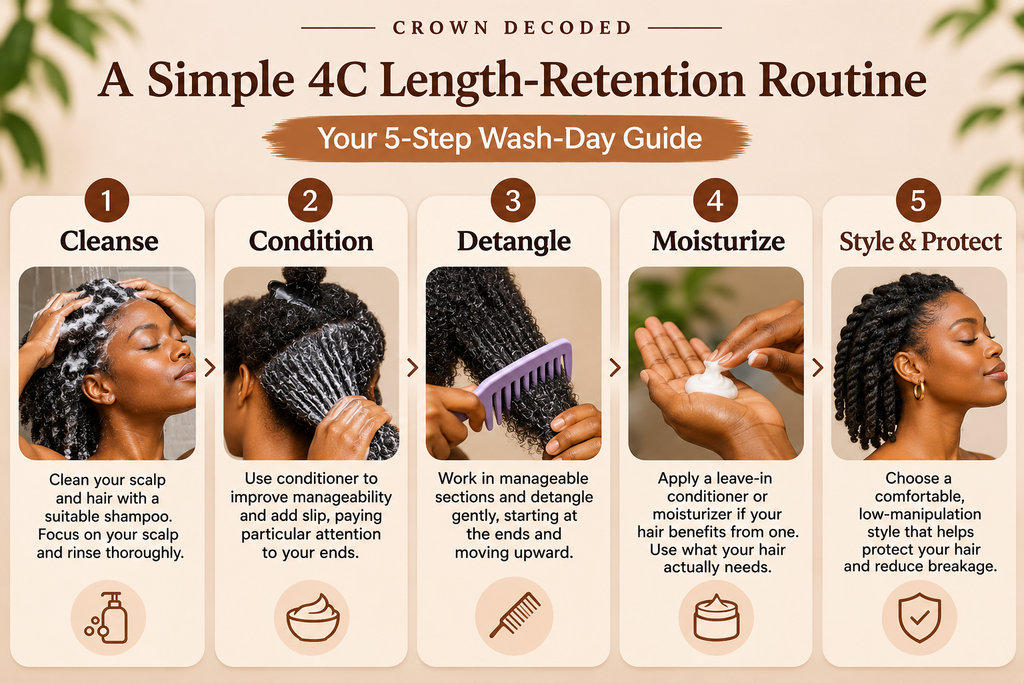
1. Cleanse
Clean your scalp and hair using a suitable shampoo. Focus on your scalp and rinse thoroughly.
2. Condition
Use conditioner to improve manageability and make handling easier.
Pay particular attention to your ends.
3. Detangle
Work in manageable sections and use enough slip to reduce unnecessary pulling.
4. Moisturize
Apply a leave-in conditioner or moisturizer if your hair benefits from one.
Avoid automatically layering multiple products.
5. Style and protect
Choose a comfortable style that doesn’t create excessive tension.
Between wash days
Keep things simple.
- Refresh your hair when needed.
- Avoid unnecessary combing.
- Maintain manageable styles.
- Pay attention to your ends.
- Avoid repeatedly manipulating the same sections.
Before bed
Nighttime care should help reduce unnecessary friction and keep your hair manageable.
You can:
- Use a satin or silk bonnet if comfortable.
- Sleep on a satin or silk pillowcase.
- Secure your hair loosely if necessary.
- Avoid tight nighttime styles.
You don’t need to use every option. Find a method that works with your hairstyle and sleeping habits.
Your 4C Length-Retention Checklist
Use this checklist to evaluate your habits regularly.
Handling
- I detangle gently and work in manageable sections.
- I avoid forcing combs through stubborn knots.
- I don’t repeatedly manipulate my hair without a reason.
Ends
- I pay attention to the condition of my ends.
- I handle tangled ends carefully.
- I address visibly damaged ends when necessary.
Styling
- My hairstyles are comfortable.
- I avoid repeated tension around my hairline.
- I give my hair breaks from demanding styles.
- I avoid excessive heat.
Moisture and maintenance
- I condition my hair regularly.
- I refresh it based on its needs.
- I avoid adding products simply because they’re available.
- I have a manageable nighttime routine.
Progress
- I pay attention to where breakage occurs.
- I notice when breakage happens.
- I make gradual changes instead of changing everything at once.
You don’t need a perfect score.
The purpose is to identify habits that may be working against your goals.
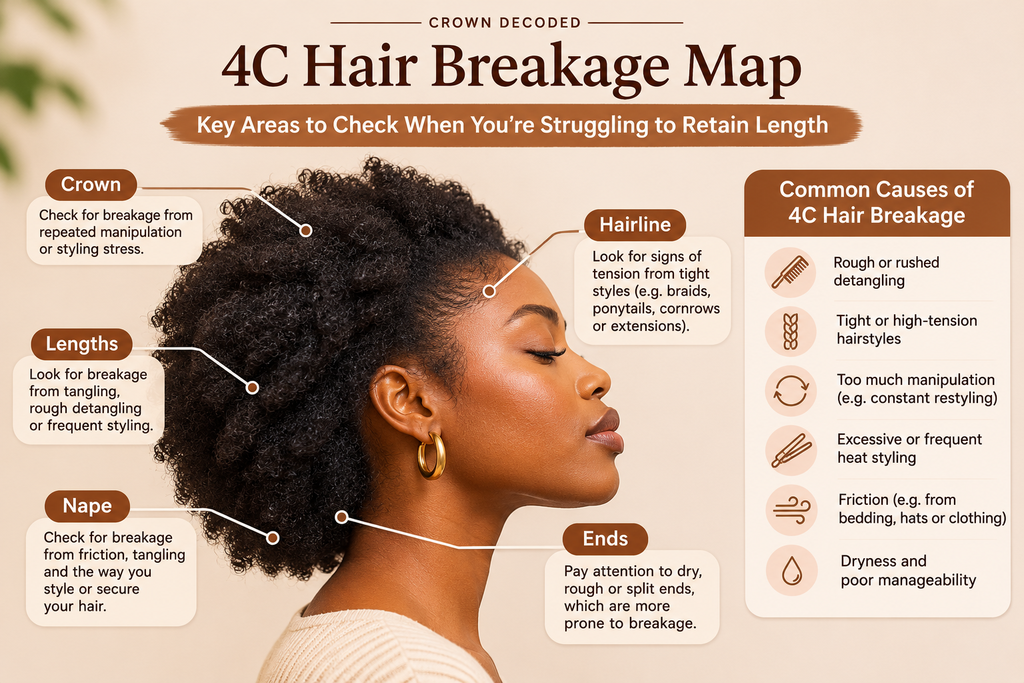
How to Audit Your 4C Hair Breakage
If you’re consistently struggling to retain length, don’t immediately replace your entire product collection.
Start by investigating where and when the breakage happens.
This is the Crown Decoded approach: identify the repeated source of stress before adding another step to your routine.
Step 1: Where is the breakage happening?
Look for patterns.
| Where you notice breakage | What to investigate |
|---|---|
| Around the hairline | Tension from hairstyles and repeated pulling |
| At the nape | Friction, tangling and styling habits |
| At the ends | Knots, damaged ends and detangling technique |
| Around the crown | Repeated manipulation or styling stress |
| Throughout the hair | Overall handling, heat and chemical exposure |
These are starting points for investigation, not diagnoses. Breakage can have more than one cause.
Step 2: When does it happen?
Consider whether you notice more broken pieces:
- During washing.
- While detangling.
- When removing braids or twists.
- After heat styling.
- While restyling between wash days.
- When separating tangled sections.
The timing can help you identify which part of your routine deserves attention.
Step 3: What changed?
Think about recent changes:
- Did you start wearing tighter hairstyles?
- Have you increased heat styling?
- Are you detangling more frequently?
- Did you change your wash-day technique?
- Are you handling your hair differently?
You don’t need to change everything at once.
Step 4: Adjust one or two habits
Once you’ve identified a possible problem, make a manageable change.
For example:
If you notice breakage during detangling, slow down and improve your sectioning and detangling technique.
If your hairline is experiencing tension, choose a looser hairstyle.
If your ends are repeatedly tangling, pay more attention to how you separate and maintain them.
Give yourself enough time to notice whether the adjustment helps.
When Length Retention May Not Be the Real Problem
Not every case of thinning or reduced hair density is caused by breakage.
Sometimes what looks like a length-retention problem may involve a hair or scalp condition that requires professional attention.
Pay attention to:
- A receding hairline.
- Thinning around the temples.
- Bald patches.
- Noticeable thinning around the crown.
- Sudden or persistent changes in shedding.
- Scalp pain, inflammation or crusting.
- Areas where hair appears to be disappearing rather than simply breaking.
For example, traction alopecia can develop when hairstyles repeatedly pull on the hair follicles.
Central centrifugal cicatricial alopecia (CCCA) is another condition that can affect Black women and commonly begins around the centre of the scalp.
These conditions are not the same as ordinary hair breakage.
If you notice unexplained thinning, progressive hair loss or scalp symptoms, consult a qualified dermatologist rather than relying exclusively on changes to your hair-care routine.
Early assessment can matter, particularly for conditions that may cause permanent hair loss.
The Crown Decoded Length-Retention Check
Before buying another hair product or changing your entire routine, ask yourself five questions.
1. Am I handling my hair gently?
Consider your washing, detangling, styling and takedown habits.
2. Where am I noticing the most breakage?
Pay attention to your ends, hairline, nape and crown.
3. Are my hairstyles actually reducing manipulation?
A style isn’t automatically protective simply because it keeps your hair tucked away.
4. Am I maintaining my hair between wash days?
Consider moisture, friction, tangling and unnecessary restyling.
5. Am I changing too many things at once?
A routine is easier to troubleshoot when you make gradual adjustments.
The Crown Decoded principle is simple:
Find the repeated source of stress before adding another product.
You don’t need the biggest product collection or the most complicated routine.
You need habits that make your hair easier to care for and that you can realistically maintain.
Frequently Asked Questions
How can I retain length with 4C hair?
Focus on gentle handling, careful detangling, manageable ends, comfortable hairstyles and reducing unnecessary manipulation. A consistent routine that suits your hair can help reduce avoidable breakage and support length retention.
Why does my 4C hair keep growing but not getting longer?
Your hair may be growing while some of the length is being lost through breakage. Tangling, rough detangling, excessive tension, heat and repeated manipulation are possible contributors. Shrinkage can also make your actual length harder to see.
Do protective styles help retain length on 4C hair?
They can help when they reduce daily manipulation without creating excessive tension. Tight braids, heavy extensions and painful hairstyles can work against your goal by damaging the hair or contributing to traction alopecia.
Should I moisturize my 4C hair every day to retain length?
Not necessarily. Your hair’s needs vary. Use conditioner during your wash routine and refresh your hair when needed. More frequent product application doesn’t automatically mean better length retention.
Does trimming 4C hair make it grow faster?
No. Trimming removes damaged portions of the hair shaft; it doesn’t increase the rate of growth at the follicle. Trimming visibly damaged ends can help manage their condition, but frequent trimming isn’t a growth treatment.
Can I retain length without protective styles?
Yes. Protective styles are not compulsory for length retention. You can wear your hair loose or choose simple low-manipulation styles, provided you manage tangling, friction and handling appropriately.
How long does it take to see results from a length-retention routine?
There isn’t a universal timeline. Results depend on your starting hair condition, growth, breakage, styling habits and consistency. Focus on reducing repeated sources of damage and compare your hair under similar conditions over time.
Is 4C hair naturally unable to grow long?
No. 4C hair can grow long. Its tightly coiled structure and individual care needs may make length retention challenging for some people, but there is no reason to assume that long hair is unattainable because of your curl pattern.
The Bottom Line
Retaining length with 4C hair isn’t about finding a miracle product or keeping your hair in protective styles all year.
It’s about understanding what your hair needs, reducing unnecessary manipulation, handling your ends carefully and choosing hairstyles that don’t create excessive tension.
Your hair doesn’t need a complicated routine.
It needs consistent care that works with its texture, condition and your lifestyle.
Learning how to retain length with 4C hair is ultimately about building sustainable habits that help you protect the length you’re already growing.
Remember: the goal isn’t simply to grow more hair. It’s to keep more of the length you’re already growing.
This article is for educational purposes and does not replace individualized advice from a qualified healthcare professional.