4C Hair Products: What You Actually Need + Recommendations
If you search for 4C hair products, you can quickly end up with a shopping list longer than your actual hair-care routine needs to be.
Shampoo. Conditioner. Deep conditioner. Leave-in. Hair milk. Butter. Oil. Gel. Edge control. Protein treatment. Pre-poo. Scalp oil. Another cream because TikTok said so…
It gets expensive fast.
The better approach is to start with what your hair-care routine needs a product to do, then choose products that fill those jobs.
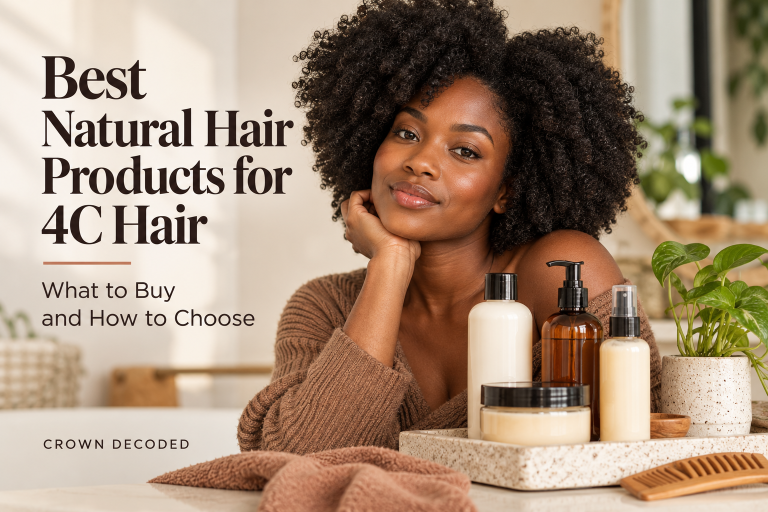
This guide breaks down the main 4C hair products, what each one is for, what to look for, which products are optional, and some current products worth considering. The recommendations are examples rather than universal “best” products, because your hair’s condition, styling habits and preferences matter.
Table of Contents
What Products Do You Actually Need for 4C Hair?
Quick answer: You can build a perfectly workable 4C hair routine with a cleanser, conditioner and one or two products that help with moisture, manageability or styling.
You do not need a dozen products simply because they’re marketed for natural or 4C hair.
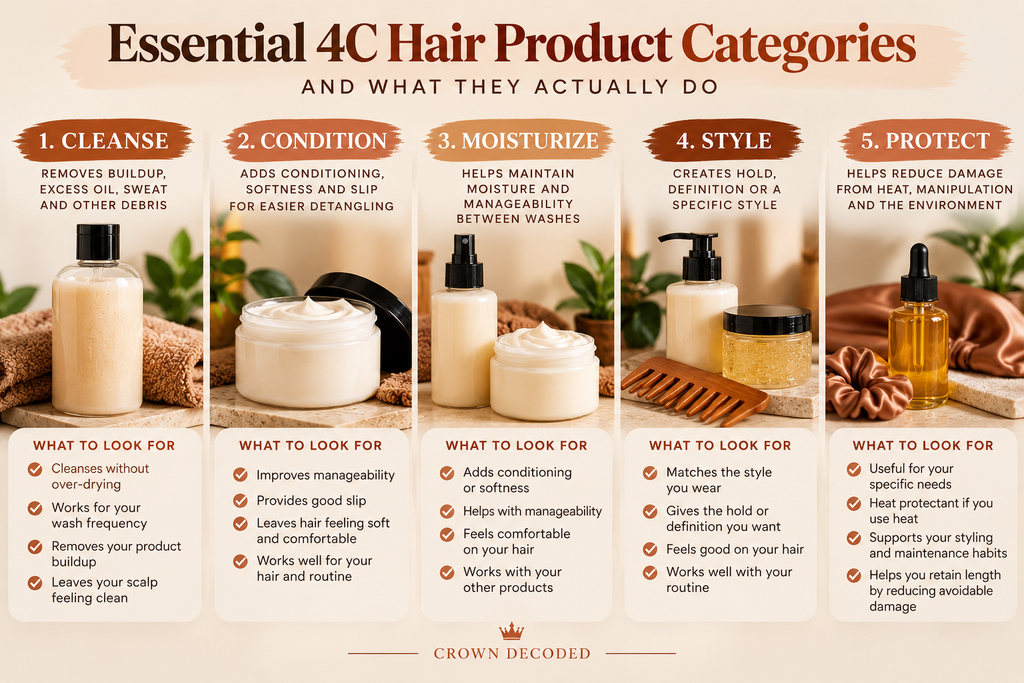
A useful starting framework is:
Cleanse → Condition → Manage moisture → Style if needed → Protect
Here’s what that can look like:
| Product | Main job | Essential? |
|---|---|---|
| Shampoo/cleanser | Cleans the scalp and hair | Yes |
| Rinse-out conditioner | Conditions and improves manageability | Yes |
| Leave-in conditioner | Adds additional conditioning/manageability | Optional but useful |
| Moisturizer/cream | Helps manage hair between washes | Optional |
| Deep conditioner | More intensive conditioning | Optional |
| Styler | Creates hold, definition or a specific style | Depends on your routine |
| Oil | Optional addition to a routine | Optional |
| Heat protectant | Used when heat styling | Essential when using heat |
The American Academy of Dermatology recommends conditioning after washing and notes that conditioner can moisturize and detangle hair, making it easier to manage. For Black hair, the AAD specifically recommends using conditioner every time you wash. AAD
The key is not to ask:
“What products do people with 4C hair use?”
Ask:
“What does my hair need this product to do?”
That one change can save you a lot of money.
The Best 4C Hair Products by Category
Rather than ranking products as universally “best,” let’s look at what each category actually does.
Shampoo or Cleanser
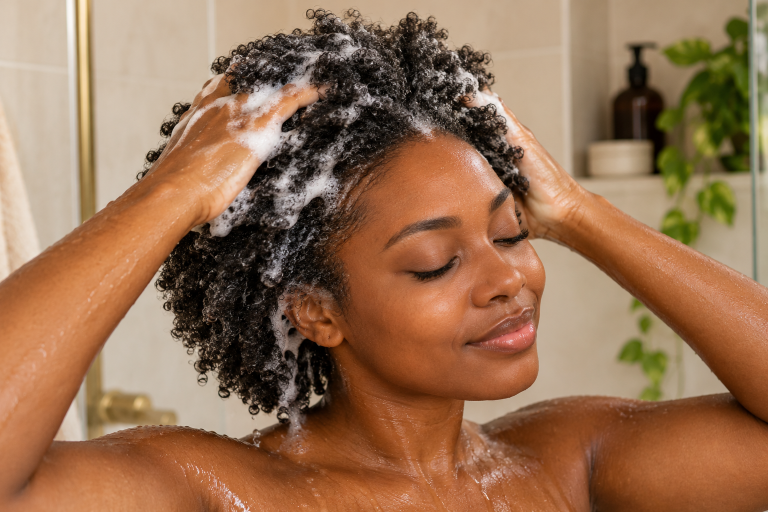
Your cleanser’s job is to remove buildup, excess oil, sweat and other debris from the scalp and hair.
For textured hair, the AAD recommends applying shampoo primarily to the scalp rather than aggressively rubbing shampoo through the full length of the hair. AAD
When shopping, look for a cleanser that:
- leaves your scalp feeling clean without making your hair unmanageably dry
- works with how often you wash
- fits your styling routine
- can remove the amount of product you actually use
You don’t automatically need the gentlest cleanser possible.
If you regularly use heavy creams, butters, gels or oils, you may occasionally need a cleanser that can handle that buildup.
The AAD notes that regular washing can help prevent buildup of hair-care products. AAD
Crown Decoded tip: Don’t judge a shampoo solely by whether your hair feels “squeaky clean.” Your scalp needs to be clean, but the goal isn’t to make your strands feel stripped.
Conditioner
If there’s one product category I would prioritize after cleanser, it’s conditioner.
Conditioner can make hair easier to manage and detangle, and dermatologists recommend using it after washing. AAD
For 4C hair, conditioner can be particularly useful during detangling because it provides slip and makes manipulation easier.
Look for a conditioner that leaves your hair:
- easier to detangle
- softer or more manageable
- comfortable rather than coated
- easier to style
You don’t need to buy the richest conditioner on the shelf just because your hair is 4C.
The right conditioner is the one that works well for your hair and your routine.
And if detangling is one of your biggest wash-day struggles, take a look at our guide to how to detangle 4C hair without breakage.
Leave-In Conditioner
A leave-in conditioner is a product you apply after washing and don’t rinse out.
It can be useful if you want additional conditioning, softness, manageability or help preparing your hair for styling.
The AAD notes that leave-in conditioner or detangler can be useful for fragile or thinning hair and can help reduce breakage, split ends and frizz. AAD
But here’s the important part:
A leave-in isn’t automatically mandatory.
If your rinse-out conditioner and styling product already give you the manageability you want, you may not need another layer.
On the other hand, if your hair feels difficult to manage after washing, a leave-in may be a useful addition.
Moisturizer, Cream or Butter
This category is where things can get confusing.
“Moisturizer,” “hair milk,” “cream,” “butter” and similar labels can describe very different formulations.
You don’t need to own all of them.
These products may be useful for:
- refreshing a style
- improving manageability
- adding conditioning between washes
- preparing hair for twists, braids or other styles
- adding the amount of richness your hair prefers
The trick is to pay attention to how your hair responds.
If a product leaves your hair soft and manageable without becoming heavy or coated, that’s useful information.
If your hair feels increasingly greasy, coated or difficult to cleanse after several applications, you may simply be using too much product or layering more products than you need.
Deep Conditioner
A deep conditioner is an optional upgrade, not a membership requirement for being a natural-haired woman.
You may find one useful when your hair needs more intensive conditioning or when your regular conditioner isn’t giving you the level of manageability you want.
Some deep conditioners are formulated for specific situations, such as chemically processed or heat-styled hair.
For example, SheaMoisture currently sells its Jamaican Black Castor Oil Strengthen & Restore Masque for Type 2C–4C hair and describes it as a deep-conditioning treatment for natural, chemically processed or heat-styled hair. SheaMoisture
That doesn’t mean everyone with 4C hair needs that particular product.
It means the category has a job, and you can decide whether that job is useful in your routine.
Oils and Sealants
Oil is one of those products that gets treated like a universal requirement in natural-hair conversations.
It isn’t.
Some people enjoy using oils as part of their styling or maintenance routine. Others find that oils make their hair feel heavy or create buildup when layered with several other products.
Think of oil as an optional tool, not the foundation of your entire moisture routine.
And don’t assume that because a product contains a particular oil, it will automatically solve dryness, breakage or hair growth concerns.
The overall formulation and how you use the product matter.
Styling Products
Styling products are about what you’re trying to do with your hair.
Depending on your style, you might use:
- gel
- curling jelly
- styling cream
- twisting butter
- mousse
- edge product
- setting lotion
You don’t need every category.
If you mostly wear wash-and-gos, your product needs will be different from someone who primarily wears two-strand twists, braid-outs or stretched styles.
For example, Kinky-Curly currently sells Original Curling Custard as a styling product alongside its Come Clean Shampoo and Knot Today Leave-In Conditioner. Its own guidance describes those products as a system for cleansing, conditioning and styling tight curls. Kinky-Curly Hair Care
That’s a useful reminder:
Choose styling products according to the style you actually wear.
How to Choose 4C Hair Products for Your Hair
Instead of shopping from a generic “best 4C products” list, start with the problem you’re trying to solve.
If your hair feels dry quickly
Don’t immediately buy three new moisturizers.
First look at:
- how you’re cleansing
- how you’re conditioning
- how much product you’re applying
- how often you’re manipulating your hair
- whether your styling routine leaves your hair feeling comfortable
- whether you’re layering multiple products unnecessarily
Your solution may be a different product — or a simpler routine.
If your hair feels coated or heavy
Look at your product stack.
Are you using:
- leave-in
- cream
- butter
- oil
- gel
- edge control
…all between washes?
You may simply have too many layers.
The AAD notes that buildup from hair-care products can be one reason to pay attention to washing frequency. AAD
If your hair tangles easily
Prioritize conditioning and gentle handling rather than buying a miracle detangler.
A good conditioner, enough slip and a manageable section-by-section technique can make a much bigger difference than adding another bottle to the shelf.
For a detailed technique, see How to Detangle 4C Hair Without Breakage.
If your hair breaks during styling
A new product may not be the main answer.
Look at:
- how tightly you’re styling
- how often you’re manipulating your hair
- how aggressively you’re detangling
- how much heat you’re using
- whether you’re pulling on fragile areas
The AAD recommends gentle detangling, limiting excessive heat and avoiding styles that pull or cause pain. AAD
Products can support manageability, but they can’t make damaging handling harmless.
If your scalp feels uncomfortable
Don’t automatically pile more hair products onto the problem.
A persistently itchy, painful, inflamed or changing scalp deserves more attention than another moisturizer.
And if you’re experiencing noticeable thinning or hair loss, the AAD recommends seeing a board-certified dermatologist rather than assuming your products are the cause. AAD
Do You Need Products Specifically Made for 4C Hair?
No.
A product does not have to say “4C” on the label to be useful for your hair.
4C is a hair-pattern classification, but individual hair characteristics and routines vary considerably. A 2026 narrative review describes Afro-textured hair as a spectrum and emphasizes differences in structure, behavior, products and styling practices. PubMed
So instead of asking:
“Is this specifically for 4C hair?”
also ask:
“Does this product do what I need it to do?”
Look at:
- what the product is designed to do
- how your hair responds to it
- whether you like the finish
- whether it fits your styling routine
- whether you can comfortably afford to keep buying it
Marketing can help you discover products.
It shouldn’t make the decision for you.
What About Hair Porosity?
Porosity can be useful as a way of thinking about how hair behaves, but I wouldn’t build your entire product routine around an online porosity quiz.
Hair fibers are naturally porous, and research shows that physical and chemical treatments can influence hair porosity. PubMed
But that doesn’t mean you need to perfectly diagnose your “porosity type” before buying shampoo.
Instead, pay attention to what your hair is actually telling you.
If products seem to sit heavily on your hair
Experiment with:
- using less product
- reducing the number of layers
- choosing lighter formulations
- cleansing appropriately for your routine
If your hair seems difficult to keep manageable
Look at:
- your conditioning routine
- your detangling technique
- how often you’re manipulating your hair
- whether your products are giving you enough slip and manageability
And don’t feel pressured to pass a hair porosity test before you’re allowed to buy conditioner.
Your routine can teach you a lot.
Our 4C Hair Product Recommendations
Here’s where we’re going to do something slightly different from the typical “25 best 4C products” article.
These are current examples worth researching, organized by what you want a product to do. They are not universal winners, and formulas, prices and availability can change.
For cleansing: SheaMoisture Jamaican Black Castor Oil Strengthen & Restore Shampoo
SheaMoisture currently lists this shampoo for Type 2C–4C hair and describes it as a cleanser for natural, chemically processed and heat-styled hair. The current formula includes ingredients such as glycerin, shea butter, castor oil and hydrolyzed proteins. SheaMoisture
This is worth considering if you’re looking for a cleanser within a line designed specifically for coily and processed hair.
SheaMoisture Jamaican Black Castor Oil Strengthen & Restore Shampoo
One thing to note: the current formula contains hydrolyzed proteins, so if you know your hair dislikes a particular type of formulation, check the ingredient list rather than buying based on the front label alone. SheaMoisture
For conditioning: SheaMoisture Jamaican Black Castor Oil Strengthen & Restore Conditioner
This conditioner is another current option in the same line. The manufacturer describes it as a strengthening conditioner for hair that is frequently colored, heat styled or chemically processed, and its current ingredient list includes conditioning agents, shea butter, glycerin, oils and hydrolyzed proteins. SheaMoisture
SheaMoisture Jamaican Black Castor Oil Strengthen & Restore Conditioner
Again, don’t interpret “strengthening” as meaning that everyone with 4C hair needs a strengthening product. Match the product to your actual routine and how your hair responds.
For a lightweight leave-in: As I Am Leave-In Conditioner
As I Am currently positions its Leave-In Conditioner as a product for curly and coily hair and describes it as a lightweight leave-in used for conditioning and styling preparation. Its Classic collection is listed for Type 3 and Type 4 hair. as i am
This can make sense if you want a leave-in step without immediately moving into a heavy butter or cream.
For detangling + leave-in conditioning: Kinky-Curly Knot Today
Kinky-Curly currently sells Knot Today as a leave-in conditioner and specifically recommends applying it generously and combing through wet hair with a wide-tooth comb. Kinky-Curly Hair Care
If your biggest issue is wash-day manageability, a product designed around conditioning and detangling may make more sense than buying a separate “moisture product” simply because someone online recommended one.
For deep conditioning: Camille Rose Algae Renew Deep Conditioner
Camille Rose currently lists Algae Renew Deep Conditioner among its products for kinky/coily hair. The brand’s current collection also includes Curl Love Moisture Milk, Curl Maker and other products designed for coily and kinky textures. Camille Rose Naturals
Camille Rose Algae Renew Deep Conditioner
This is a category to consider if you want an additional deep-conditioning step, rather than something you necessarily need every wash day.
For styling and definition: Kinky-Curly Original Curling Custard
If you regularly wear wash-and-go styles, a dedicated styler can make more sense than adding another general-purpose moisturizer.
Kinky-Curly currently lists Original Curling Custard as one of its styling products and recommends applying it to soaking-wet hair in sections for tight curls. Kinky-Curly Hair Care
Kinky-Curly Original Curling Custard
If wash-and-gos aren’t your thing, you may have absolutely no reason to buy it.
And that’s the point.
The best product is often the one that solves a problem you actually have.
A Simple 4C Hair Product Routine for Beginners
If you’re starting from scratch, don’t buy everything at once.
Start with the smallest routine that lets you learn what your hair likes.
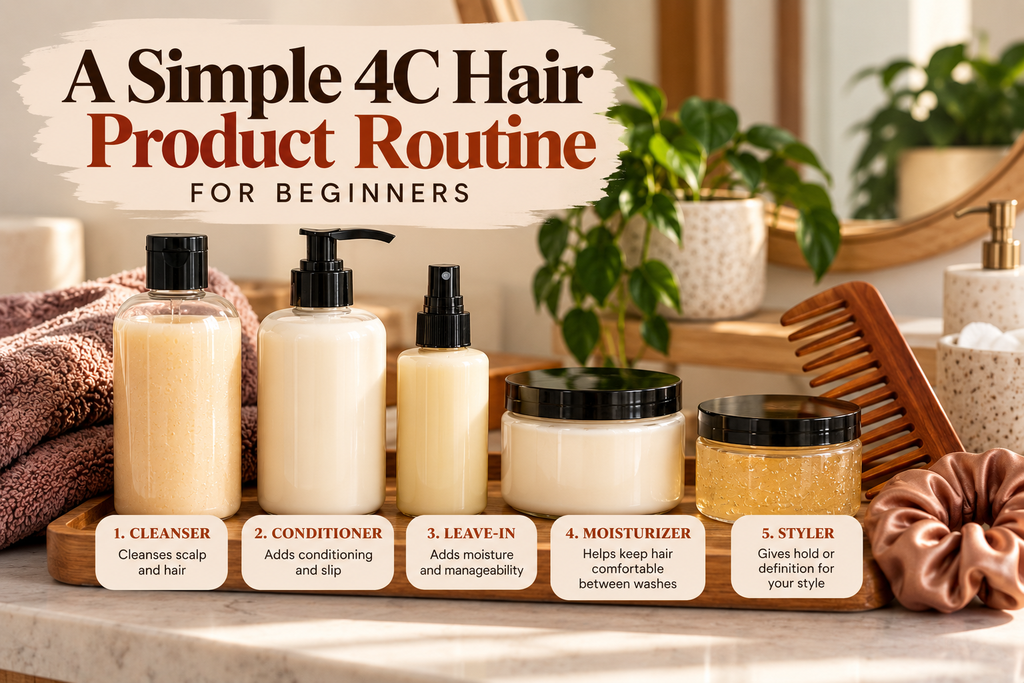
The minimalist routine
1. Cleanser
Use a shampoo or cleanser appropriate for your scalp and routine.
2. Conditioner
Condition after washing and use the step to make detangling easier.
3. Leave-in or moisturizer
Choose one if your hair benefits from additional conditioning or manageability.
4. Styler
Only add one if you actually need hold or definition for the style you’re wearing.
That’s it.
You can build from there.
The expanded routine
If your hair benefits from additional steps, you might eventually add:
Cleanser → Conditioner → Deep conditioner → Leave-in → Styler
An oil or other finishing product can be optional depending on what works for you.
You don’t need to introduce all of these at once.
When you change five products simultaneously, it becomes very difficult to figure out which one actually helped — or which one caused a problem.
If you’re completely new to building a routine, start with our 4C Hair Care for Beginners: Where to Start and then move into our more detailed 4C hair care routine guide.
Common 4C Hair Product Mistakes
Buying too many products at once
More products don’t automatically mean better hair care.
Start with a small routine and add products when you have a reason.
Changing products constantly
If something is working reasonably well, you don’t need to replace it because a new product went viral.
Give yourself enough time to understand how a product fits into your routine.
Buying because the label says “4C”
A 4C label can help you discover products, but it isn’t a guarantee that you’ll love the formula.
Assuming expensive means better
Price isn’t a reliable substitute for knowing what a product is supposed to do.
A $10 product that works well for your routine can be more useful than a $40 product that sits untouched in your cabinet.
Layering too many products
Leave-in + cream + butter + oil + gel + edge control can become a lot of product.
If your hair starts feeling coated or your scalp becomes uncomfortable, reassess the routine instead of automatically adding something else.
Expecting products to fix mechanical damage
Products can improve conditioning and manageability, but they don’t make tight styling, excessive heat or rough manipulation harmless.
The AAD specifically recommends avoiding excessive heat, pulling and tugging, and styles that cause pain. AAD
Expecting a product to make your hair grow faster
Be especially skeptical of this one.
A hair product can support the care and manageability of your existing hair, but that isn’t the same thing as proving it increases your rate of hair growth.
If you’re experiencing unexplained thinning or hair loss, that’s a reason to speak with a dermatologist rather than simply buying another growth oil. AAD
Your 4C Hair Product Shopping Checklist
Before you buy another product, ask:
The Crown Decoded Product Check
☐ What job does this product perform?
☐ Do I already own something that does the same job?
☐ Does my hair actually need it?
☐ Will I use it regularly?
☐ Does it fit the way I wear my hair?
☐ Does the formula work well with the other products I use?
☐ Am I buying it because I need it — or because everyone is talking about it?
☐ Is it worth the price for how often I’ll use it?
☐ Can I explain why this product belongs in my routine?
If you can’t answer the last question, put the product back on the shelf.
Your wallet will survive.
The Crown Decoded Routine Check
Before adding a new product, look at your current routine as a whole.
Cleanse
Does my scalp and hair feel appropriately clean after washing?
Condition
Is my hair easier to manage and detangle after conditioning?
Moisture
Does my hair stay comfortable between washes without becoming coated?
Styling
Does my styling product help me create the styles I actually wear?
Handling
Am I using products to support gentle handling rather than trying to compensate for rough manipulation?
If most of those answers are yes, you may not need another product.
That’s an important Crown Decoded principle:
A good hair routine isn’t the one with the most products. It’s the one you can understand, maintain and adjust when your hair gives you new information.
For the bigger-picture framework, see How to Build a 4C Hair Care Routine That Actually Works.
Bottom Line
The best 4C hair products aren’t necessarily the most expensive, most viral or most aggressively marketed to 4C hair.
Start with the basics:
Cleanse. Condition. Manage moisture. Style when needed. Protect your hair from unnecessary damage.
Then choose products based on the job you need them to perform.
You may eventually discover that your ideal routine contains five products.
Or eight.
Or three.
That’s okay.
Your goal isn’t to build the most impressive bathroom shelf.
It’s to build a routine that makes your hair clean, manageable and easier for you to care for consistently.
And if you’re just starting out, don’t feel like you need to figure everything out at once. Start with the basics, pay attention to how your hair responds, and build from there.