How to Keep 4C Hair Moisturized Between Wash Days
You finish wash day with soft, manageable 4C hair. A few days later, your hair feels dry again, your ends seem harder to manage, and you’re wondering whether you need more water, another leave-in conditioner, or a heavier cream.
Sound familiar?
Learning how to keep 4C hair moisturized between wash days doesn’t have to mean applying products every morning or starting your routine from scratch halfway through the week. The goal is to maintain hair that feels comfortable and manageable while avoiding unnecessary buildup and manipulation.
The key is to pay attention to how your hair responds, refresh it when needed, and use products that serve a clear purpose.
In this guide, we’ll walk through a simple between-wash routine, explain what water, leave-in conditioners, creams, and oils actually do, and show you what to try when your hair still feels dry after moisturizing.
Table of Contents
How Do You Keep 4C Hair Moisturized Between Wash Days?
The simplest approach is to check how your hair feels, lightly refresh it when needed, apply a suitable conditioning product if necessary, and protect it from unnecessary friction and handling.
You don’t need to use every product you own every time you refresh your hair.
Here’s a practical routine to start with:
- Check your hair first. Does it feel dry or difficult to manage, or does it still feel comfortable? Look for product residue and pay attention to scalp comfort, too.
- Use water or a water-based leave-in if needed. Lightly dampen the relevant sections rather than automatically soaking your entire head.
- Apply a small amount of a suitable moisturizer or leave-in. Distribute it through the hair, paying attention to areas that feel dry.
- Add another product only if it helps. A cream or a little oil may suit your routine, but neither is automatically necessary.
- Keep handling to a minimum. Avoid repeatedly combing, restyling, or pulling at your hair just to make it look freshly done.
- Protect your hair overnight if helpful. A satin bonnet, scarf, or pillowcase may be a useful part of your routine.
These steps are a starting point, not a rigid formula. You may need only a light refresh on some days and a little more conditioning on others.
Dermatologists at the American Academy of Dermatology recommend conditioning curly hair and using suitable leave-in conditioners or oils as part of hair care. The best combination for you will depend on your hair, products, and styling routine.
For the bigger picture, see our guide to building a 4C hair care routine that actually works.
Why Does 4C Hair Feel Dry Between Wash Days?
If your hair feels dry again shortly after wash day, it doesn’t necessarily mean your products have failed. Several factors can affect how your hair feels and how easy it is to manage.
Your hair’s texture and natural oil distribution
Tightly coiled hair can be more difficult to lubricate and manage along its length. Its structure, along with individual differences in hair condition and styling practices, can influence how it responds to handling and conditioning.
That doesn’t mean every person with 4C hair needs the same moisturizer or amount of product.
Two people with similar curl patterns may prefer very different routines. One may find that a lightweight leave-in is enough between washes, while another prefers a richer conditioning product.
Use your own results as a guide instead of assuming that a particular texture automatically requires a specific product combination.
Friction, tangling, and everyday handling
Moisture maintenance isn’t only about what you apply to your hair. How you handle it matters, too.
Repeated combing, rough towel-drying, tight styling, and unnecessary restyling can place additional stress on fragile strands. Tangles can also make everyday handling more difficult.
This is one reason a simple refresh routine can be useful: you can improve manageability without repeatedly taking down your style or combing through your hair.
If detangling is a challenge, read our guide to how to detangle 4C hair without breakage.
Product buildup and environmental conditions
Sometimes, what feels like dryness is not solved by adding another layer of cream or oil.
If your hair feels coated, sticky, unusually heavy, or harder to manage after several refreshes, accumulated product may be contributing to the problem.
Weather, exposure to wind or dry air, and the way you style your hair can also influence your routine. The important thing is to notice patterns rather than assuming that every change in how your hair feels means it needs more product.
When buildup becomes noticeable, consider whether your hair needs cleansing instead of another refresh.
A Simple Routine for Refreshing 4C Hair
You don’t need a long evening routine to maintain your hair between washes. Start with the simplest method that makes your hair easier to manage.
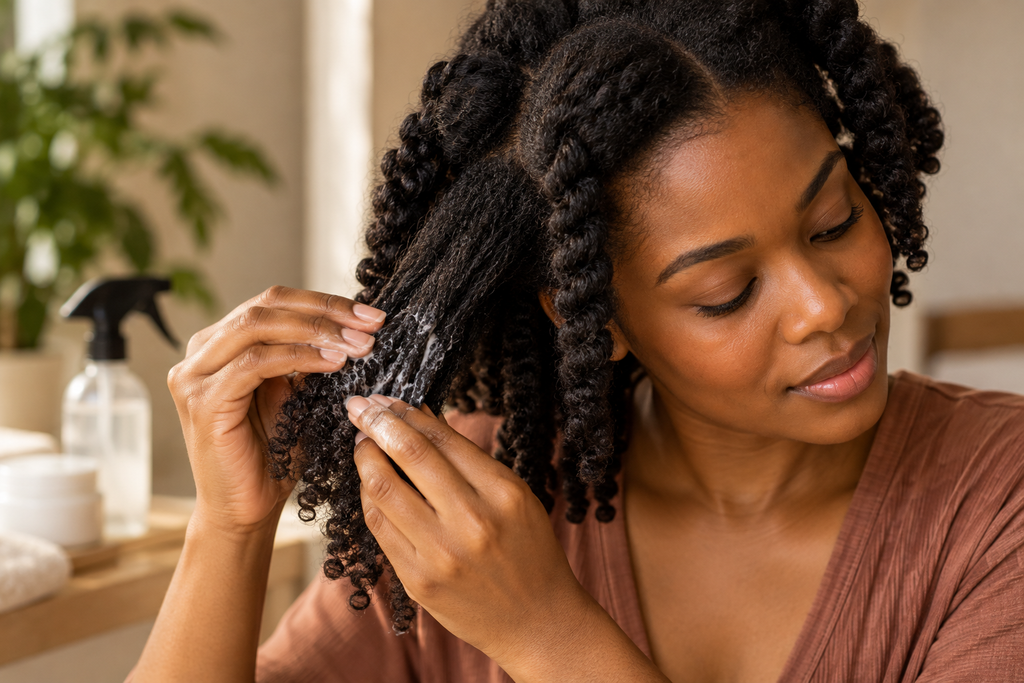
Step 1: Check whether your hair needs moisture
Before reaching for a spray bottle, take a moment to assess your hair.
Ask yourself:
- Does my hair feel dry or unusually difficult to manage?
- Are my ends harder to handle than the rest of my hair?
- Does my hair already feel comfortable after the last refresh?
- Is there visible residue or a coated feeling?
- Is my scalp comfortable?
If your hair feels fine, you may not need to do anything beyond your usual nighttime protection.
If it feels dry or difficult to manage, move on to a light refresh.
Step 2: Lightly re-wet or refresh the hair when appropriate
Water can help re-wet your hair and prepare it for a conditioning product.
You can use a spray bottle to lightly dampen the sections that need attention, or apply a small amount of water with your hands. You don’t have to soak your entire head if a lighter refresh is sufficient.
If you wear twists or another style, work carefully around the sections rather than pulling the style apart.
Pay attention to how your hair responds. If repeated dampening leaves it difficult to style or doesn’t improve manageability, reassess your method instead of adding more water automatically.
Step 3: Apply a suitable leave-in or moisturizer
If your hair benefits from additional conditioning, apply a small amount of a leave-in conditioner or moisturizer.
Work in manageable sections when necessary. Try to distribute the product evenly instead of concentrating it in one spot.
Start with less than you think you need, then check the result. You can always make a small adjustment if your hair still feels dry.
Choose a product formulated for your hair’s needs and follow its directions. A product that works well for someone else may not produce the same result for you.
Step 4: Add another product only if needed
Some people like to follow a leave-in with a cream or a small amount of oil. Others find that a single conditioning product is enough.
Neither approach is automatically better.
If you already have several layers of product on your hair, adding more may leave it feeling heavy or coated. Try simplifying the routine before buying another product.
The goal is comfortable, manageable hair—not the largest possible number of layers.
Step 5: Leave the style alone and protect it
Once you’ve refreshed your hair, avoid repeatedly touching, combing, or restyling it throughout the day.
At night, consider a satin bonnet, scarf, or pillowcase if it works for you. These can be useful ways to reduce friction during sleep, although they cannot guarantee that breakage will be prevented.
You can also use a loose, comfortable nighttime style if that suits your hair. Avoid tying or wrapping it so tightly that you experience pain or tension.
Water, Leave-In Conditioner, Cream, or Oil: What Does Your Hair Need?
One of the most confusing parts of maintaining 4C hair is figuring out which products you actually need.
Water, leave-in conditioners, creams, and oils don’t all serve the same purpose. Understanding their roles can help you avoid unnecessary layering.
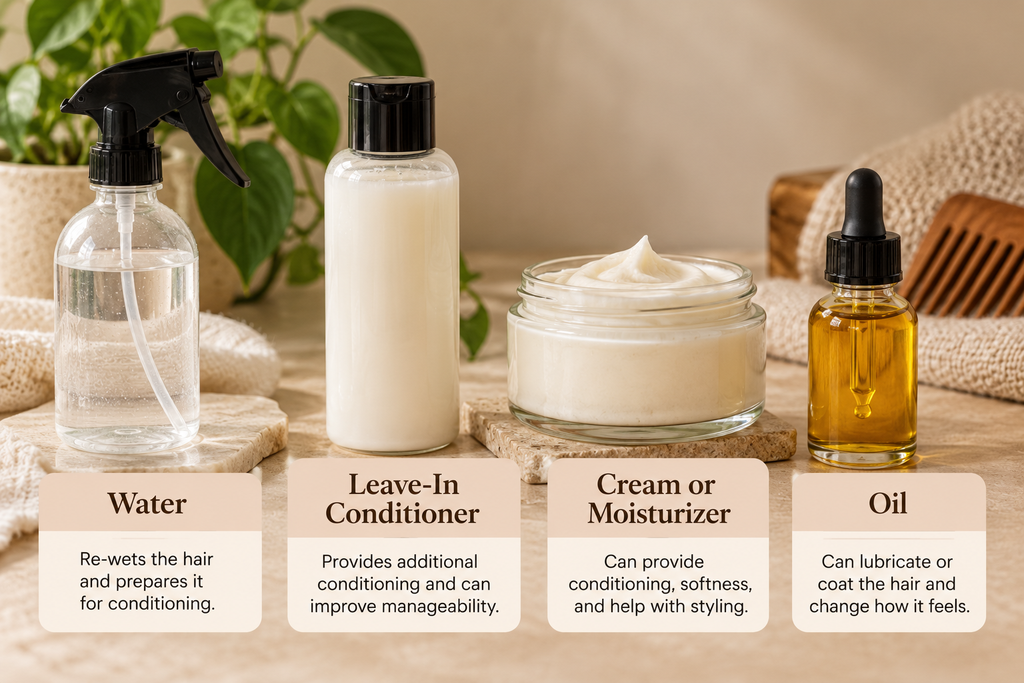
| Product or step | What it does | When to consider it |
|---|---|---|
| Water | Re-wets the hair | When your hair needs a light refresh |
| Leave-in conditioner | Provides additional conditioning and can improve manageability | When your hair benefits from a product that remains on the strands |
| Cream or moisturizer | Can provide conditioning, softness, and help with styling | When your hair responds well to a richer product |
| Oil | Can lubricate or coat the hair and change how it feels | When an oil suits your existing routine and product combination |
The exact effects depend on the formulation and how you use each product. A product’s name alone doesn’t tell you everything about how it will perform.
Do you need to use water, leave-in, cream, and oil every time?
No.
A familiar natural-hair routine is to apply a water-based product, follow it with a cream, and finish with oil. Some people find that combination useful, but it isn’t a requirement for everyone.
The American Academy of Dermatology recommends conditioning curly hair and notes that suitable leave-in conditioners and oils can help with moisturization. That guidance does not mean every person must use all these products in a fixed order between every wash day.
You might find that a leave-in conditioner works well on its own. You might prefer a cream for styling or a small amount of oil as a finishing step.
Try a simple combination, observe how your hair responds, and adjust from there.
How much product should you use?
Start with a small amount and work it through your hair evenly.
Using more product does not automatically make hair more manageable. If your hair starts feeling sticky, greasy, coated, or unusually heavy, the amount or combination may not be working well for you.
You may also need to cleanse away accumulated product rather than continuing to layer over it.
A simple routine you understand is often easier to maintain than one involving several overlapping products.
How Often Should You Moisturize 4C Hair?
There isn’t one scientifically established schedule that suits everyone with 4C hair.
Some people prefer a light refresh every few days. Others can go longer between refreshes, depending on their hair, hairstyle, products, and environment.
Instead of following a schedule simply because someone online recommends it, use your hair’s condition as a guide.
Consider refreshing when:
- Your hair feels dry or becomes more difficult to manage.
- Your ends need a little extra attention.
- Your usual style is losing manageability.
- A small amount of conditioning product improves how your hair feels.
You may not need another refresh when:
- Your hair still feels comfortable and manageable.
- Your current products are working well.
- Your hair already feels coated or heavy.
- Your scalp needs attention or cleansing rather than another layer of product.
Remember that moisturizing and washing serve different purposes. A refresh can help maintain manageability, but it does not replace cleansing your scalp and hair when they need it.
The American Academy of Dermatology advises people with Black hair to condition regularly and choose washing habits that help manage product buildup. Your ideal wash schedule will depend on your scalp, hair, styling practices, and products.
How to Keep 4C Hair Moisturized in Twists, Braids, and Other Styles
A style that reduces daily manipulation can make between-wash maintenance easier, but you still need to pay attention to your hair and scalp.
Focus on the hair you can reach
When wearing twists or braids, concentrate on accessible sections of your natural hair, particularly the lengths and ends if they feel dry.
Use a manageable amount of product and distribute it carefully. Avoid repeatedly soaking the style or applying so much product that residue accumulates.
Your approach will also depend on the style itself. Loose twists, tightly installed braids, and styles with extensions have different maintenance needs.
Don’t forget your scalp
A comfortable scalp is part of a sustainable routine.
If your scalp feels itchy, irritated, or uncomfortable, adding moisturizer to the hair lengths may not address the underlying issue. Heavy product application around the scalp can also make buildup more noticeable for some people.
Follow the care instructions appropriate for your style and cleanse your scalp when needed. If symptoms persist, seek advice from a qualified healthcare professional.
Protect your style at night
A satin bonnet, scarf, or pillowcase may help reduce friction while you sleep. Choose an option that feels comfortable and doesn’t pull tightly on your hairline.
Nighttime protection is an optional supporting habit, not a substitute for appropriate conditioning or cleansing.
If you regularly wear a protective style, make sure it isn’t painful or excessively tight. A style should not require persistent discomfort to maintain.
Why Does Your 4C Hair Still Feel Dry After Moisturizing?
If you’ve refreshed your hair and it still feels dry, resist the urge to add several more products immediately.
Instead, troubleshoot one thing at a time.
Your application method may need adjusting
If you apply product only to the outer surface of a style, some sections may receive very little conditioning.
Try working in smaller sections and distributing a modest amount more evenly. You don’t need to dismantle an entire style if a careful refresh is enough.
You may be layering too many products
If your hair feels coated, sticky, greasy, or heavy, more product may make the problem worse.
Consider simplifying the routine. At your next appropriate cleansing session, remove accumulated residue according to the directions for your shampoo and products, then rebuild your routine with fewer layers.
Change one or two things at a time so you can tell what helps.
Your hair may need cleansing rather than another layer
Moisturizing products do not replace cleansing.
If your scalp or hair has noticeable residue, or if your usual products no longer leave your hair manageable, consider whether it’s time to wash rather than refresh again.
The American Academy of Dermatology recommends cleansing practices that help remove accumulated products, dead skin, and excess oil while avoiding unnecessarily harsh handling.
Your handling or styling habits may be contributing
Repeated combing, rough detangling, and styles that create excessive tension can make hair harder to manage and contribute to damage.
Give your hair a break from unnecessary manipulation. Use gentle handling methods, and reconsider any style that repeatedly causes pain or pulls on your hairline.
Persistent symptoms deserve attention
If you notice significant changes in hair loss, persistent scalp irritation, or breakage that continues despite gentler handling and a manageable routine, consult a qualified healthcare professional, preferably a dermatologist experienced with textured hair.
Dryness alone does not establish a medical condition, and changing moisturizers repeatedly may not address an underlying scalp or hair disorder.
Your Between-Wash Moisture Checklist
Save this checklist or use it as a quick reference whenever your hair starts feeling different between wash days.
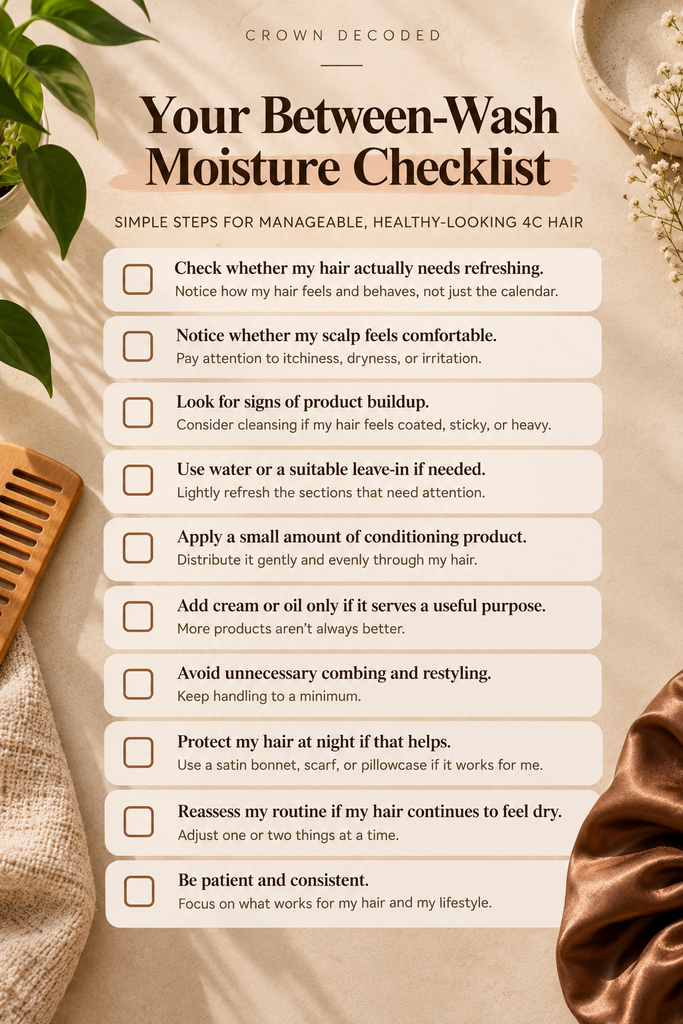
- Check whether my hair actually needs refreshing.
- Notice whether my scalp feels comfortable.
- Look for signs of product buildup.
- Use water or a suitable leave-in if needed.
- Apply a small amount of conditioning product and distribute it gently.
- Add cream or oil only if it serves a useful purpose in my routine.
- Avoid unnecessary combing and restyling.
- Protect my hair at night if that helps.
- Reassess my routine if my hair continues to feel dry or coated.
- Change one or two things at a time instead of replacing every product.
You don’t have to complete every step every day. The checklist is there to help you make thoughtful decisions, not give you another demanding routine to maintain.
The Crown Decoded Approach to Moisture Maintenance
At Crown Decoded, we believe a good hair-care routine should make your hair easier to manage—not give you more work to do.
That means starting with what you notice about your own hair, using products with a clear purpose, and changing your approach when something isn’t working.
If your hair feels comfortable and manageable, you may not need another layer of moisturizer. If it feels dry, a simple refresh may be enough. And if your hair feels coated or your scalp is uncomfortable, the answer may be to reassess your routine rather than add another product.
For more practical guidance, explore our 4C hair care routine guide and our guide to detangling 4C hair without breakage.
The bottom line
To keep 4C hair moisturized between wash days, focus on gentle handling, suitable conditioning, and refreshing when your hair needs it. You don’t need a complicated product lineup or a rigid daily schedule.
Pay attention to how your hair responds, keep your routine manageable, and remember that more product isn’t always the solution.
Your goal isn’t to keep your hair coated in products. It’s to build a routine that helps your hair feel comfortable, manageable, and easier to care for.
Sources and further reading
- American Academy of Dermatology Association. Black hair: Tips for everyday care.
- American Academy of Dermatology Association. 6 curly hair care tips from dermatologists.
- Douglas A, Onalaja AA, Taylor SC. Hair care products used by women of African descent: review of ingredients. Cutis. 2020;105(4):183–188.
- Humphrey JG, Harding MJ, Cartwright KM, Thomas LE, Luke J. Afro-textured hair care: a narrative review and recommendations for dermatologists. International Journal of Women’s Dermatology. 2026.
This article is for educational purposes only and is not a substitute for individualized medical advice.