
What Makes Protective Hairstyles for 4C Hair Protective?
If you have 4C hair, you’ve probably heard about protective hairstyles for 4C hair—braids, twists, cornrows, wigs and other styles designed to reduce daily manipulation.
Braids. Twists. Cornrows. Wigs. Buns. Updos.
But here’s the part that’s easy to miss: a hairstyle doesn’t become protective simply because we call it one.
A style can reduce daily manipulation and make your routine easier—or it can put repeated tension on your hairline, make your scalp uncomfortable, and leave you with more problems than you started with.
So what actually makes a protective style protective?
For Crown Decoded, the simplest way to think about it is this:
A protective style should make your hair easier to manage while minimizing unnecessary manipulation and tension.
The way a style is installed, how long you wear it, how heavy it is, and how you care for your hair while wearing it all matter.
Table of Contents
What Is a Protective Style?
A protective style is generally a hairstyle designed to reduce how much you manipulate your natural hair during everyday life.
The idea is pretty simple.
Instead of repeatedly combing, brushing, restyling or handling your hair, you put it into a style that can stay relatively undisturbed for a period of time.
That might include:
- Braids
- Twists
- Cornrows
- Certain updos
- Buns
- Wigs
- Some styles worn with extensions
But the label alone doesn’t tell you whether a particular installation is actually a good choice for your hair.
For example, tightly installed braids may reduce daily manipulation while simultaneously creating significant tension on the scalp and hairline.
The American Academy of Dermatology (AAD) notes that repeated pulling from tight hairstyles—including tightly braided hair, cornrows, buns, ponytails and extensions—can contribute to traction alopecia, a form of hair loss caused by repeated tension. AAD
So rather than asking:
“Is this hairstyle protective?”
It can be more useful to ask:
“How is this hairstyle affecting my hair?”
What Makes a Hairstyle Protective?
There are five things I would look at before calling a hairstyle protective.
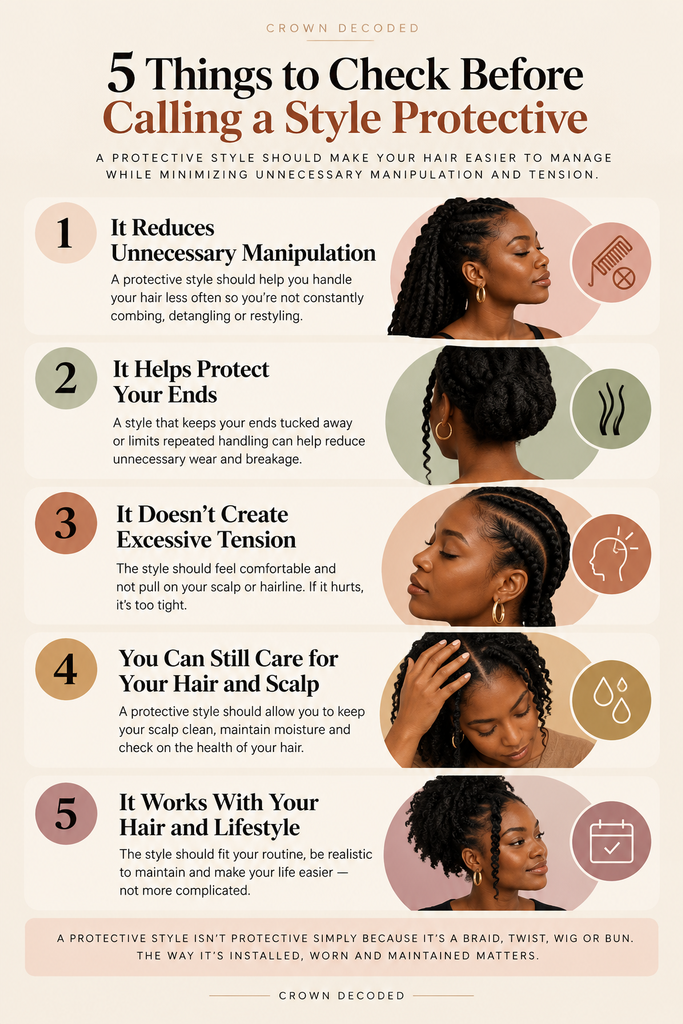
1. It Reduces Unnecessary Manipulation
One of the main reasons people choose protective styles is to give themselves a break from constant styling.
If you’re repeatedly combing, brushing, detangling and restyling your hair throughout the week, a style that allows you to leave your hair relatively undisturbed may make your routine easier.
That’s particularly useful if your hair becomes difficult to manage when you’re constantly changing styles.
But there’s an important distinction:
Less manipulation doesn’t automatically make every style healthy for your hair.
A style that stays in place but pulls continuously on your hairline is not solving the whole problem.
The goal is less unnecessary handling without replacing it with excessive tension.
2. It Helps Minimize Repeated Handling of Your Ends
Your ends are the oldest part of your hair, so they’re the section that has been exposed to your daily routine the longest.
A style that keeps the ends tucked away or otherwise limits repeated handling can make it easier to avoid constantly manipulating them.
This is one reason styles such as twists, braids and certain updos can be useful as part of a low-manipulation routine.
But don’t turn this into a rule that says your ends must always be hidden.
You can wear your hair loose and still have a perfectly reasonable routine.
The bigger question is:
Is the way you’re wearing and handling your hair helping you avoid unnecessary mechanical stress?
3. It Doesn’t Create Excessive Tension
This is the part that deserves the most attention.
A hairstyle shouldn’t have to hurt to look neat.
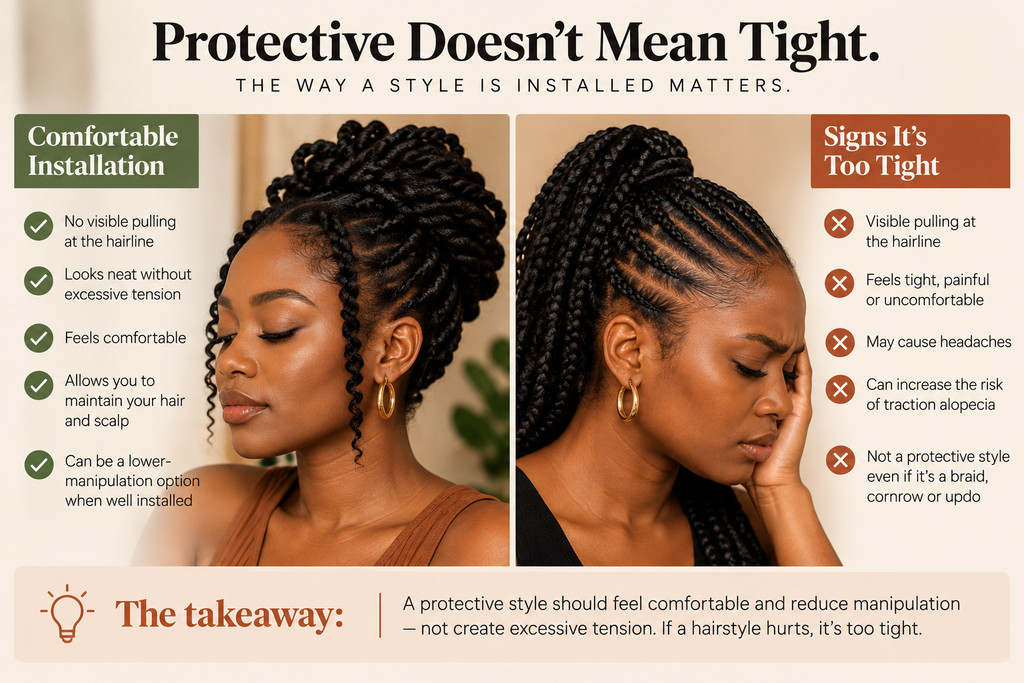
Tight braids, cornrows, ponytails, buns, extensions and other styles that repeatedly pull on the hair can contribute to traction alopecia. The risk is related to factors including the amount and duration of traction. AAD
And pain is not something you should simply accept as part of getting your hair done.
The AAD recommends loosening hairstyles that pull and changing a hairstyle if you experience pain, stinging, crusting or visible pulling of the scalp. AAD
That means a useful protective-style check is:
Does this style feel comfortable?
Not:
“Can I tolerate it?”
If your scalp hurts after installation, tell your stylist.
If your edges feel like they’re being pulled, pay attention.
If the style gives you a headache or creates obvious tension, it deserves a rethink.
The AAD specifically advises that if a weave or extension style causes pain or feels too tight, you should ask the stylist to loosen the affected area.
4. You Can Still Care for Your Hair and Scalp
“Protective” shouldn’t mean “ignore your hair for the next several weeks.”
Your routine may look different while your hair is in a protective style, but you still need to pay attention to how your scalp and hair are doing.
For example, consider:
- Can you keep your scalp comfortable?
- Can you cleanse when your routine calls for it?
- Can you manage buildup appropriately?
- Can you keep your hair from becoming excessively dry?
- Can you avoid constantly manipulating the style?
- Can you notice changes in your scalp or hair?
The exact routine will vary depending on the style.
A wig, for example, is different from cornrows underneath extensions. A set of twists is different from a tightly installed braid style.
There’s no need to create a complicated universal maintenance schedule.
Instead, choose a style you can realistically maintain.
5. It Works With Your Hair and Lifestyle
This one gets overlooked.
A hairstyle can look beautiful and still be a terrible fit for your actual routine.
Maybe you exercise frequently.
Maybe you need easy access to your scalp.
Maybe your hairline is already fragile.
Maybe you don’t have the time to maintain a complicated style.
Maybe extensions make your hair too heavy.
Maybe you simply don’t like how a particular style feels.
That’s useful information.
Your protective style should make your life easier, not turn hair care into another full-time job.
This is very much in line with the Crown Decoded approach to hair care: a routine should be something you can understand, repeat and adjust based on how your hair actually responds.
Are Protective Styles Good for 4C Hair?
They can be useful, but “protective” doesn’t mean automatically beneficial.
A well-managed low-manipulation style can reduce how frequently you handle your hair.
But the same basic style can become problematic if it’s installed too tightly, worn continuously without adequate breaks, or creates repeated stress on the same areas.
Research on traction alopecia has identified tight braids, cornrows, weaves, extensions and tightly pulled styles as potential sources of repeated traction. PubMed
So I wouldn’t approach protective styling as:
“Put your hair away and forget about it.”
I’d approach it as:
“Find a way to reduce unnecessary manipulation while continuing to pay attention to your hair and scalp.”
And one important distinction:
Protective styling is not a hair-growth treatment.
A protective style doesn’t make your follicles produce hair faster.
Its practical value is that, when done appropriately, it can make your hair easier to manage and reduce some of the everyday handling and mechanical stress that can contribute to breakage.
That’s why length retention and hair growth shouldn’t automatically be treated as the same thing.
When Does a Protective Style Stop Being Protective?
Sometimes the answer is surprisingly simple:
When the style starts creating more stress than it saves you from.
Here are some signs to pay attention to.
The style is painful
Pain isn’t a badge of a good installation.
If your hairstyle hurts, it’s too tight. The AAD explicitly recommends changing hairstyles that cause pain. AAD
Your scalp is stinging or irritated
Stinging, crusting or obvious scalp irritation can be warning signs that the style needs to be changed. AAD
Your hairline is being pulled
The hairline is one of the areas where traction-related hair loss can become noticeable.
Watch for:
- Broken hairs around the forehead
- Thinning edges
- A changing hairline
- Areas where the hair appears noticeably thinner
The AAD recommends regularly checking for early signs of hair loss if you frequently wear styles that pull. AAD
The style is unnecessarily heavy
Longer extensions can be heavier, which may increase pulling on the hair. The AAD recommends considering shorter and thicker braids or locs to reduce constant pulling. AAD
You’re constantly restyling it
If your “low-maintenance” hairstyle requires daily combing, brushing, edge work and repositioning, it’s worth asking whether it’s actually reducing manipulation.
You’re ignoring problems because you want the style to last
This is where the phrase “protective style” can become misleading.
Keeping a style in for longer isn’t automatically better.
If something is causing pain, irritation or obvious stress, keeping it in simply because you’ve already paid for it isn’t a good reason to ignore the problem.
Are Braids, Twists, Cornrows and Wigs Protective?
There’s no need to declare one hairstyle universally “best.”
The installation and maintenance matter.
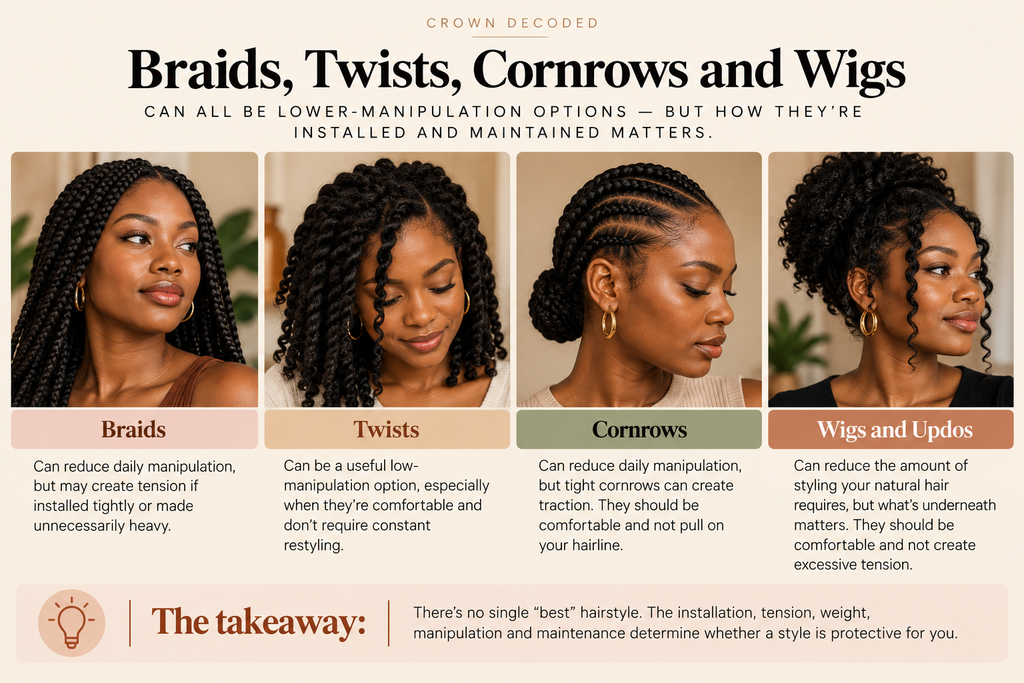
Braids
Braids can reduce daily manipulation, but they can also create significant tension if installed tightly or made unnecessarily heavy.
Pay particular attention to your hairline and how the style feels immediately after installation.
The AAD recommends loosening braids around the hairline when needed and avoiding styles that continuously pull. AAD
Twists
Twists can be a useful low-manipulation option, particularly when they’re comfortable and don’t require constant restyling.
As with any style, however, the fact that a style is called “protective” doesn’t remove the need to pay attention to tension and handling.
Cornrows
Cornrows can reduce daily manipulation, but tight cornrows can also create traction.
The AAD specifically recommends making sure cornrows aren’t tight and changing the style if it causes pain or irritation. AAD
Wigs
A wig can reduce the amount of styling your natural hair requires, but what happens underneath matters.
If your natural hair is tightly braided underneath, the underlying style can still create tension.
The wig itself can also become part of the problem if wearing it means excessive friction, tight attachment or constant manipulation.
Buns and updos
A bun or updo can be a simple low-manipulation option.
But a tightly pulled bun worn repeatedly in the same position can create tension. The AAD includes tightly pulled buns and ponytails among hairstyles that can contribute to traction alopecia.
The takeaway: don’t judge a hairstyle only by its name.
Judge the tension, weight, manipulation and maintenance.
How to Choose a Protective Style for 4C Hair
Before choosing your next style, ask yourself these questions.
1. Will I need to manipulate my hair frequently?
If yes, the style may not be giving you the low-manipulation benefit you’re looking for.
2. Will the style put tension on my edges?
If your hairline is already an area of concern, be particularly cautious about styles that pull there.
3. Is the style comfortable?
If the answer is no, don’t convince yourself that discomfort is normal.
4. Is the added hair unnecessarily heavy?
More length and volume aren’t always better for your hair.
5. Can I maintain my hair underneath?
Think about cleansing, scalp comfort and whatever basic care your hair needs.
6. How long am I realistically going to wear it?
Longer wear isn’t automatically better. The AAD recommends avoiding prolonged use of styles that pull and notes that braids or locs should generally not be worn longer than 6–8 weeks.
7. What will I do after takedown?
Don’t forget the transition between styles.
A gentle takedown followed by careful detangling is much more sensible than ripping through accumulated tangles because you’re eager to get the style out.
If detangling is one of your biggest struggles, read our guide on How to Detangle 4C Hair Without Breakage.
Protective Style Checklist
Save this before your next appointment.
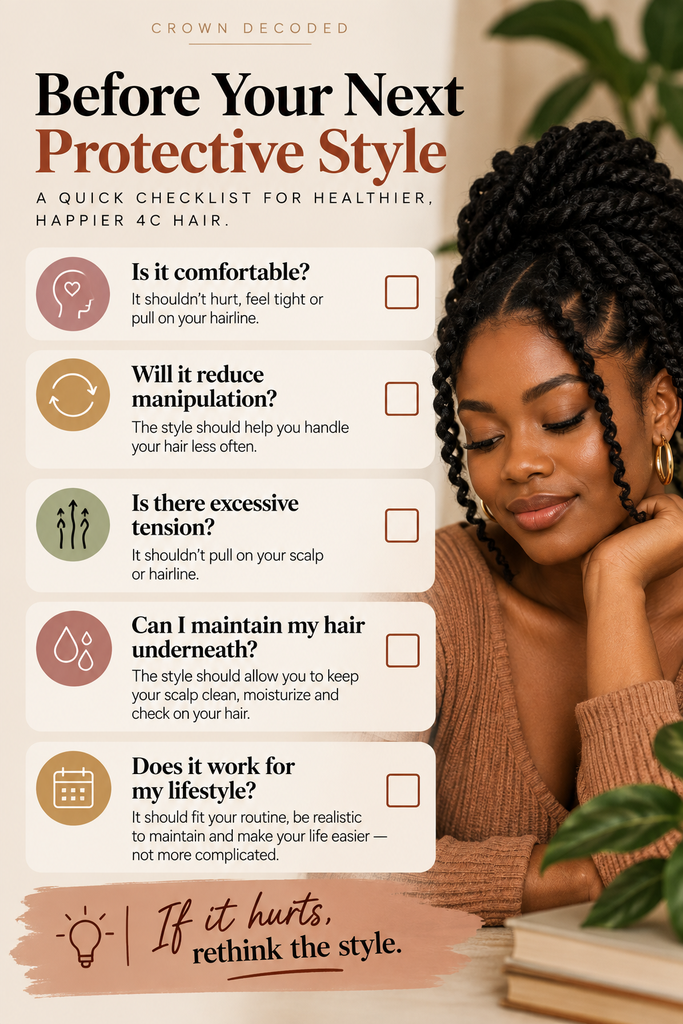
Before installation
☐ Is this style actually going to reduce manipulation?
☐ Will it put unnecessary tension on my edges?
☐ Is the added hair reasonably lightweight?
☐ Can I maintain my hair and scalp while wearing it?
☐ Have I told my stylist about any areas that are particularly sensitive?
During installation
☐ Does the style feel comfortable?
☐ Am I experiencing pulling or pain?
☐ Is my hairline being pulled tightly?
☐ Is the stylist making the style tighter simply to make it look neater?
If it hurts, speak up.
While wearing the style
☐ Is my scalp comfortable?
☐ Am I noticing irritation or stinging?
☐ Am I constantly restyling the hair?
☐ Is my hairline showing signs of stress?
☐ Am I maintaining my hair appropriately for the style?
After takedown
☐ How does my hair feel?
☐ Where did I notice the most tangling?
☐ Did I notice unusual breakage?
☐ Did the style make my routine easier?
☐ Is there anything I would change next time?
What About Breakage?
It’s worth separating breakage from hair loss here.
You may notice some shed hair when you take down a style, particularly if you’ve worn it without much manipulation for a while. That’s not automatically a sign that the style damaged your hair.
What matters is the overall pattern.
Are you seeing:
- More broken hairs than usual?
- Increased tangling?
- Thinning around the hairline?
- Persistent scalp discomfort?
- Changes in the appearance of your hair?
The Crown Decoded routine guide recommends paying attention to where breakage happens and looking for patterns rather than simply adding more products.
And if you’re experiencing sudden or significant hair loss, persistent scalp symptoms, or noticeable thinning, it’s worth speaking with a qualified healthcare professional. Hair loss can have many causes, and a dermatologist can help determine what’s actually happening.
The Crown Decoded Takeaway
A protective style isn’t protective simply because it’s a braid, twist, wig, cornrow or bun.
The way you wear it matters.
A useful protective style should ideally:
- Reduce unnecessary manipulation
- Keep your hair manageable
- Avoid excessive tension
- Be comfortable
- Allow you to maintain your hair and scalp
- Fit realistically into your lifestyle
And perhaps the most important rule:
If a hairstyle is causing repeated pain, excessive tension or obvious stress around your hairline, don’t keep wearing it just because it’s labelled “protective.”
Your hair doesn’t need the most complicated style. It needs a routine you can actually maintain.
That’s the same principle we use throughout Crown Decoded: consistent, gentle habits matter more than having an enormous collection of products or following every new hair trend.
For more practical 4C hair care guidance, start with How to Build a 4C Hair Care Routine That Actually Works and How to Detangle 4C Hair Without Breakage.